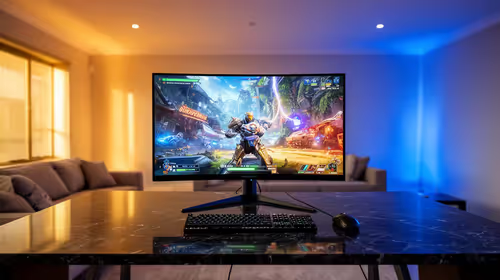
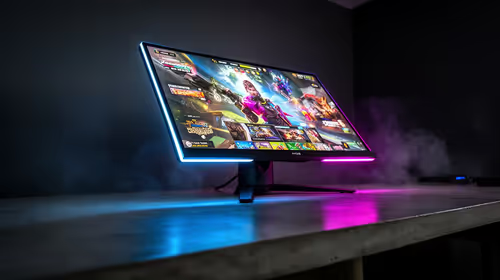
Sim racing and strategy games use ultrawide space differently, but both benefit from a broad view, legible detail and a curve that keeps the outer image comfortable from a central seat.
Quick Answer
For sim racing, prioritise 3440 x 1440, useful 21:9 support, smooth adaptive refresh, fast controlled response and a 1500R curve. For strategy, add clear text, strong contrast, window space and a GPU capable of maintaining stable frame times in large battles. The AW3426DWM combines those directions at R8,999 with 240Hz VA and FreeSync Premium.
Sim racing needs peripheral coherence
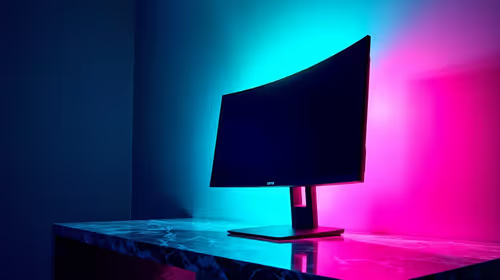
A 34-inch ultrawide can show mirrors, apexes and nearby cars without a centre bezel. The curve turns the side image towards the driver, helping the cockpit feel continuous. Position the wheel and screen centre on the same line.
Frame stability matters more than a short peak. FreeSync Premium reduces tearing as output changes, while the 1ms GTG rating should be checked for clean trackside motion without overshoot.
Compare physical formats through the curved monitor selection.
Strategy needs detail and space
UWQHD provides room for large maps, production panels and unit information. At 3440 x 1440, text remains detailed while the extra width exposes more interface. Ensure the game allows HUD scaling so controls do not sit uncomfortably at the far edges.
Large late-game simulations can become CPU-limited even when the graphics card has room. Watch frame times in crowded battles, not only an empty tutorial map.
Check South African build value
At R8,999, the AW3426DWM also offers DisplayHDR 400, Dolby Vision and 95% DCI-P3. Those features help scenic tracks and colourful strategy worlds, while VA contrast supports darker content.
Use the gaming monitor range to compare the current rand value with other refresh and resolution combinations.
Include PC and desk requirements
UWQHD places more load on the GPU than ordinary QHD. Test a full starting grid and a complex late-game map. Create separate profiles: racing may reduce reflections and crowds, while strategy can lower shadows or effects around large armies.
The 1500R screen needs enough depth and a central chair. USB-C 15W charging can serve a controller or phone, but it is not a laptop power solution.
Compare panel priorities
The Alienware uses VA. Buyers prioritising self-emissive response and blacks can inspect the OLED monitor category as another technology. Judge interface use and ownership alongside picture quality.
Configure sim-racing field of view
Place the screen at the measured distance and use the simulator's field-of-view calculator where available. A sensible starting point preserves object scale and helps braking references remain consistent. Adjust gently for comfort rather than choosing an exaggerated camera purely to see more.
Check mirror placement, dashboard readability and HUD position. A correct 21:9 render should expand useful peripheral information without stretching the cockpit. Run both daylight and night races to assess VA motion and contrast.
Organise strategy interfaces
Use UI scaling so resource counters and unit labels remain readable at 3440 x 1440. Move optional panels inward when the game permits, keeping the central map free. Wide space is valuable when it reduces overlays, not when essential controls become distant.
Test late-game pathfinding, simulation speed and huge armies. If frame rate falls while GPU utilisation remains modest, the processor or game engine may be limiting the battle. Lower graphical resolution will not solve that simulation ceiling.
Plan peripherals around the curve
A wheel base, large keyboard or control pad can push the chair away from the monitor. Measure final eye distance with every peripheral installed. Mounting the screen behind the wheel may need an arm or rig bracket rated for the panel.
For strategy, reserve mouse movement space and avoid a stand leg intruding under the mat. A comfortable physical layout lets the 1500R curve benefit both genres instead of forcing a compromise between them.
Save separate game presets and label them by workload. The racing profile can protect motion and mirror detail, while the strategy profile can favour text, shadows and late-game simulation stability.
Frequently Asked Questions
Does ultrawide improve every racing game?
Only titles with useful 21:9 support can exploit the complete width correctly.
Is 240Hz necessary for turn-based strategy?
No. It makes motion smoother, but resolution, text clarity and CPU performance may matter more.
Why test a crowded strategy battle?
It exposes processor and engine limits hidden by quiet early-game scenes.
Is the curve useful for work too?
Yes. It can face side panes towards a central user when windows are arranged deliberately.
Building one ultrawide station for racing lines and strategy maps?
Test a full grid, a crowded campaign and the real desk position, then choose features that remain useful across both genres.