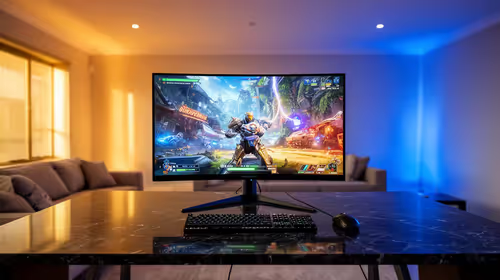
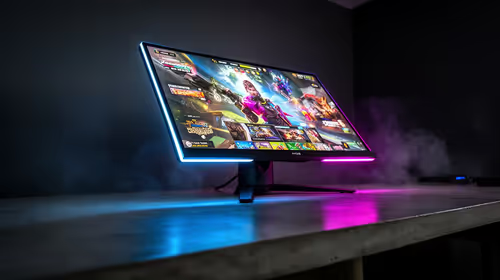
South African esports and FPS players should rank a 500Hz monitor by the motion chain, not the refresh badge alone. The strongest 500Hz monitor features for competitive gaming include rapid response, QHD visibility, adaptive sync and source connectivity. ASUS combines them in the XG27AQDPG for R23,899.
Quick Answer
Prioritise native QHD at 500Hz, fast pixel transition, G-SYNC Compatible or FreeSync Premium Pro for the installed GPU, and a direct HDMI 2.1 or DisplayPort 1.4 route. The XG27AQDPG adds 0.03ms GTG QD-OLED response, OLED Anti-Flicker 2.0, True Black HDR and wide colour. The PC must still deliver strong, stable game frames.
⚡ Start with the update interval
At 500Hz, a new refresh can begin every 2ms. That gives a high-frame competitive game frequent opportunities to present a newer image. The benefit shrinks when the PC delivers far fewer frames or large frame-time spikes.
Use the gaming monitor collection to compare refresh with resolution and response.
🎯 Require rapid pixel transitions
The ASUS lists 0.03ms GTG. Response describes how quickly pixels change state, while refresh describes update timing. Clear competitive motion needs both parts to work with the frame stream.
Test fast strafing, crosshair stops and moving silhouettes in a repeatable training map rather than a menu animation.
🗺️ Keep QHD visibility in the plan
QHD can make distant geometry and fine edges easier to resolve on a 27-inch screen, but it increases rendering work over Full HD. Benchmark the exact title and competitive preset before choosing the supporting GPU and processor.
🔄 Match sync to the graphics card
NVIDIA systems can use the G-SYNC Compatible route; AMD builds can use FreeSync Premium Pro. Adaptive refresh reduces timing conflict when output varies below 500Hz. It does not create frames or solve network latency.
🔌 Inspect the competitive cable path
The monitor includes HDMI 2.1 and DisplayPort 1.4. Choose a matching direct GPU output, select native QHD and confirm the refresh in both operating system and game. Store that baseline after every driver update.
🌈 Count the off-match experience
DisplayHDR 500 True Black and 99% DCI-P3 improve the feature case for cinematic games and content. The OLED monitor range provides picture-quality context, while the curved monitor category offers a separate shape comparison.
🧪 Build a South African match-day test
Select the competitive title, local server region and graphics preset used most often. Capture a fixed training route at QHD, then play a complete online match. Record frame-time stability separately from ping, packet loss and input behaviour. A 500Hz display can improve local visual timing, but it cannot repair a network fault.
Next, verify the monitor after a cold boot: correct input, native resolution, 500Hz selection and platform sync state. Run the moving-target route once before joining a ranked queue. This catches a driver or game update that has returned the display to a lower setting.
Finally, compare visibility in daylight and evening room conditions. Save brightness profiles that preserve shadow detail without excessive glare. This match-day test joins local hardware, South African online conditions and QD-OLED picture comfort without making the monitor responsible for every part of competition.
Add a second match from a visually demanding title. It will operate farther below 500Hz and reveal whether the selected adaptive-sync route keeps motion useful outside esports. This broader test prevents one lightweight game from defining the entire R23,899 purchase.
Keep the light-title and demanding-title results on one card. The first measures the upper competitive region; the second shows sync behaviour through wider frame changes. Together they describe the monitor more accurately than either title alone.
After both game tests, inspect the input and sync card once more. A competitive feature set is dependable when it returns after reboot and remains stable through the light and demanding workloads, not only during an initial control-panel setup.
Frequently Asked Questions
Which feature supports the fastest pixel changes?
ASUS rates the QD-OLED pixel transition at 0.03ms GTG.
Why is QHD useful for an FPS display?
It offers finer 2560x1440 detail, which can help resolve distant geometry and interfaces.
What should NVIDIA and AMD players check?
NVIDIA players should check G-SYNC Compatible; AMD users should configure FreeSync Premium Pro.
Do the available inputs matter for esports setups?
Yes. The source, cable and HDMI 2.1 or DisplayPort 1.4 route must expose the intended mode.
Is HDR part of the competitive feature set?
It broadens picture capability, although competitive visibility should be tuned per title.
How much is this 500Hz monitor in South Africa?
It is R23,899.
Ready to make 500Hz part of a balanced esports system?
Explore Evetech's competitive displays and pair motion speed with measured QHD frame delivery.