A tiny gaming PC can fit beautifully into a room while every compatible part asks for more planning. A compact ITX build earns its extra cost through space saved, provided cooling, noise and service access remain acceptable.
Quick Answer
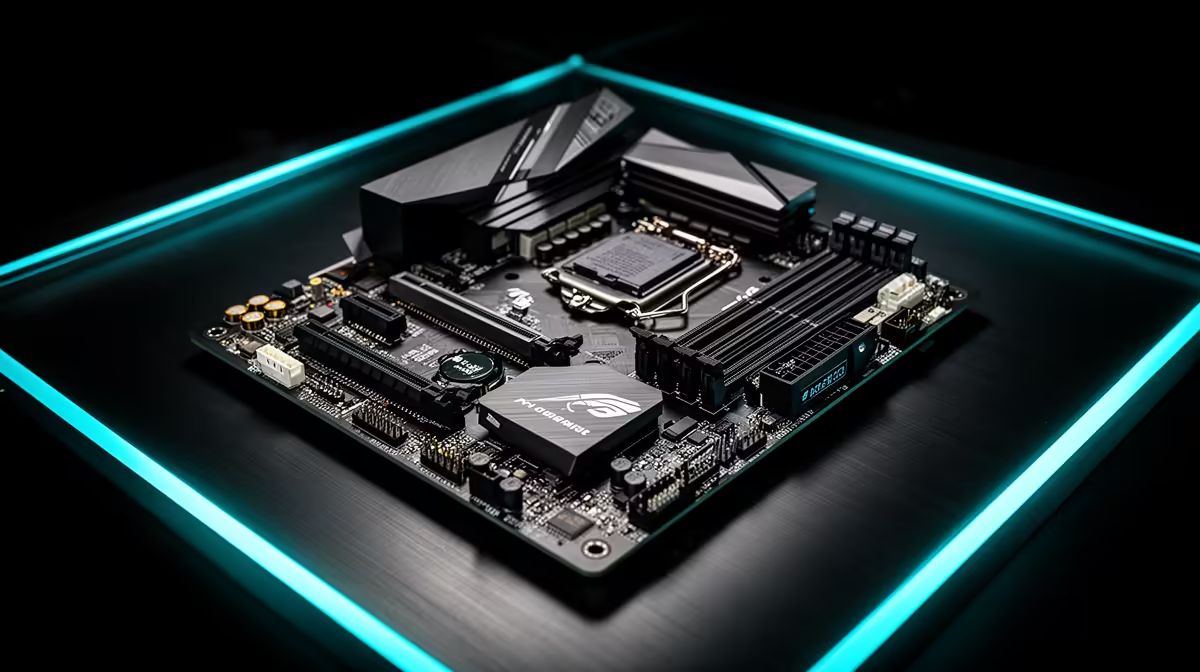
A compact Mini-ITX gaming PC is worth the extra cost when the smaller footprint has a real job: fitting a lounge cabinet, travelling between homes or clearing a tiny desk. It does not add frame rate. The premium can come from the ITX motherboard, small-form-factor power supply, case engineering and low-profile cooling, but exact prices vary. Component fit, heat, noise and service access need more planning than ATX. If the PC stays under a normal desk, micro ATX can deliver the same gaming target with cheaper parts and easier cooling.
Define genuinely small
Measure the shelf, desk or bag and set a case-volume or dimension limit. A tall narrow case can save desk area without being easy to carry. A short case can become wide enough to crowd the same surface.
Include cables and ventilation clearance. A small box pressed against a wall is not using its advertised cooling path.
Every component needs a fit check
Record graphics-card length, height, slot thickness and power-connector bend room. Check CPU cooler height or radiator support, power-supply format, memory height and storage placement.
Cases can use riser cables, rotated layouts and sandwich chambers. PCIe generation support and cable routing matter. Do not force a riser or high-power lead into a tight bend.
Heat and noise are the performance trade
Small volume can recycle GPU and CPU heat. Use measured thermal tests from the exact case with a comparable power load. A lower-power CPU or GPU can produce a quieter, better-balanced ITX machine than flagship parts forced into the smallest shell.
Undervolting within supported tools can improve efficiency, but the build must work at supported defaults first. A tune is not a substitute for intake area.
Service takes more steps
Replacing one SSD may require removing the GPU, cables or a radiator. Build in an order you can reverse, photograph routing and keep every case bracket.
ITX also offers fewer expansion and memory slots. Choose network, storage and ports you expect to keep because adding cards later may be impossible.
Cable length can surprise you
SFX power supplies designed for tiny cases often include short cables. They may not reach cleanly if you later move the unit into a larger chassis. Full-size supply cables can be too bulky for an ITX chamber.
Use only cables approved for the exact power-supply model. Modular plugs are not standardised at the supply end, even when they fit. Plan connector direction and length before mounting the motherboard.
Front USB and riser cables also need a route without sharp folds or fan contact.
Browse gaming PC systems and PC best sellers for current complete-build references.
FAQ
Is ITX gaming slower than ATX?
Size alone is not slower. Cooling, power, parts and sustained clocks determine performance.
Does every ITX build need an SFX power supply?
No. Case support decides. Check exact PSU format, length, cables and connector clearance.
Is micro ATX a better value?
Often, when you have room for it. It can offer cheaper boards, more slots and easier cooling at the same game speed.
Compare ITX and micro ATX builds only after setting a real footprint, noise and service target.