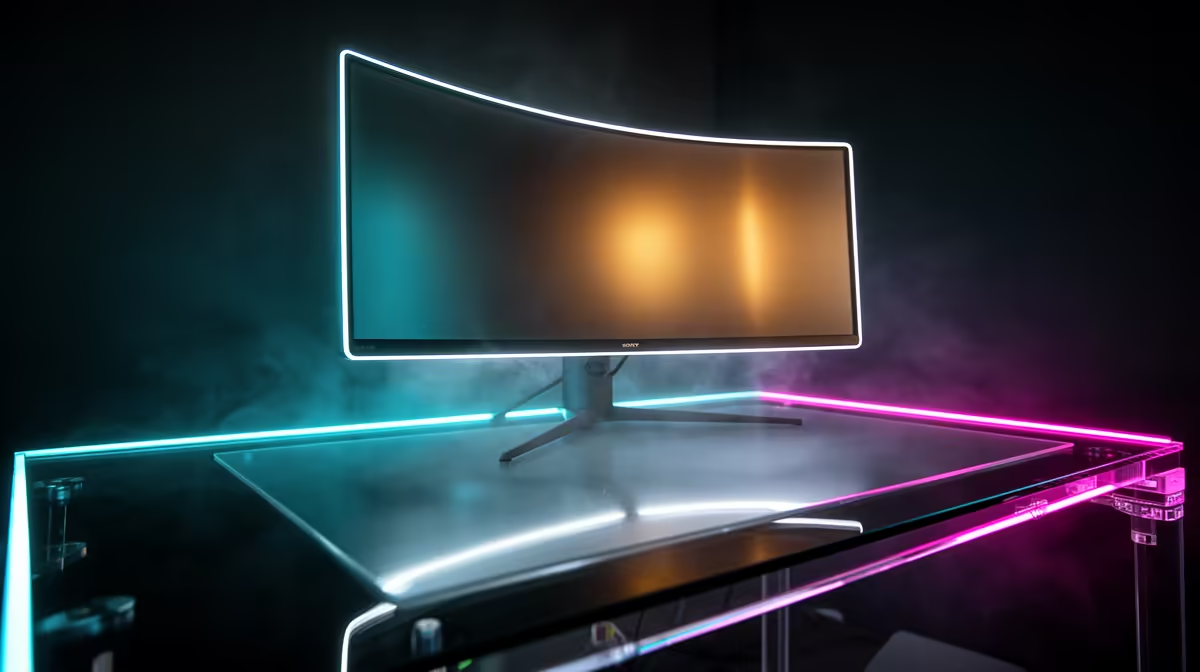
High resolution, refresh and colour depth can exceed the raw bandwidth of a display link. Display Stream Compression fits that signal through with visually lossless compression when the GPU, cable and monitor support it.
Quick Answer
Display Stream Compression, or DSC, compresses display data so high resolution, refresh, bit depth, and colour can fit through a supported link. It is designed to be visually lossless under its target conditions. The GPU, cable, port, monitor, driver, and signal mode must all support the path.
Compare exact port and refresh details through the monitor catalogue. The current monitor best sellers provide another place to inspect real configurations. A display using DSC is not admitting poor image quality; it is managing finite link bandwidth.
Why DSC appears on gaming monitors
A 4K high-refresh signal with HDR and greater bit depth carries far more data than 1080p SDR at 60Hz. DisplayPort or HDMI modes have payload limits after encoding overhead.
DSC compresses the stream before transmission and reconstructs it in the display. The alternative may be lower refresh, lower bit depth, chroma subsampling, or another connection with more bandwidth.
Whether DSC activates can depend on resolution, refresh, colour format, and bit depth. The monitor manual or information page may expose the active state.
Image quality is only one check
DSC is intended to avoid visible artefacts in normal viewing. Extreme test patterns or capture workflows can reveal differences or compatibility limits, and "visually lossless" is not the same phrase as mathematically lossless.
Check text, gradients, dark scenes, fine game detail, and HDR at normal distance. Compare against a lower-bandwidth uncompressed mode at matched settings when possible.
Compatibility can matter more. Certain GPU generations, docks, KVMs, adapters, capture cards, or multi-monitor combinations may not pass DSC or may consume shared display resources.
Troubleshoot the complete link
Use a cable proven for the target mode and connect directly during diagnosis. Install current supported graphics drivers and monitor firmware where the maker recommends it.
If the highest refresh produces black screens, wake faults, or missing colour modes, step down one variable and test. Do not blame compression before checking cable, port, GPU, and display support.
Decide whether to leave DSC enabled
Keep it when the target resolution, refresh, HDR, and colour mode work cleanly. Disable it only when the monitor or GPU exposes a supported alternative and a repeatable fault points to that path.
Dropping from 240Hz to 120Hz can remove the bandwidth need and changes motion as well as compression. Reducing bit depth or moving to chroma subsampling changes image information. Compare one alternative at a time.
Multi-monitor setups can expose GPU display-pipeline limits even when every panel works alone. Test cold boot, sleep, wake, game launch, and HDR switching with all intended screens connected.
FAQ
Does DSC reduce gaming image quality?
It is designed to be visually lossless. Judge the exact implementation and mode through normal content, text, gradients, HDR, and compatibility tests.
Does DSC add input lag?
Its processing is designed for display transport, but total latency depends on the complete GPU, link, monitor, and image path. Use model-level measurements.
Can a capture card record a DSC signal?
Only when the full output and capture path support the required mode. Many capture devices accept lower resolution or refresh combinations, so verify exact specifications.
Confirm DSC support across GPU, port, cable, monitor, and any capture device, then test the target high-refresh mode with real content.