


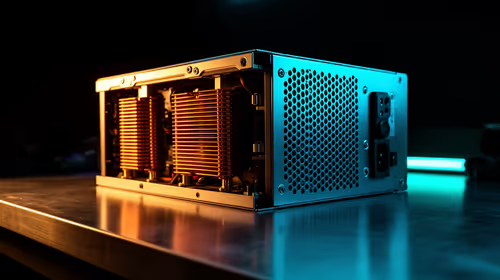
1000W PSU Planning for RTX 5090 Builds in SA
1000W for RTX 5090 needs a full-build check, not a simple yes. Review GPU guidance, CPU draw, transient load, connectors, PSU quality, and upgrade plans before deciding.
Read morePlant-based PLA does not automatically require a different printing setup from standard PLA. Start with suitable PLA guidance and test the spool; at R499, ELEGOO Galaxy PLA provides 1kg of 1.75mm material with gloss, dynamic shimmer and shifting colour.

Plant-based describes what a filament is made from; it does not automatically dictate a unique profile for every spool. Plant-based PLA printing should begin with the same disciplined compatibility and calibration process used for another named PLA. The actual product and printer remain more useful than assumptions attached to one material phrase.
Biodegradable plant-based PLA does not automatically print differently from every standard PLA option. Start with the printer's supported PLA guidance and a short test for the exact spool. ELEGOO Galaxy PLA is R499 for 1kg of 1.75mm material, adding gloss and dynamic angle-dependent colour.

The ELEGOO material is plant-based and biodegradable. Diameter and formulation matter to the material choice, but they do not establish a universal temperature, travel value or feeding rule. Use the documentation for the machine and observe what the actual test produces.
Comparing named candidates through the 3D printing filament category keeps the decision attached to real spools rather than an imagined standard product.
Choose a compact object with a broad wall, curve and a few travel moves. Begin with the normal supported PLA profile, then inspect extrusion, layer consistency and the first layer. Alter one element only when a specific fault appears.
Keep a clean standard PLA sample beside the Galaxy attempt if the question is a direct comparison. Use the same geometry and viewing conditions, but allow each material to start from appropriate guidance rather than forcing identical settings without reason.
This spool is glossy and shifts colour as the viewing angle changes. Rotate the sample beneath stable light to reveal the dynamic space effect. A visual difference does not prove a process difference; surface appearance and print behaviour need separate observations.
Check machine support in Evetech's 3D printer selection when planning new hardware. The 1.75mm diameter must fit the chosen feed system before any comparison with another PLA becomes useful.
A fair material comparison keeps the question consistent, not necessarily every profile value. Each named spool should begin from guidance appropriate to it and the same printer. The model, orientation and inspection method can remain matched while the setup respects the real material being tested.
Record whether a difference belongs to geometry, surface appearance or process stability. If both candidates form clean parts, then compare their finish and project fit. If one has an unresolved print fault, solve or document that issue before treating the result as a material-family conclusion. This prevents a poorly chosen baseline from becoming a false lesson about all plant-based PLA.
Repeat the comparison only when it can answer a new question. A second test might use the final curve instead of a generic wall, or it might confirm the result after storage. Reprinting the same sample without changing the hypothesis consumes material but adds little evidence. A disciplined comparison ends when the project requirement has been settled clearly enough to choose the next step.
The plant-derived biodegradable formulation defines what the material is made to be, while the Galaxy surface defines how the completed piece looks. Neither fact requires the spool to abandon the user-friendly printing character of traditional PLA. In practice, the exact printer and model still determine the successful profile, but makers do not need to treat the material as a completely different polymer family merely because it carries a premium finish.
Its difference appears most clearly after a clean print: high gloss, deep-space lustre, shifting colour and dynamic reflection. Compare that result with ordinary PLA on the same geometry if the buying decision is about appearance. The test isolates the visible benefit without claiming a universal change in every printing setting.
Keep the ordinary-PLA and Galaxy samples together after the comparison. They form a useful reference pair for future models, showing whether a new design genuinely needs moving lustre or only the straightforward surface of a standard spool.
Label both pieces with the printer and date so the pair remains useful after settings, machines or workshop conditions change.
No. Begin with suitable guidance for the actual printer and spool, then change only what the test result supports.
The ELEGOO filament is both biodegradable and plant-based.
Use the same representative geometry and inspection conditions while giving each named product an appropriate starting setup.
It produces gloss, dynamic shimmer and vibrant colour changes as the viewing angle moves.
Ready to compare PLA by evidence instead of labels? Review Evetech's filament and printer ranges, then give each real spool a controlled test tied to the machine using it.
No. Begin with suitable guidance for the actual printer and spool, then change only what the test result supports.
The ELEGOO filament is both biodegradable and plant-based.
Use the same representative geometry and inspection conditions while giving each named product an appropriate starting setup.
It produces gloss, dynamic shimmer and vibrant colour changes as the viewing angle moves.
1000W for RTX 5090 needs a full-build check, not a simple yes. Review GPU guidance, CPU draw, transient load, connectors, PSU quality, and upgrade plans before deciding.
Read more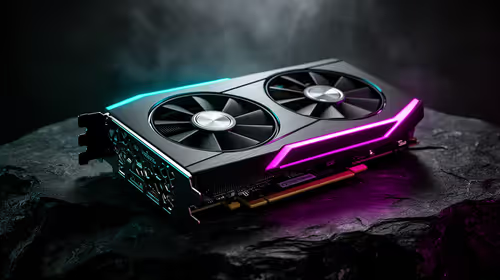
RTX 5080 Super with a 750W PSU is more comfortable than lower wattage if the unit is quality. SA builders should still confirm GPU guidance, CPU draw, connector type, airflow, and upgrade room.
Read more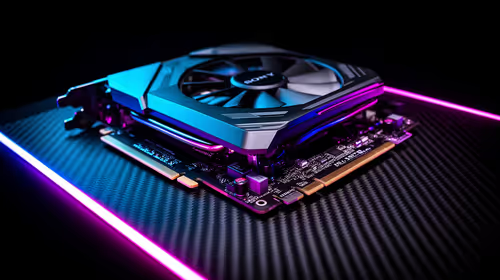
How to fix FPS drops after a RX 9070 XT starts with driver cleanup, chipset updates, thermals, and power checks. For SA gaming PCs, confirm PCIe seating, monitor refresh, frame caps, and per-game graphics settings before replacing parts.
Read more
How to fix low FPS Windows 11 Wi-Fi 7 issues starts by checking whether the problem is frame rate or network lag. Test ping, drivers, power settings, Ethernet, and game FPS before adjusting visuals.
Read more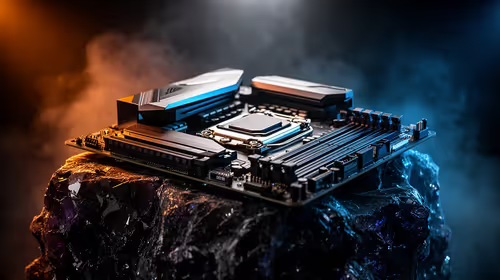
AM5 is smart for SA builders because it supports newer Ryzen CPUs, DDR5 memory, and a longer upgrade path. Compare board cost, cooling, gaming needs, and local part availability before choosing your next PC platform.
Read more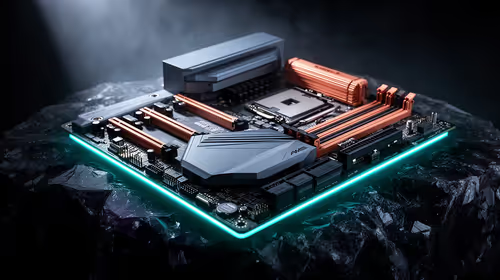
AM5 gives Randburg gaming builders a longer upgrade path. For SA buyers, DDR5 support, newer board features, and future CPU options can justify the platform. Weigh board cost, cooler support, BIOS maturity, and upgrade timing before choosing.
Read more
RTX 5090 on a 550W PSU leaves almost no practical room for OC plans. Treat the setup as constrained, with CPU draw, power spikes, cable quality, thermals, and stability checks more important than chasing extra clocks.
FPS drops on a Ryzen 9 9950X3D build often have a fixable cause. Check settings, drivers, thermals, background tasks, network conditions, and bottlenecks before assuming a part must be replaced.

The difference between PCIe 5.0 and PCIe 4.0 for SA gamers is mostly bandwidth headroom. Compare GPU slot needs, NVMe speed, motherboard support, and upgrade timing before paying extra for a newer platform.

Gaming PC stuck pixel checks in South Africa should confirm the monitor fault first. Use colour tests, screenshot comparison, cable swaps, display menu checks, and clear photos before deciding on support.

AMD's current driver now lists a Radeon RX 9050 4GB, while product coverage details a narrowed memory system. SA buyers should weigh the low VRAM ceiling against current local Radeon options.

Samsung Display has demonstrated a 16-inch 2.5K OLED laptop panel running at 300Hz. SA buyers should wait for a named notebook, full panel specifications and a local price before planning an upgrade.

Microsoft says some Windows 11 game crashes after recent updates are linked to RGB-related drivers. Affected SA gamers should confirm the update and driver before using the published registry workaround.
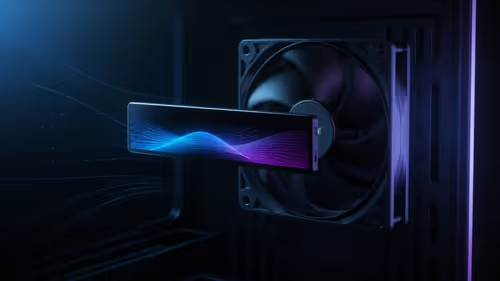
Thermalright's Fan Frame Vision-1 adds a 640x172 status screen to a standard 120mm fan. SA builders should check clearance, USB routing and local support before treating it as an easy upgrade.

Shokz OpenFit Air 2 earbuds weigh 7.2g each and use a redesigned dual-driver open-ear layout. SA buyers should choose them for comfort and awareness, not maximum isolation.

A fake 113GB GTA VI ISO reportedly used empty padding around a small malware payload. SA gamers should delete unofficial builds, keep Windows security active and wait for official channels.

The ROG Flux Charger Dock combines 260W total output, 140W laptop charging and HDMI 2.1. SA buyers should check laptop USB-C limits, display needs and local warranty first.

ASRock's Rock 360 Digital AIO adds a 1.05-inch CPU temperature display, 360mm radiator and simplified wiring. SA builders should check case fit, socket support and local warranty.