


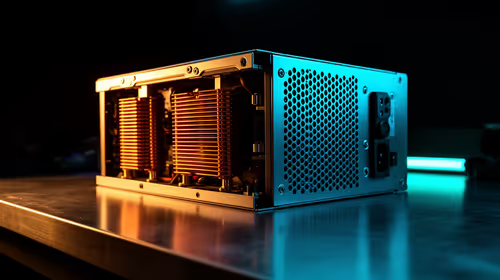
1000W PSU Planning for RTX 5090 Builds in SA
1000W for RTX 5090 needs a full-build check, not a simple yes. Review GPU guidance, CPU draw, transient load, connectors, PSU quality, and upgrade plans before deciding.
Read moreA router cannot beat physics, but rollback netcode makes overseas fighting matches playable from South Africa by predicting inputs and correcting instantly instead of waiting on frame confirmation. Evetech routers with low jitter help rollback work best.
Rollback netcode can make distance feel better by predicting inputs, while unstable latency still creates visible corrections. Fighting games from South Africa need good rollback, wired consistency and opponents close enough for the match to stay coherent.
Rollback netcode lets a fighting game predict remote inputs and correct the game state when the real inputs arrive. It can make a long-distance match feel more responsive than delay-based netcode. Distance still creates latency, and unstable jitter or loss creates visible corrections. South African players should favour current titles with well-tested rollback and opponents whose connection stays consistent.
Compare wired and wireless options in the networking selection. A suitable Ethernet cable or related item can be found among best-selling accessories. Your router protects the local path; the game's netcode handles the match model.
With rollback, your local input can appear without waiting for every remote input to cross the network. The game predicts what the opponent did. When the prediction differs, it corrects earlier frames and catches up.
Small corrections can be hard to notice. Larger ones can look like a character snapping, an animation skipping or a hit changing outcome. The implementation and game design decide how gracefully this appears.
Signals need time to travel between South Africa and an overseas opponent. Rollback changes how the game presents that delay; it cannot remove it. Every title also sets its own acceptable range and matchmaking behaviour.
Do not publish one playable ping threshold for all fighters. Test the exact game, opponent region and platform. A slow tactical matchup and a frame-tight combo can expose the same route differently.
Jitter often feels worse than a steady baseline because the game must correct by changing amounts. Packet loss can cause heavier skips or disconnects. Stability deserves equal space beside the latency number.
Practise a familiar punish or combo offline, then try it in several online matches with the same opponent. Record the game's delay or rollback indicator where available, visual skips and input consistency.
Use Ethernet and pause household uploads. Compare another opponent in the same country before deciding that the game's implementation is poor.
Check the current official network and cross-play information. Platform combinations can receive different builds or routes after updates.
Start with players in your city, then another South African region, a neighbouring country and a regular overseas community. Record match quality and the game's own connection indicator. This creates a personal distance curve without pretending every route follows the map.
Use a private lobby where supported so rank and matchmaking do not change the test. Keep stage, platform and background traffic consistent.
If the match becomes unstable, lower visual settings only when client frame time also jumps. Rollback corrections and a slow PC can look similar during a busy effect.
No. It predicts and corrects game state so inputs can feel more immediate. Distance, jitter and loss remain.
Check the current official information for the exact title and mode. Do not rely on an old genre list.
Yes where practical. It removes Wi-Fi variation from the first hop and gives rollback a steadier stream.
Test the exact fighter with regular opponents over Ethernet, then judge rollback from input consistency and corrections rather than a universal ping limit.
No. It predicts and corrects game state so inputs can feel more immediate. Distance, jitter and loss remain.
Check the current official information for the exact title and mode. Do not rely on an old genre list.
Yes where practical. It removes Wi-Fi variation from the first hop and gives rollback a steadier stream.
1000W for RTX 5090 needs a full-build check, not a simple yes. Review GPU guidance, CPU draw, transient load, connectors, PSU quality, and upgrade plans before deciding.
Read more
RTX 5080 Super with a 750W PSU is more comfortable than lower wattage if the unit is quality. SA builders should still confirm GPU guidance, CPU draw, connector type, airflow, and upgrade room.
Read more
How to fix FPS drops after a RX 9070 XT starts with driver cleanup, chipset updates, thermals, and power checks. For SA gaming PCs, confirm PCIe seating, monitor refresh, frame caps, and per-game graphics settings before replacing parts.
Read more
How to fix low FPS Windows 11 Wi-Fi 7 issues starts by checking whether the problem is frame rate or network lag. Test ping, drivers, power settings, Ethernet, and game FPS before adjusting visuals.
Read more
AM5 is smart for SA builders because it supports newer Ryzen CPUs, DDR5 memory, and a longer upgrade path. Compare board cost, cooling, gaming needs, and local part availability before choosing your next PC platform.
Read more
AM5 gives Randburg gaming builders a longer upgrade path. For SA buyers, DDR5 support, newer board features, and future CPU options can justify the platform. Weigh board cost, cooler support, BIOS maturity, and upgrade timing before choosing.
Read more
RTX 5090 on a 550W PSU leaves almost no practical room for OC plans. Treat the setup as constrained, with CPU draw, power spikes, cable quality, thermals, and stability checks more important than chasing extra clocks.
FPS drops on a Ryzen 9 9950X3D build often have a fixable cause. Check settings, drivers, thermals, background tasks, network conditions, and bottlenecks before assuming a part must be replaced.

The difference between PCIe 5.0 and PCIe 4.0 for SA gamers is mostly bandwidth headroom. Compare GPU slot needs, NVMe speed, motherboard support, and upgrade timing before paying extra for a newer platform.

Gaming PC stuck pixel checks in South Africa should confirm the monitor fault first. Use colour tests, screenshot comparison, cable swaps, display menu checks, and clear photos before deciding on support.

AMD's current driver now lists a Radeon RX 9050 4GB, while product coverage details a narrowed memory system. SA buyers should weigh the low VRAM ceiling against current local Radeon options.

Samsung Display has demonstrated a 16-inch 2.5K OLED laptop panel running at 300Hz. SA buyers should wait for a named notebook, full panel specifications and a local price before planning an upgrade.

Microsoft says some Windows 11 game crashes after recent updates are linked to RGB-related drivers. Affected SA gamers should confirm the update and driver before using the published registry workaround.
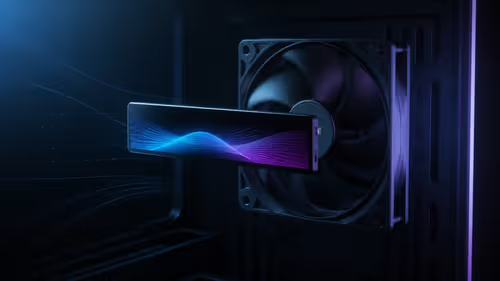
Thermalright's Fan Frame Vision-1 adds a 640x172 status screen to a standard 120mm fan. SA builders should check clearance, USB routing and local support before treating it as an easy upgrade.

Shokz OpenFit Air 2 earbuds weigh 7.2g each and use a redesigned dual-driver open-ear layout. SA buyers should choose them for comfort and awareness, not maximum isolation.

A fake 113GB GTA VI ISO reportedly used empty padding around a small malware payload. SA gamers should delete unofficial builds, keep Windows security active and wait for official channels.
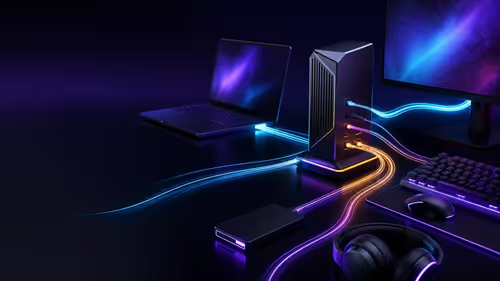
The ROG Flux Charger Dock combines 260W total output, 140W laptop charging and HDMI 2.1. SA buyers should check laptop USB-C limits, display needs and local warranty first.

ASRock's Rock 360 Digital AIO adds a 1.05-inch CPU temperature display, 360mm radiator and simplified wiring. SA builders should check case fit, socket support and local warranty.