


1000W PSU Planning for RTX 5090 Builds in SA
1000W for RTX 5090 needs a full-build check, not a simple yes. Review GPU guidance, CPU draw, transient load, connectors, PSU quality, and upgrade plans before deciding.
Read moreBetter PLA results across temperature changes start with a stable print area and a short repeat test. At R499 per 1kg spool, ELEGOO Galaxy PLA adds a glossy 1.75mm surface whose shifting colour is easiest to compare under stable conditions.

A profile that worked in one room condition can look different after the workspace heats up or cools down. PLA printing in changing temperatures improves when the print area, material and comparison method stay as stable as practical. South African makers need an observable baseline, not a collection of seasonal guesses.
Reduce sudden environmental changes around the printer, repeat a short known model and compare it with a saved successful sample. The ELEGOO Galaxy spool is R499 for 1kg of glossy 1.75mm PLA, giving the test a consistent material reference. Adjust the setup only when the result shows a specific defect, and follow the printer's own operating limits.
Room conditions matter most through what reaches the active print area. Keep the machine away from abrupt drafts and avoid moving the setup between very different locations during a long job. Stable placement makes it easier to tell whether a change came from the environment, material delivery or the profile.
Record the general room condition and time of day beside a successful test. Exact household measurements are useful only if the maker can repeat them; a clear note such as cool morning near an open doorway may explain more than an isolated number with no context.
Compare hardware arrangements in the Evetech 3D printer category when planning a workspace.
Choose a small object with a broad wall, curve and overhang representative of normal work. Print it after a meaningful environmental change and place it beside the baseline. Look for lifting, uneven lines, altered surface texture or another repeatable difference.
Do not change several profile values simply because the weather feels different. First remove obvious airflow or placement changes, then test the single variable most closely linked to the defect. Keeping notes across a few days builds local knowledge without turning assumptions into rules.
ELEGOO Galaxy PLA shifts colour by viewing angle and presents a glossy surface. Seasonal or room lighting can change how that effect appears even when the printed geometry is identical. Inspect comparison pieces beneath the same lamp before deciding that the material response has changed.
Use the 3D printing filament selection to compare material options after the environmental test is understood. A new spool should not be used to hide an uncontrolled workspace variable.
Before changing the printer profile, test whether moving airflow or direct sunlight affects one part of the room more than another. Observe the printer at the start and end of a normal job. A stable interior position may provide more repeatable conditions than a desk beside an often-opened door.
Do not relocate the machine during an active long print. Instead, use short samples to compare candidate positions safely and follow the printer requirements for clearance and operation. Record which location produced the most repeatable geometry, then keep the lighting test separate. This builds practical local knowledge without claiming that one South African climate rule applies to every home or workshop.
Once a position is chosen, mark the practical boundaries around it: doors that should stay closed during critical stages, direct sun periods to avoid and surfaces that must remain clear for safe operation. The note should describe the workspace, not claim to control the weather. A repeatable local arrangement makes later PLA comparisons more meaningful because the immediate environment is no longer changing at random.
The Galaxy spool provides a stable material identity for these comparisons: plant-derived biodegradable PLA, user-friendly printing behaviour and a high-gloss decorative finish. What changes with the room is the printing environment, not the fact that the filament is designed to create deep-space reflections and colour transitions. Repeat the same sample before altering several settings so the maker can separate a temperature-related change from the normal view-dependent effect.
Keep one successful curved test in the workshop. Its surface gives both a layer-quality reference and a lighting reference, making later seasonal comparisons more reliable than memory alone.
Keep printer placement, model, material path and evaluation light consistent so the environmental change is not mixed with other variables.
It provides a physical reference for layer texture, shape and surface appearance that does not depend on memory.
No. Change the setup only after a repeatable test reveals a specific problem connected to the current conditions.
Yes. The Galaxy surface moves through different colours by angle, so comparison pieces need the same viewing light.
Ready to make local conditions part of a repeatable method? Compare Evetech's printer and filament ranges, then build a short baseline test that can travel through the seasons with your workspace.
Keep printer placement, model, material path and evaluation light consistent so the environmental change is not mixed with other variables.
It provides a physical reference for layer texture, shape and surface appearance that does not depend on memory.
No. Change the setup only after a repeatable test reveals a specific problem connected to the current conditions.
Yes. The Galaxy surface moves through different colours by angle, so comparison pieces need the same viewing light.
1000W for RTX 5090 needs a full-build check, not a simple yes. Review GPU guidance, CPU draw, transient load, connectors, PSU quality, and upgrade plans before deciding.
Read more
RTX 5080 Super with a 750W PSU is more comfortable than lower wattage if the unit is quality. SA builders should still confirm GPU guidance, CPU draw, connector type, airflow, and upgrade room.
Read more
How to fix FPS drops after a RX 9070 XT starts with driver cleanup, chipset updates, thermals, and power checks. For SA gaming PCs, confirm PCIe seating, monitor refresh, frame caps, and per-game graphics settings before replacing parts.
Read more
How to fix low FPS Windows 11 Wi-Fi 7 issues starts by checking whether the problem is frame rate or network lag. Test ping, drivers, power settings, Ethernet, and game FPS before adjusting visuals.
Read more
AM5 is smart for SA builders because it supports newer Ryzen CPUs, DDR5 memory, and a longer upgrade path. Compare board cost, cooling, gaming needs, and local part availability before choosing your next PC platform.
Read more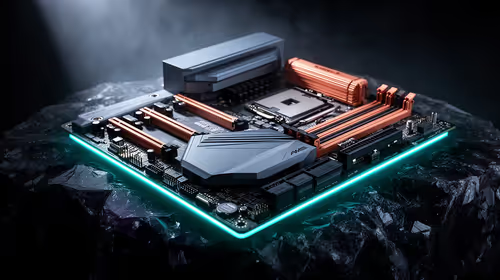
AM5 gives Randburg gaming builders a longer upgrade path. For SA buyers, DDR5 support, newer board features, and future CPU options can justify the platform. Weigh board cost, cooler support, BIOS maturity, and upgrade timing before choosing.
Read more
RTX 5090 on a 550W PSU leaves almost no practical room for OC plans. Treat the setup as constrained, with CPU draw, power spikes, cable quality, thermals, and stability checks more important than chasing extra clocks.
FPS drops on a Ryzen 9 9950X3D build often have a fixable cause. Check settings, drivers, thermals, background tasks, network conditions, and bottlenecks before assuming a part must be replaced.

The difference between PCIe 5.0 and PCIe 4.0 for SA gamers is mostly bandwidth headroom. Compare GPU slot needs, NVMe speed, motherboard support, and upgrade timing before paying extra for a newer platform.

Gaming PC stuck pixel checks in South Africa should confirm the monitor fault first. Use colour tests, screenshot comparison, cable swaps, display menu checks, and clear photos before deciding on support.

AMD's current driver now lists a Radeon RX 9050 4GB, while product coverage details a narrowed memory system. SA buyers should weigh the low VRAM ceiling against current local Radeon options.

Samsung Display has demonstrated a 16-inch 2.5K OLED laptop panel running at 300Hz. SA buyers should wait for a named notebook, full panel specifications and a local price before planning an upgrade.

Microsoft says some Windows 11 game crashes after recent updates are linked to RGB-related drivers. Affected SA gamers should confirm the update and driver before using the published registry workaround.
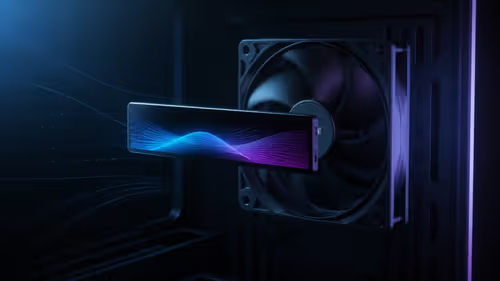
Thermalright's Fan Frame Vision-1 adds a 640x172 status screen to a standard 120mm fan. SA builders should check clearance, USB routing and local support before treating it as an easy upgrade.

Shokz OpenFit Air 2 earbuds weigh 7.2g each and use a redesigned dual-driver open-ear layout. SA buyers should choose them for comfort and awareness, not maximum isolation.

A fake 113GB GTA VI ISO reportedly used empty padding around a small malware payload. SA gamers should delete unofficial builds, keep Windows security active and wait for official channels.

The ROG Flux Charger Dock combines 260W total output, 140W laptop charging and HDMI 2.1. SA buyers should check laptop USB-C limits, display needs and local warranty first.

ASRock's Rock 360 Digital AIO adds a 1.05-inch CPU temperature display, 360mm radiator and simplified wiring. SA builders should check case fit, socket support and local warranty.