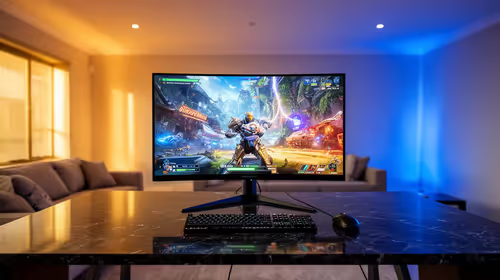
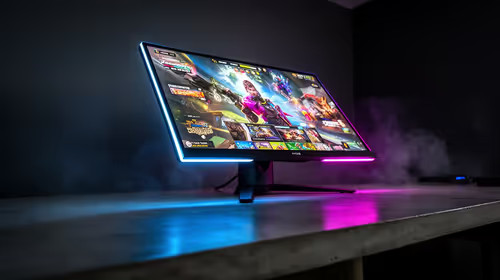
The 1ms GTG figure is one part of motion performance: it describes a grey-to-grey pixel-transition target, while refresh rate, overdrive tuning, frame delivery and input latency shape what the player actually sees and feels.
Quick Answer
A fast GTG response helps new frames replace old pixel states with less visible trailing. In rapid camera turns or when following a moving opponent, that can preserve clearer edges. The benefit is greatest when transitions remain controlled across bright and dark shades; an aggressive mode that creates inverse ghosting can look worse despite posting a faster measurement.
Follow a frame from the PC to the panel
The game creates a frame, the system queues and transmits it, the monitor begins a refresh, and pixels change towards their new values. GTG addresses only the final transition stage. It does not measure network delay, mouse polling, game-engine latency or the entire display pipeline.
That distinction explains why two monitors with the same advertised response can look different in motion. Compare the Alienware AW3426DWM's 1ms GTG rating alongside its 240Hz refresh and FreeSync Premium support rather than treating the number as a complete latency result.
Relate response to 240Hz timing
A 240Hz refresh interval is approximately 4.17ms. Ideally, pixel changes should settle quickly enough for the next image to remain distinct. Slow transitions can smear details across consecutive refreshes, particularly in darker scenes on some VA panels.
Use a repeatable pursuit test, dark corridor and fast pan. Look for a clean moving edge, then check for bright halos that signal excessive overdrive. The best mode is the one that balances speed with minimal overshoot across the frame rates you use.
The gaming monitor range provides context for comparing response claims with resolution, refresh and adaptive-sync features.
Keep frame delivery in the equation
Even a fast panel repeats information when the PC is producing fewer frames than refreshes. Conversely, a high frame rate with uneven frame times can create visible judder. Measure the complete loop with a consistent game route and identical settings.
AMD FreeSync Premium on the AW3426DWM helps align the monitor with variable output. It addresses tearing and cadence within its operating range; it does not change the panel's physical transition behaviour. These features complement each other rather than replacing one another.
Account for ultrawide VA behaviour
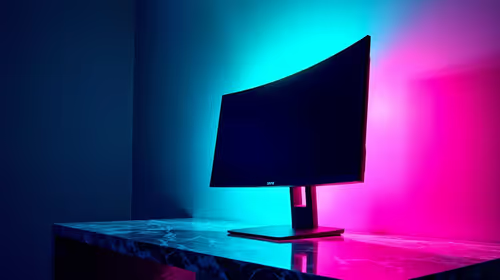
The 34-inch 3440 x 1440 panel uses VA technology and a 1500R curve. VA is valued for contrast, but response can vary by shade transition. Inspect dark-on-dark movement as carefully as bright test patterns. Keep the viewing position centred so the curved surface works as intended.
Other display technologies make different trade-offs. The OLED monitor selection offers a separate reference point, while the curved monitor category helps isolate the effect of screen shape from panel response.
Judge the whole R8,999 package
The AW3426DWM's price includes far more than a response rating: UWQHD detail, 240Hz, DisplayHDR 400, Dolby Vision, 95% DCI-P3, a 1500R curve and USB-C with 15W charging. A buyer should decide whether those capabilities solve regular needs, not pay solely for a single millisecond claim.
Competitive players should test control during real movement, while mixed-use buyers should also inspect text, contrast, colour and desktop comfort. The most useful monitor is balanced for the full week.
Repeat the comparison with the monitor warmed up and the room lighting fixed. Consistent conditions make small motion differences easier to attribute to the selected setting.
Use camera footage carefully
High-frame-rate phone footage can help reveal broad trailing and overshoot when the camera follows a moving object at the correct speed. Lock exposure where possible and avoid drawing conclusions from rolling-shutter bands produced by the camera itself. A pursuit photo is most useful when repeated across the same test, speed and overdrive modes. It complements direct gameplay observation rather than replacing it.
Frequently Asked Questions
Does 1ms GTG mean one millisecond of total input lag?
No. GTG refers to pixel transitions and does not include every stage between input and the displayed result.
Can overdrive make motion worse?
Yes. An overly strong setting can overshoot the target shade and produce bright or dark inverse trails.
Why test dark scenes on a VA monitor?
Different shade transitions can behave differently, so a bright pattern alone does not represent motion across an entire game.
Is response time useful at lower frame rates?
Yes. Faster, well-controlled transitions can still reduce visible smearing, although the refresh cadence and frame delivery remain important.
Want motion clarity that holds up outside a specification table?
Compare overdrive modes in bright and dark gameplay, watch for overshoot, and choose the setting that stays composed across your real frame-rate range.