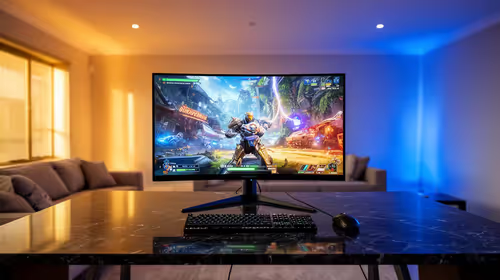
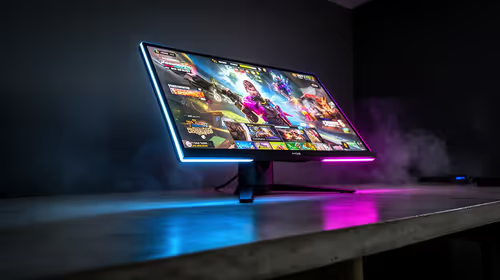
DisplayHDR 500 True Black describes HDR performance for a self-emissive display, where deep black and controlled highlights shape contrast. Understanding True Black HDR on an OLED gaming monitor means judging suitable HDR content, gamut and room light together. The ASUS XG27AQDPG carries this class at R23,899.
Quick Answer
DisplayHDR 500 True Black supports an HDR presentation with OLED black levels and distinct highlights when the source and settings are correct. The QD-OLED XG27AQDPG also covers 99% DCI-P3 for broad HDR colour. It cannot turn SDR content into correctly mastered HDR, remove room reflections or replace game-specific calibration.
🌑 Begin with self-emissive black
OLED pixels produce their own light and can switch dark areas off at pixel level. This creates strong local contrast without relying on a conventional backlight zone. Direct glare can still obscure near-black texture, so control room light before increasing shadow settings.
Explore Evetech's OLED monitor range to compare HDR classes and panel implementations.
✨ Inspect highlights beside darkness
Use a scene with stars, lamps, reflections or effects against a dark background. Good HDR separation keeps the bright object distinct while preserving the surrounding black. A full-screen white page is not a complete HDR test.
Set the black point before chasing highlight intensity. Lifting shadows too far can flatten the contrast that True Black HDR is intended to present.
🎨 Connect 99% DCI-P3 with content
Wide gamut supports richer colour in correctly authored material. Coverage does not guarantee perfect preset accuracy, white balance or application colour management. Check familiar natural subjects and neutral greys alongside vivid game effects.
🧰 Match every output layer
Connect through HDMI 2.1 or DisplayPort 1.4, enable HDR for the intended display in the operating system, then configure the game's HDR controls. Save values per title. A washed-out image often signals an SDR/HDR mismatch rather than weak panel contrast.
⚡ Keep competitive priorities separate
The monitor also reaches 500Hz and lists 0.03ms GTG. Competitive players may choose a visibility-focused SDR preset for one title and HDR for another. Picture mode should serve content and gameplay rather than remain permanently enabled because the display supports it.
🔄 Preserve smooth HDR gaming
G-SYNC Compatible and FreeSync Premium Pro support variable frame delivery on NVIDIA and AMD platforms. Adaptive sync controls timing, while HDR controls luminance and colour mapping. Diagnose motion and picture layers independently.
The gaming monitor catalogue gives context across HDR and speed. Evetech's curved display selection frames shape as a separate feature.
🧪 Compare SDR and HDR without changing the room
Begin with a familiar SDR game scene, save its neutral preset and note black detail. Enable the HDR path, load the matching HDR scene and complete the title's calibration. Keep room light, viewing distance and screen position unchanged. This reveals the content-mode difference without letting reflections become a hidden variable.
Inspect a dark area, a natural mid-tone and a small highlight in both modes. HDR should expand suitable luminance and colour presentation rather than simply make the entire image brighter. If shadows turn grey, return to the black-point control; if highlights lose detail, inspect the title's brightness mapping.
Save the two profiles separately and switch back to SDR before judging ordinary desktop work. DisplayHDR 500 True Black becomes practical when the correct source can be selected and restored, not when HDR remains enabled for every application.
Repeat the HDR route through both the dark scene and a bright outdoor area. If one profile handles only half the game, adjust title-level mapping before creating several nearly identical monitor presets. Keep the SDR baseline untouched for ordinary desktop content.
Add one full-screen bright scene to the comparison and watch whether the chosen preset preserves mid-tone detail. HDR quality is a balance across darkness, ordinary luminance and highlights; a single black-background demo can conceal a poor daytime or bright-game result.
Frequently Asked Questions
What viewing change should True Black support?
It supports deep OLED black beside distinct HDR highlights and shadow detail.
Does HDR improve content that is not mastered for HDR?
Not automatically. Content and output treatment must support the HDR path.
How does QD-OLED relate to black levels?
Its self-emissive pixels can produce black without a constantly lit backlight.
Why does DCI-P3 coverage matter for HDR?
It describes access to a broad colour gamut used by suitable content.
Should competitive players always enable HDR?
No. Choose the picture route that provides the best visibility and consistency for each title.
What is the price of this True Black display?
The XG27AQDPG costs R23,899.
Ready to judge HDR through dark texture, highlights and real colour?
Explore Evetech's OLED monitors and tune True Black content in the room where it will be viewed.