


1000W PSU Planning for RTX 5090 Builds in SA
1000W for RTX 5090 needs a full-build check, not a simple yes. Review GPU guidance, CPU draw, transient load, connectors, PSU quality, and upgrade plans before deciding.
Read moreAdjust 3-zone lumbar support by setting the chair at the desk, sitting in the normal work position and reviewing lower-back contact. The E3 Air wraps its three support zones through 80 degrees.

Lower-back setup should begin with a repeatable seated baseline, not a frantic search for a control. To adjust 3-zone lumbar support, first stabilise the desk, seat and normal work posture, then observe contact during a familiar task. The E3 Air uses an 80-degree auto-wrap arrangement across its three zones at R7,399.
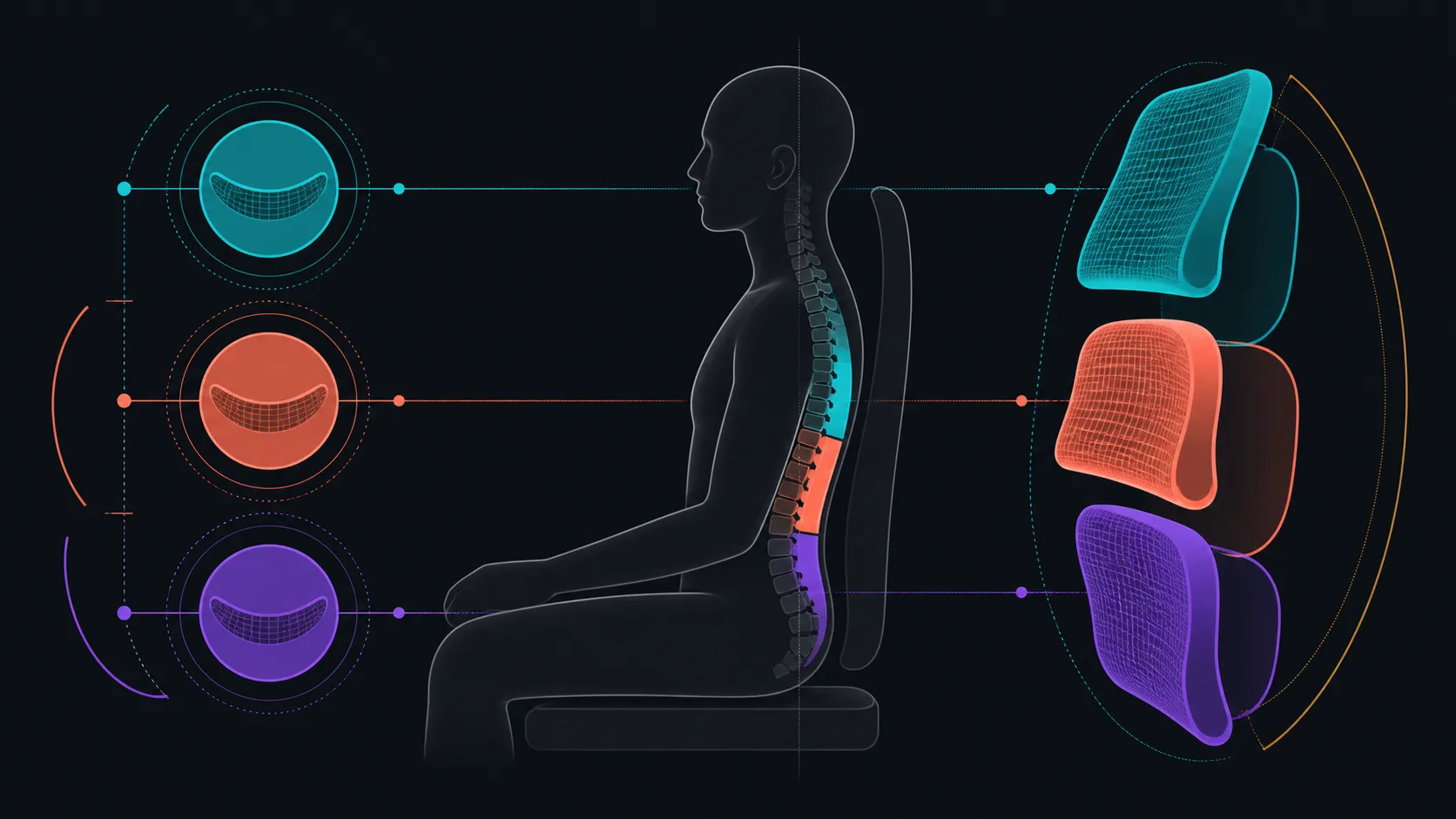
Adjust E3 Air lumbar support through six vertical levels, then choose one of four depth locks within 30mm before fine-tuning the 80-degree wrapping wings.
Set the chair at the working desk, sit naturally against the backrest and assess where the three lumbar zones meet the lower back during normal activity. The R7,399 E3 Air wraps that contact through 80 degrees, but no generic knob sequence should be assumed. Make one supported change at a time and judge fit rather than seeking a medical outcome.
Place the screen, keyboard and mouse in their intended locations. Bring the chair to the desk and settle the feet before focusing on the backrest. A lumbar setting cannot be assessed consistently if the user is reaching for the inputs or changing desk distance between trials.
Notice centre and side contact without deliberately arching or leaning. Type or read for several minutes, then write a short note about pressure, gaps and whether the posture remained natural. This reference makes later differences easier to recognise.
Evetech's HBADA office-chair range can be compared with the same baseline once the desired contact area is clear.
The E3 Air distributes lumbar contact over three zones inside an 80-degree auto-wrap area. That establishes coverage but not an extra adjustment mechanism or universal control procedure. Learn the model's operation and avoid borrowing instructions from another chair.
Keep the 4D dual-axis headrest and 360-degree omni-motion armrests still during this test. If upper supports, desk position and lumbar contact all change together, the user cannot tell which decision produced the result.
Return to the same position later in the work period. Initial contact and sustained suitability are different observations. If the support becomes distracting, reset to the recorded baseline before trying another change. Do not force the body into a setting merely because the chair has three zones.
The mesh seat combines high density with a cloud-like form and also affects the seated relationship; the backrest endpoint is 140 degrees. Treat a changed angle as a new configuration and learn its controls separately. Browse Evetech's broader office-chair category with the same staged method.
Lumbar support can alter contact, but it cannot guarantee pain relief. Persistent symptoms call for appropriate professional guidance. A successful setup is one that suits the individual, task and desk and can be recovered without guesswork.
Write observations in a form that can guide the next check. "Side contact became distracting while typing" is more useful than a broad verdict because it identifies the area and activity. For another user, restart from that person's seated baseline rather than handing over the previous conclusion. Finish by standing, returning to the desk and seeing whether the useful relationship reappears naturally. A lumbar setup that can be recovered is more practical than one found only through extended posing.
The 12-degree flex track follows movement, so test the chosen setting while leaning and reclining rather than only upright. Smaller users can move support lower; taller users can raise it. Stop when the floating wings create broad contact without pinching.
Save the chosen height and lock number so another user can restore it.
Stabilise the desk distance, screen, input devices, feet and normal sitting position. A consistent baseline lets the user compare support changes rather than unrelated workstation movement.
An 80-degree auto-wrap arc covers all three lumbar zones. Learn the exact adjustment sequence and mechanism through the controls on the chair.
No. Learn the controls and guidance for the actual chair, because similar lumbar labels do not prove that two mechanisms operate in the same way.
Check it during the main work task and again later in the session. Sustained contact is more informative than an immediate impression made while consciously posing.
It does not. Coverage may change support contact, but health outcomes are individual and ongoing pain needs suitable professional assessment.
Cloud-like, high-density mesh forms the E3 Air seat. Evaluate its feel over time rather than treating comfort as guaranteed.
Ready to build a lumbar baseline you can repeat? Compare Evetech office chairs with the desk fixed and each contact change recorded on its own.
Stabilise the desk distance, screen, input devices, feet and normal sitting position. A consistent baseline lets the user compare support changes rather than unrelated workstation movement.
An 80-degree auto-wrap arc covers all three lumbar zones. Learn the exact adjustment sequence and mechanism through the controls on the chair.
No. Learn the controls and guidance for the actual chair, because similar lumbar labels do not prove that two mechanisms operate in the same way.
Check it during the main work task and again later in the session. Sustained contact is more informative than an immediate impression made while consciously posing.
It does not. Coverage may change support contact, but health outcomes are individual and ongoing pain needs suitable professional assessment.
Cloud-like, high-density mesh forms the E3 Air seat. Evaluate its feel over time rather than treating comfort as guaranteed.
1000W for RTX 5090 needs a full-build check, not a simple yes. Review GPU guidance, CPU draw, transient load, connectors, PSU quality, and upgrade plans before deciding.
Read more
RTX 5080 Super with a 750W PSU is more comfortable than lower wattage if the unit is quality. SA builders should still confirm GPU guidance, CPU draw, connector type, airflow, and upgrade room.
Read more
How to fix FPS drops after a RX 9070 XT starts with driver cleanup, chipset updates, thermals, and power checks. For SA gaming PCs, confirm PCIe seating, monitor refresh, frame caps, and per-game graphics settings before replacing parts.
Read more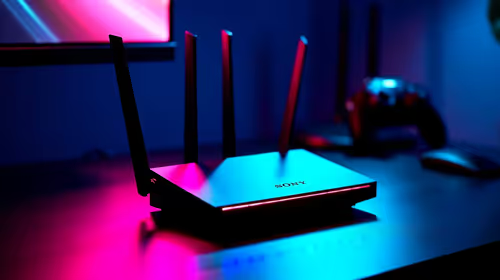
How to fix low FPS Windows 11 Wi-Fi 7 issues starts by checking whether the problem is frame rate or network lag. Test ping, drivers, power settings, Ethernet, and game FPS before adjusting visuals.
Read more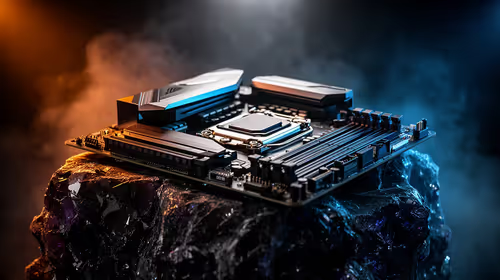
AM5 is smart for SA builders because it supports newer Ryzen CPUs, DDR5 memory, and a longer upgrade path. Compare board cost, cooling, gaming needs, and local part availability before choosing your next PC platform.
Read more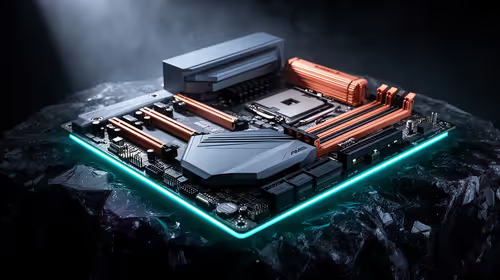
AM5 gives Randburg gaming builders a longer upgrade path. For SA buyers, DDR5 support, newer board features, and future CPU options can justify the platform. Weigh board cost, cooler support, BIOS maturity, and upgrade timing before choosing.
Read more
RTX 5090 on a 550W PSU leaves almost no practical room for OC plans. Treat the setup as constrained, with CPU draw, power spikes, cable quality, thermals, and stability checks more important than chasing extra clocks.
FPS drops on a Ryzen 9 9950X3D build often have a fixable cause. Check settings, drivers, thermals, background tasks, network conditions, and bottlenecks before assuming a part must be replaced.

The difference between PCIe 5.0 and PCIe 4.0 for SA gamers is mostly bandwidth headroom. Compare GPU slot needs, NVMe speed, motherboard support, and upgrade timing before paying extra for a newer platform.

Gaming PC stuck pixel checks in South Africa should confirm the monitor fault first. Use colour tests, screenshot comparison, cable swaps, display menu checks, and clear photos before deciding on support.

AMD's current driver now lists a Radeon RX 9050 4GB, while product coverage details a narrowed memory system. SA buyers should weigh the low VRAM ceiling against current local Radeon options.

Samsung Display has demonstrated a 16-inch 2.5K OLED laptop panel running at 300Hz. SA buyers should wait for a named notebook, full panel specifications and a local price before planning an upgrade.

Microsoft says some Windows 11 game crashes after recent updates are linked to RGB-related drivers. Affected SA gamers should confirm the update and driver before using the published registry workaround.

Thermalright's Fan Frame Vision-1 adds a 640x172 status screen to a standard 120mm fan. SA builders should check clearance, USB routing and local support before treating it as an easy upgrade.

Shokz OpenFit Air 2 earbuds weigh 7.2g each and use a redesigned dual-driver open-ear layout. SA buyers should choose them for comfort and awareness, not maximum isolation.

A fake 113GB GTA VI ISO reportedly used empty padding around a small malware payload. SA gamers should delete unofficial builds, keep Windows security active and wait for official channels.
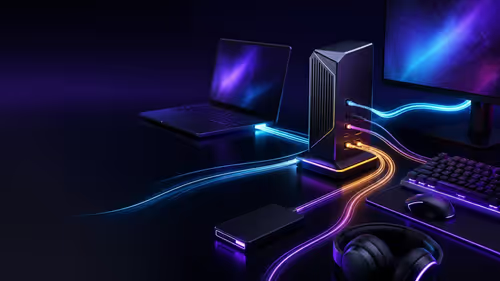
The ROG Flux Charger Dock combines 260W total output, 140W laptop charging and HDMI 2.1. SA buyers should check laptop USB-C limits, display needs and local warranty first.

ASRock's Rock 360 Digital AIO adds a 1.05-inch CPU temperature display, 360mm radiator and simplified wiring. SA builders should check case fit, socket support and local warranty.