


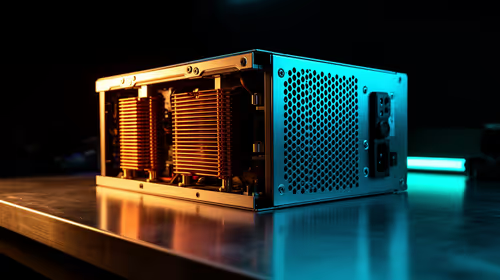
1000W PSU Planning for RTX 5090 Builds in SA
1000W for RTX 5090 needs a full-build check, not a simple yes. Review GPU guidance, CPU draw, transient load, connectors, PSU quality, and upgrade plans before deciding.
Read moreBuild a flexible dual-screen setup by matching the second display to the stand and positioning it around the main screen. The UStand supports 7-15.6-inch displays, rotates 360 degrees, folds through 135 degrees and keeps charging access available while mounted.

A flexible dual-screen setup with a portable monitor stand begins with a defined role for the second screen. Its size, orientation, position and cable should complement the primary workspace rather than merely adding another display to a crowded desk.
Build a flexible dual-screen desk by mounting a 7-to-15.6-inch portable display on the UStand and using its 360-degree head for portrait or landscape work.
At R399, the UPERFECT UStand supports a 7-15.6-inch secondary display, rotates fully and uses a 135-degree folding arm. Seat the screen on its rubber contact zones, align it around the primary display and preserve a clear mounted-charging path.
Choose one regular purpose such as references, communication, notes or a preview panel. This reveals whether portrait or landscape orientation is more useful and how close the screen should sit to the primary workspace.
Confirm the secondary display lies in the UStand's diagonal range. Exact fit also depends on its body, controls and connectors. A laptop should not be assumed compatible simply because a screen-size number appears familiar.
Compare portable monitors from Evetech by diagonal and port placement before assembling the two-screen arrangement.
Clear a suitable area beside the main device. Open the aluminium stand without a load and set the folding arm inside its 135-degree span. Mount the second screen, then check that the all-around rubber meets the intended surfaces evenly.
Use rotation only after the supporting position makes sense. A complete circle is mechanically available, though the main screen, wall or desk edge may reduce the practical path.
Open typical applications on both screens. Observe how far the eyes and pointer travel, then make one small positional change. The stand offers movement but cannot guarantee a particular productivity or ergonomic outcome.
Keep the secondary display centred on its support while adjusting. Anti-slip rubber contributes grip; the surface and exact seating remain important. Do not extend the setup through an assumed load rating or VESA route.
If the second screen blocks a notebook or main-device control, revisit the role or position rather than accepting permanent clutter.
Mounted charging lets the compatible secondary display remain powered. Route its lead away from the primary keyboard and provide slack for the chosen orientation. The plug should not press into the stand.
Explore Evetech's monitor accessories for the broader layout, confirming each connector separately.
When the desk must return to single-screen use, disconnect, remove the portable display and fold the UStand flat. Its tripod and selfie-stick conversions are separate roles that need their own fit checks.
Review the arrangement after completing a real task, not only while it looks tidy. Notice whether windows naturally stay on the intended screen and whether turning to the secondary panel interrupts the main workflow. If the display is rarely used, revise its role or remove it. A flexible setup earns desk space through repeated utility rather than permanent presence.
When another user takes the desk, return the portable screen to an unloaded starting state. That reset prevents one person's preferred orientation from being mistaken for correct seating in the next session.
Keep the reset visible.
The 135-degree arm sets height and reach, while cable holes keep power or video from hanging across the desk. Anti-tip geometry supports the forward screen position and rubber contacts resist sliding. Place reference, chat or tall documents on the portable panel, then fold the aluminium stand flat when the workspace must move. The same unit can later serve a tripod for calls.
A second-screen arrangement should have one saved portrait use and one landscape use. Clear roles make the mechanical flexibility translate into repeatable productivity.

The UStand accepts 7-15.6-inch diagonals, followed by checks for body support and connector clearance.
Its rotating section covers 360 degrees, letting the user choose an orientation within the desk's physical clearance.
A separate arm folds through 135 degrees, changing how the portable screen sits relative to the base.
Yes. A compatible monitor may remain on power when the lead stays relaxed and outside contact zones.
Rubber adds grip around intended contact points while correct centring and a suitable surface complete placement.
The aluminium stand folds flat once the screen and cable are removed, making the temporary second display easier to clear.
Adding a second screen without fixing the layout forever? Explore portable monitor stands at Evetech with the secondary task, desk zone and power route decided first.
The UStand accepts 7-15.6-inch diagonals, followed by checks for body support and connector clearance.
Its rotating section covers 360 degrees, letting the user choose an orientation within the desk's physical clearance.
A separate arm folds through 135 degrees, changing how the portable screen sits relative to the base.
Yes. A compatible monitor may remain on power when the lead stays relaxed and outside contact zones.
Rubber adds grip around intended contact points while correct centring and a suitable surface complete placement.
The aluminium stand folds flat once the screen and cable are removed, making the temporary second display easier to clear.
1000W for RTX 5090 needs a full-build check, not a simple yes. Review GPU guidance, CPU draw, transient load, connectors, PSU quality, and upgrade plans before deciding.
Read more
RTX 5080 Super with a 750W PSU is more comfortable than lower wattage if the unit is quality. SA builders should still confirm GPU guidance, CPU draw, connector type, airflow, and upgrade room.
Read more
How to fix FPS drops after a RX 9070 XT starts with driver cleanup, chipset updates, thermals, and power checks. For SA gaming PCs, confirm PCIe seating, monitor refresh, frame caps, and per-game graphics settings before replacing parts.
Read more
How to fix low FPS Windows 11 Wi-Fi 7 issues starts by checking whether the problem is frame rate or network lag. Test ping, drivers, power settings, Ethernet, and game FPS before adjusting visuals.
Read more
AM5 is smart for SA builders because it supports newer Ryzen CPUs, DDR5 memory, and a longer upgrade path. Compare board cost, cooling, gaming needs, and local part availability before choosing your next PC platform.
Read more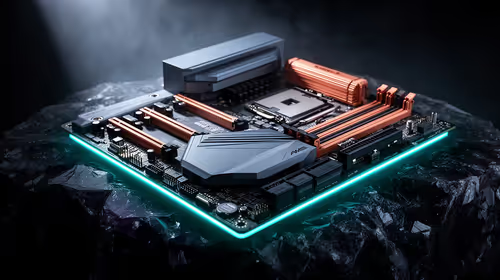
AM5 gives Randburg gaming builders a longer upgrade path. For SA buyers, DDR5 support, newer board features, and future CPU options can justify the platform. Weigh board cost, cooler support, BIOS maturity, and upgrade timing before choosing.
Read more
RTX 5090 on a 550W PSU leaves almost no practical room for OC plans. Treat the setup as constrained, with CPU draw, power spikes, cable quality, thermals, and stability checks more important than chasing extra clocks.
FPS drops on a Ryzen 9 9950X3D build often have a fixable cause. Check settings, drivers, thermals, background tasks, network conditions, and bottlenecks before assuming a part must be replaced.

The difference between PCIe 5.0 and PCIe 4.0 for SA gamers is mostly bandwidth headroom. Compare GPU slot needs, NVMe speed, motherboard support, and upgrade timing before paying extra for a newer platform.

Gaming PC stuck pixel checks in South Africa should confirm the monitor fault first. Use colour tests, screenshot comparison, cable swaps, display menu checks, and clear photos before deciding on support.

AMD's current driver now lists a Radeon RX 9050 4GB, while product coverage details a narrowed memory system. SA buyers should weigh the low VRAM ceiling against current local Radeon options.

Samsung Display has demonstrated a 16-inch 2.5K OLED laptop panel running at 300Hz. SA buyers should wait for a named notebook, full panel specifications and a local price before planning an upgrade.

Microsoft says some Windows 11 game crashes after recent updates are linked to RGB-related drivers. Affected SA gamers should confirm the update and driver before using the published registry workaround.
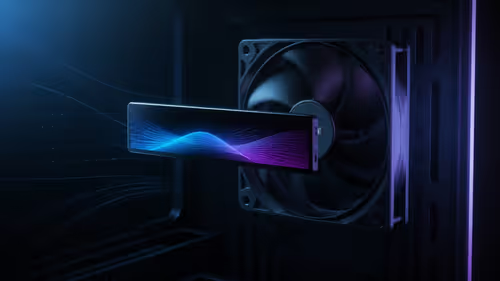
Thermalright's Fan Frame Vision-1 adds a 640x172 status screen to a standard 120mm fan. SA builders should check clearance, USB routing and local support before treating it as an easy upgrade.

Shokz OpenFit Air 2 earbuds weigh 7.2g each and use a redesigned dual-driver open-ear layout. SA buyers should choose them for comfort and awareness, not maximum isolation.

A fake 113GB GTA VI ISO reportedly used empty padding around a small malware payload. SA gamers should delete unofficial builds, keep Windows security active and wait for official channels.
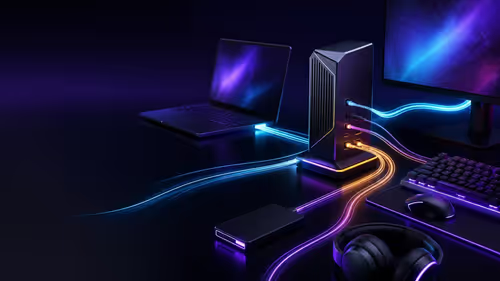
The ROG Flux Charger Dock combines 260W total output, 140W laptop charging and HDMI 2.1. SA buyers should check laptop USB-C limits, display needs and local warranty first.

ASRock's Rock 360 Digital AIO adds a 1.05-inch CPU temperature display, 360mm radiator and simplified wiring. SA builders should check case fit, socket support and local warranty.