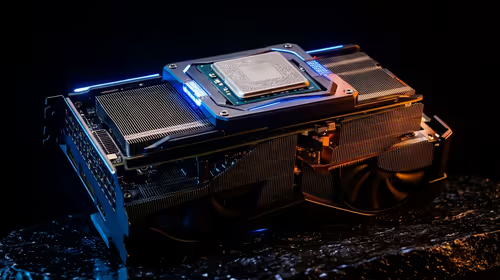
Fans spinning, lights on, and a completely blank screen is the classic eGPU enclosure fault: the box clearly has power, but no picture is reaching your monitor. That split between power and display is actually good news, because it narrows the problem down. Power and the data link are two separate things. If the enclosure powers up but shows nothing, the break is almost always in the PCIe data connection between host and card, or in the display path itself, not in the power supply.
Quick Answer
When an eGPU powers on but gives no display, the GPU has power but the PCIe data link or the display cable has failed. Work through it in order: reseat the graphics card in the enclosure, reseat the host cable at both ends, then check the monitor lead. Isolating one link at a time finds the fault without guesswork.
Reseat the graphics card first
Open the enclosure and check that the GPU is fully seated in its PCIe slot, pushed down until the latch clicks, and that its own power connectors are firmly attached. A card that has worked loose in transit or during installation will spin its fans on enclosure power yet never establish the data link. Remove it, reseat it squarely, reconnect the power leads, and try again before touching anything else.
Check the host connection
The cable between the enclosure and your computer carries the PCIe data, and it is a common failure point. Reseat it firmly at both the enclosure and the host end, and if you have a spare known-good cable, swap it in, since a marginal cable can deliver power while failing the high-speed data link. Plug the enclosure directly into the host port rather than through a hub or adapter, and disconnect other devices on the same bus so nothing else competes for the connection. A solid, certified cable and a direct connection rule out the most frequent culprit. The docking station and connectivity range at Evetech covers the cables and adapters that keep these links reliable.
Isolate the display path
If the link looks healthy but the screen is still blank, move to the monitor side. Plug the display cable into the eGPU's own output, not the laptop's built-in port, and use a direct HDMI or DisplayPort lead rather than a dongle or video adapter, which often break eGPU output. Try a different cable and a different output on the card. Confirm the monitor is set to the correct input. These small checks catch a surprising share of no-display cases.
When it is firmware or settings
If reseating everything fails, the issue may be in the host's settings rather than the hardware. On many systems the connection type needs to be enabled and its security set to allow the device, and an out-of-date controller firmware or GPU driver can leave the card visible to power but not initialised for display. Updating the GPU driver and the host's connection firmware resolves a number of stubborn cases. If the enclosure still shows nothing after all of this, test the GPU in another machine to confirm the card itself is alive. When you are sourcing a replacement card to rule the GPU out, the top-selling graphics cards at Evetech are a quick reference for current models.
Frequently Asked Questions
Why do my eGPU fans spin but I get no picture?
Fans run on the enclosure's power, which is working. A blank screen means the PCIe data link or the display path has failed, not the power supply. Reseat the card, the host cable, and the monitor lead in turn.
Should I plug my monitor into the eGPU or the laptop?
Into the eGPU's own output for full performance and to rule out a display-routing problem. Use a direct HDMI or DisplayPort cable rather than an adapter, which can stop the output working.
Can a bad cable cause an eGPU to show no display?
Yes. A marginal host cable can carry power while failing the high-speed data link, leaving the GPU powered but with no picture. Reseat it at both ends and try a known-good, certified cable.
How do I know if the problem is the GPU or the enclosure?
Test the graphics card in a normal desktop. If it works there, the card is fine and the fault is in the enclosure, cable, host settings or firmware. If it fails there too, the card itself is the issue.