Quick Answer
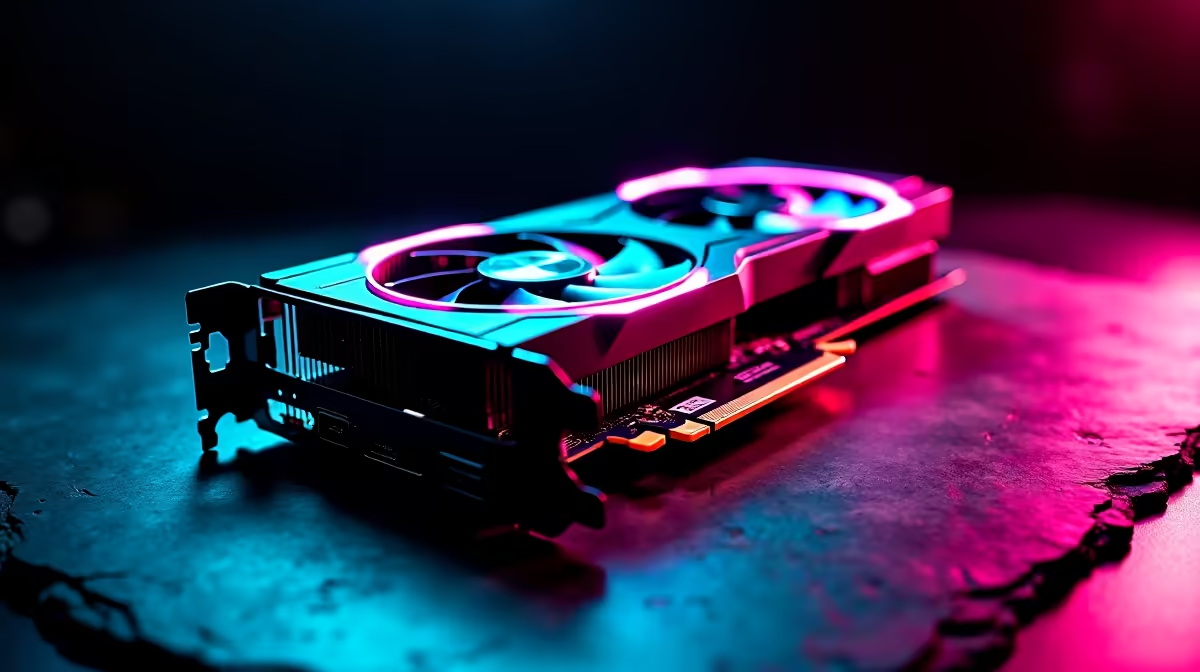
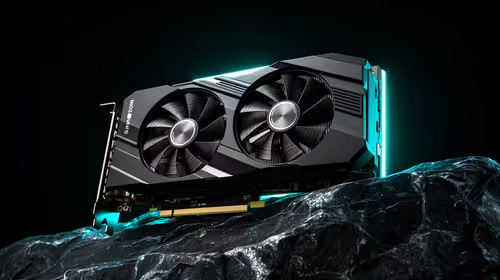
The RX 7800 XT is AMD's strongest mid-range RDNA 3 GPU, designed to excel at 1440p gaming. To maximize its performance, combine smart driver settings, FSR 3 adoption, and proper cooling management for consistent peak framerates. South African gamers can squeeze even more value from this card by optimizing for their specific monitor and titles.
Driver Settings and Software Optimization
AMD Adrenalin software gives RX 7800 XT owners direct access to performance-critical settings that most users leave at default. Start by enabling Radeon Boost for supported titles, which dynamically reduces render resolution during fast motion where detail loss is imperceptible, and scales back up during static moments. This can add 15 to 20% effective framerate in compatible games. Set your Radeon Anti-Lag or Anti-Lag+ to enabled in the global settings or per-game profiles. This reduces input latency by synchronizing CPU game engine work with GPU rendering, which translates to a more responsive feel even at the same FPS number. For competitive games like Valorant, Apex Legends, or CS2, this is a meaningful improvement. Turn on AMD AFMF (AMD Fluid Motion Frames) at the driver level for titles that do not natively support FSR 3 Frame Generation. This driver-level frame generation works across a wide range of games and can dramatically boost perceived smoothness, though it works best above a 60 FPS base. Make sure your RX 7800 XT driver is current since AMD has continued improving AFMF stability with each Adrenalin release. In the Tuning section of Adrenalin, consider enabling Rage Mode with one click, which gives the GPU a mild automatic overclock within safe thermal limits. On a well-cooled card this adds a few percent performance with no user tinkering required. ## Thermal Management and Power Delivery
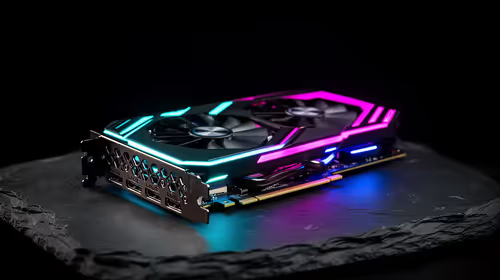
The RX 7800 XT runs hot under sustained load, with reference cards often hitting 85 to 90 degrees Celsius on the junction temperature. This is within AMD's spec but throttling can occur if airflow in your case is poor. For South African gamers, case temperatures can be higher than benchmarks suggest because ambient room temperatures are often warmer, especially during summer in Gauteng or KwaZulu-Natal. Improve airflow by ensuring your case has at least two intake fans at the front or bottom and one exhaust at the rear. If your case allows, add a top exhaust fan. Clean GPU fans and heatsink fins every three to six months, more frequently if you are in a dusty environment. For gamers in areas with heavy loadshedding, dust accumulation when the system is off and then rapid spin-up when power returns can accelerate buildup. If you have an aftermarket RX 7800 XT with triple-fan cooling, you have more headroom for manual fan curves. Use Adrenalin's manual fan control to set a more aggressive ramp starting at 65 degrees, which keeps temperatures in the 75 to 80 degree range and prevents thermal throttling during extended gaming sessions. For power, the RX 7800 XT draws up to 263W TDP. Ensure your PSU is 750W or above with an 80 Plus Gold rating for stable delivery. During loadshedding recovery when power returns, voltage can spike briefly. A quality surge protector or UPS with AVR (automatic voltage regulation) protects your GPU from these spikes, which are a genuine hardware risk in the SA power environment. ## Resolution, Upscaling, and Display Sync
The RX 7800 XT is built for 1440p, and this is where you get the best price-to-performance ratio. At native 1440p, it handles the majority of 2025 AAA titles at high to ultra settings with 60 to 100+ FPS depending on the game. For games that push it harder, FSR 3 Quality mode at 1440p (rendering at roughly 960p and upscaling to 1440p) is visually near-indistinguishable from native while adding 30 to 50% framerate headroom. Enable FreeSync if your monitor supports it. The RX 7800 XT pairs excellently with FreeSync Premium monitors, eliminating screen tearing without the fixed VSync latency penalty. Most quality 1440p monitors in South Africa at the R5,000 to R8,000 price bracket include FreeSync Premium support. If you are gaming at 1080p instead, the RX 7800 XT is overkill for most scenarios but still useful as a future-proofing investment when you eventually move to 1440p. ## Game-Specific Tuning for Maximum FPS
Different game engines respond differently to RX 7800 XT settings. For DX12 and Vulkan titles, the RX 7800 XT tends to perform at its best since RDNA 3 was designed with these APIs in mind. Older DX11 titles may not show the same gains from GPU optimizations, so focus those improvements on the CPU and in-game settings. For open-world games like Cyberpunk 2077 and The Witcher 4, shadows and ambient occlusion are the biggest framerate killers. Drop these from ultra to high and gain 15 to 25% more FPS with minimal visual difference. Volumetric fog quality is another setting where ultra adds significant GPU load for a subtle visual return. Screen space reflections at high rather than ultra is another smart tradeoff. For esports titles, disable all unnecessary post-processing, set textures to medium or high rather than ultra, and prioritize raw framerate over visual polish. The RX 7800 XT will deliver well above 144 FPS in virtually all esports titles at these settings, which is the goalpost for high-refresh-rate competitive gaming. ## Frequently Asked Questions
What is the best in-game upscaling setting for the RX 7800 XT?
FSR 3 Quality mode at 1440p strikes the best balance between image quality and performance gain. Balanced mode is suitable for titles where you want more headroom without noticeable sharpness loss. Does the RX 7800 XT support ray tracing well?
The RX 7800 XT handles ray tracing in supported titles but the performance hit is significant in RT-heavy games. Enable FSR 3 alongside ray tracing to recover framerate if you want both features active. Is 16GB VRAM on the RX 7800 XT useful?
Yes, especially for 1440p texture-heavy games and future titles. The 16GB VRAM buffer means the RX 7800 XT is not VRAM-constrained in any current or near-future title, which is a genuine long-term advantage over 8GB competitors. Should I use Rage Mode for everyday gaming?
Rage Mode is safe to use daily on a well-cooled system. It applies within AMD's thermal and power limits and adds a few percent performance at no cost. Just ensure your case airflow is adequate before enabling it.