Smooth reclining depends on understanding the exact chair, not on copying a generic routine from a feature name. To use a gravity-sensing chair mechanism, identify its controls, read the applicable guidance and create safe clearance before leaning back. For angle context, the R7,399 E3 Air reaches a 140-degree maximum recline.
Quick Answer
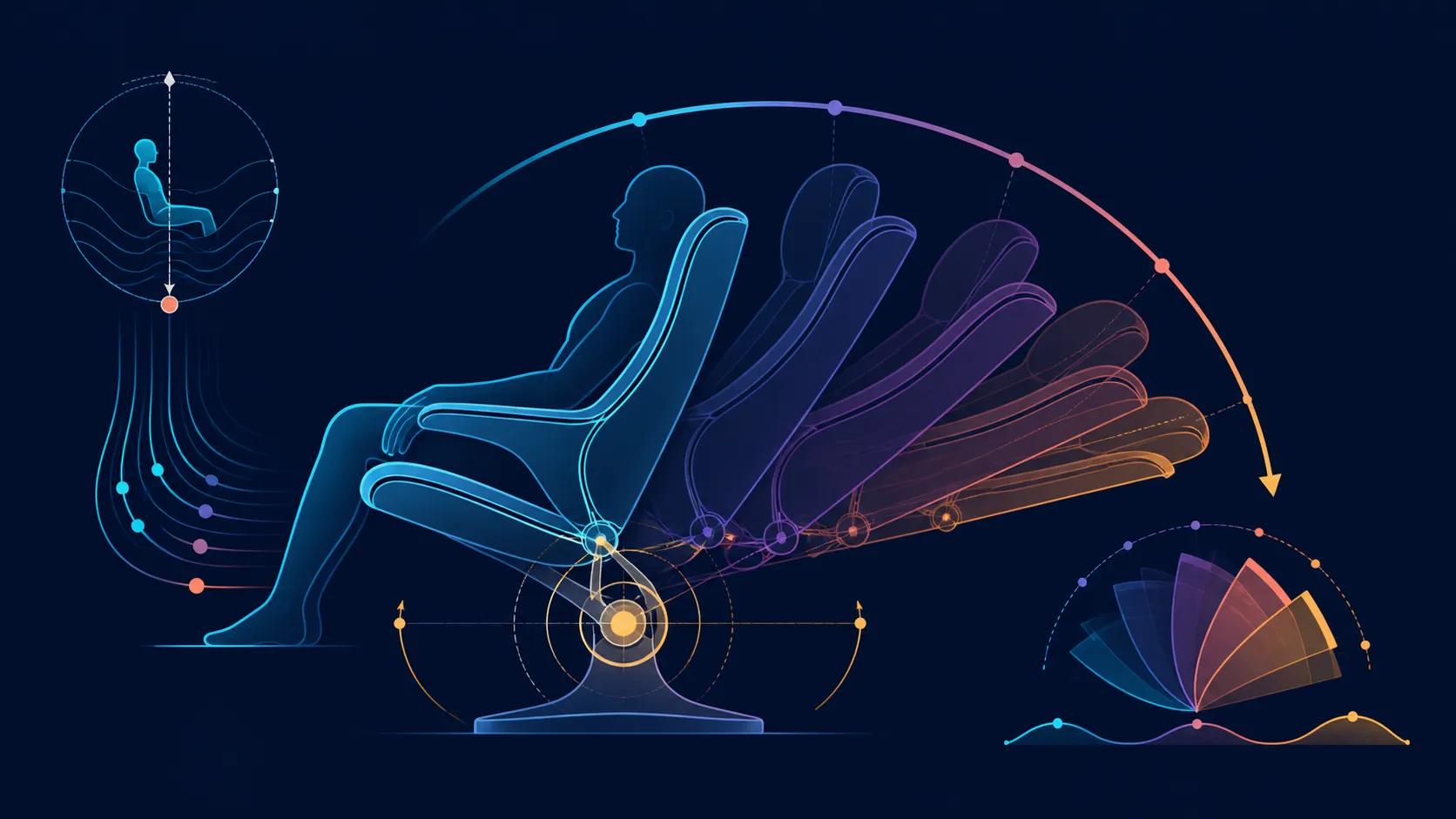
The E3 Air uses defined 105-115, 115-125 and 140-degree recline positions with synchronised support, not an automatic gravity-sensing chassis.
Learn the controls and operating instructions for the specific gravity-sensing chair, clear the movement area and test it slowly before normal use. Keep that mechanism separate from the R7,399 E3 Air, which reaches a 140-degree maximum. Compare the endpoint with control behaviour as two different questions.
🎛️ Learn the actual control path
Find the chair's own guidance before applying body weight to a new mechanism. Identify how recline begins, how it returns and what stops or settings are available. A general label cannot tell the user which lever, resistance or lock behaviour applies.
Perform the first movement in open space. Keep feet secure, move gradually and stop if the control response is unclear. Another model's sequence may look familiar yet operate differently, so avoid relying on memory from a previous chair.
Use the HBADA office-chair selection at Evetech to compare models only after mechanism questions have been separated from maximum-angle questions.
📐 Use the E3 Air only for angle context
The E3 Air reaches a 140-degree recline endpoint, giving the buyer an angle reference within a R7,399 chair. Test gravity sensing, tension, intermediate locks and the operating sequence only on the candidate that claims that mechanism.
At a changed angle, assess the three-zone lumbar contact and the 4D dual-axis headrest again. Its lumbar design covers 80 degrees through auto-wrap support, but no active movement through recline should be inferred.
🛑 Check space, task and recovery
Make sure the backrest, steel five-star base and user's limbs remain clear of furniture and cables. The E3 Air has a 150kg maximum user weight, yet that rating does not reveal external dimensions or the clearance a mechanism needs.
Name the activity before choosing a reclined position. Reading or listening may work with the inputs farther away, while sustained typing usually requires a different relationship. Confirm that the upright desk state can be restored without rebuilding the whole setup.
Browse the broader Evetech office-chair range with a mechanism checklist rather than assuming a named feature. Safe smooth use comes from learning the exact controls and testing them in the actual room.
Keep separate notes for the gravity-sensing candidate and the E3 Air angle reference. Columns for starting control, movement response, intended activity and return sequence prevent one chair's behaviour from being assigned to the other. Repeat a movement only after the user can explain what the completed action did. Predictable control matters more than reaching an endpoint quickly, and a second successful return to the working position is stronger evidence than one promising attempt.
A housemate should learn the same sequence independently if both people will use that mechanism. Compare whether each person can return upright without coaching before calling the operating routine repeatable.
A buyer specifically requiring automatic weight response needs another model. On the E3 Air, evaluate the zero-gap focus range, adaptive middle band and zero-gravity cradle directly, along with how the lumbar and arm systems follow the chair's motion.
Its 4D arms and Auto-Wrap lumbar are synchronised with motion, but that is different from sensing body weight automatically.
Frequently Asked Questions
What should determine gravity-sensing recline use?
The chair's own controls, instructions and safety guidance should lead the process. A category term does not provide a universal sequence or guarantee smooth operation.
How does the E3 Air enter this comparison?
It provides a 140-degree maximum-angle reference at R7,399. Keep that endpoint separate from the gravity-sensing mechanism being evaluated on another chair.
What does a maximum recline figure reveal?
It identifies an endpoint. It does not explain resistance, locking positions, control location or the route the backrest takes to reach that angle.
Which upper support can change with angle?
The E3 Air has a 4D dual-axis headrest. Reassess its contact if the viewing direction changes, while avoiding assumptions about exact movement ranges.
What lower-back design accompanies the chair?
Three lumbar zones use 80-degree auto-wrap coverage. This describes support area without proving how the mechanism behaves during reclining.
What foundation and capacity apply?
Five steel spokes make up the model's base, while user weight is capped at 150kg. Neither fact substitutes for learning recline operation or measuring space.
Ready to compare recline controls without confusing them with angle?
Explore Evetech office seating with mechanism questions, clearance and intended activities listed separately.