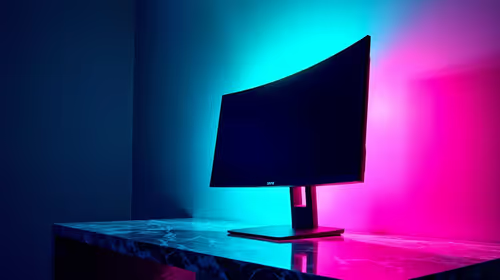
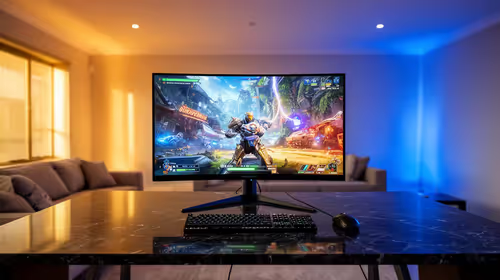
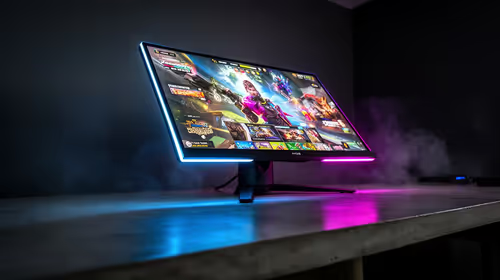
A 1ms badge is useful only when you know which delay it describes. 1ms GTG response time for FPS games refers to a grey-to-grey pixel transition, not the entire journey from mouse click to changed image. The Alienware AW2726DL lists 1ms GTG alongside a 280Hz IPS panel, giving its R4,499 QHD package the right ingredients for crisp competitive movement.
Quick Answer
Yes, 1ms GTG is worthwhile when it comes with clean overdrive behaviour and a high refresh rate your PC can feed. It can reduce visible trailing between frames, but it does not equal total input lag or guarantee every transition occurs in 1ms. At R4,499, the AW2726DL supports the claim with 280Hz, FreeSync Premium and native 2560x1440.
🧪 Know what GTG measures
Pixels create a moving image by changing between colour values. Grey-to-grey testing times selected transitions between those levels. Manufacturers can derive a headline from a fast transition or response mode, while other changes may take longer. That is why the number should open a motion evaluation rather than end it.
Refresh cadence is separate. At 280Hz, the display begins a new refresh roughly every 3.57ms. Pixels need to settle quickly enough that the next image does not carry a visible remnant of the previous one. The AW2726DL's 1ms GTG specification fits that objective on paper.
Compare high-speed options through the gaming monitor range, then look beyond the smallest response label.
👻 Check for blur and overshoot
Overdrive applies extra voltage to accelerate transitions. Too little can leave soft trails; too much can create bright or dark inverse ghosts. The fastest named mode is therefore not always the clearest one.
Motion clarity also changes with the colours involved. A dark opponent crossing a bright wall may expose a different weakness from pale text moving over charcoal UI. Use several contrast pairs instead of one test animation, and keep the camera speed repeatable. A setting that handles both light and dark transitions cleanly is more valuable than one spectacular result in a narrow test.
Use a repeatable game scene with fence posts, text or dark shapes against a light background. Pan at a consistent speed and compare response modes at high and middle frame rates. Select the setting that preserves edges without producing halos.
FreeSync Premium changes refresh timing as frame rate moves, so test overdrive away from the 280Hz ceiling too. The PC monitor deals shelf can help compare models where the same 1ms phrase may hide different real motion behaviour.
🎯 Place response in the full latency chain
Mouse polling, game simulation, processor work, GPU rendering, queueing, display scanout and pixel transitions all add time. Improving one stage helps, but a frame-time spike can overwhelm the fraction saved at the panel.
For FPS play, hold graphics settings at a level that delivers consistent frames in real fights. Confirm Windows is using 280Hz, keep sync and the frame cap deliberate, and avoid unnecessary picture processing. Those actions give the 1ms GTG hardware a cleaner stream to display.
Separate aiming feel from visual evidence. A lower setting can feel more immediate simply because it raises frame rate, while the panel response has not changed. Run the same route at a fixed cap when comparing overdrive modes, then unlock performance only after selecting the cleanest transition behaviour. This order prevents two improvements from being credited to one control.
Comfort still matters in a long session. Use height and tilt so the centre of action sits within a relaxed gaze, then align swivel with your shoulders. Reduced neck movement makes fast eye tracking easier to sustain, which can matter more over an evening than a tiny laboratory difference between response modes.
The AW2726DL also brings IPS viewing consistency, HDR10 and 93% DCI-P3, so it is not limited to esports. Browse the monitor best-sellers page to weigh motion against the screen qualities you use outside a match.
Frequently Asked Questions
Is 1ms GTG the same as a 1ms click response?
No. GTG covers a pixel transition measurement, while click-to-photon response includes the mouse, game, CPU, GPU and display pipeline.
Can overdrive make a 1ms mode look worse?
Yes. Excessive acceleration can cause inverse ghosting, so a slightly slower mode may produce cleaner edges during real play.
Does 280Hz require 1ms pixels?
Fast transitions help a high-refresh image remain distinct, but the labels use different measurements. Evaluate cadence, response and frame delivery together.
Ready to judge response time by the moving image rather than one millisecond label?
Compare Evetech's fast gaming monitors, test the complete motion chain, and keep the response mode that leaves the cleanest edge behind.