


1000W PSU Planning for RTX 5090 Builds in SA
1000W for RTX 5090 needs a full-build check, not a simple yes. Review GPU guidance, CPU draw, transient load, connectors, PSU quality, and upgrade plans before deciding.
Read moreA sensor mounted near the centre of a mouse's shell reduces rotational tracking error, since off-centre placement can misread motion slightly during wide swipes and flicks. Evetech points buyers toward this detail when shape and sensor specs otherwise look identical.
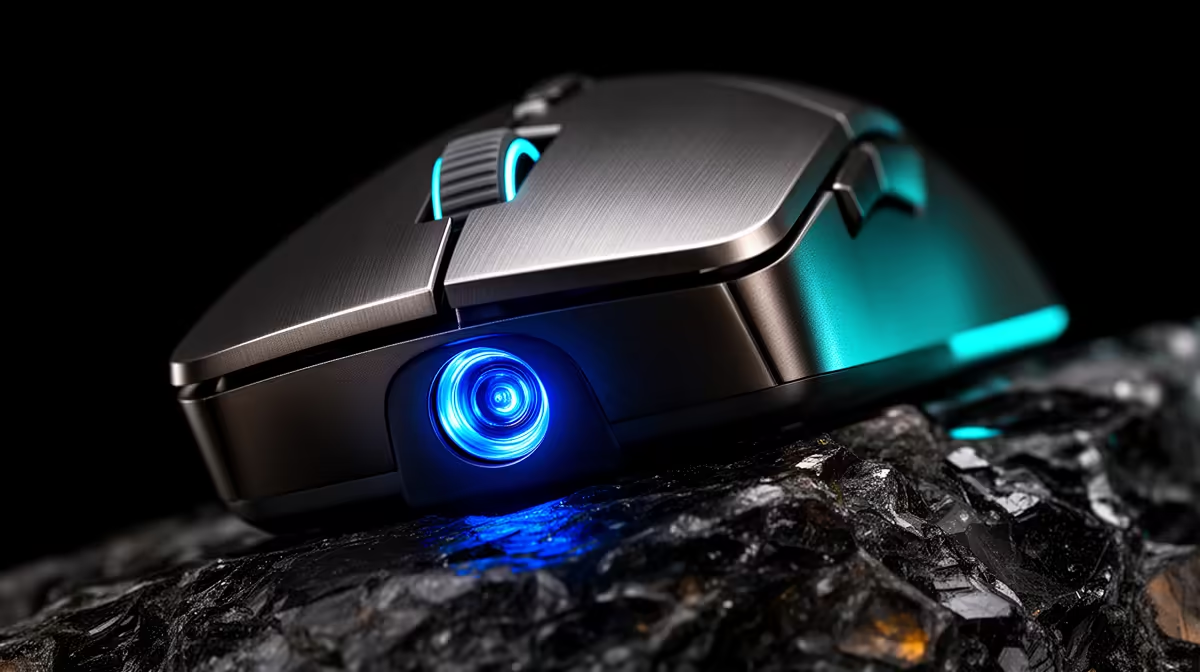
Rotating a mouse around your wrist makes a sensor near the front or rear travel through a different arc. Mouse sensor placement therefore changes how a familiar hand movement feels without making one position universally accurate.
Sensor position changes how a mouse reports rotation around your wrist or fingers. A sensor closer to the front travels a larger arc during the same pivot; one farther back travels a smaller arc. This is a geometry and feel difference, not a tracking error or proof that centre placement is better. Shape, grip and where you pivot decide which position feels natural.
Browse gaming mouse deals with shell length and grip in mind. Cross-check the candidates against best-selling mice, then find a reliable base photo or maker diagram when sensor position is omitted.
Slide two mice straight and sensor position changes little when their real DPI matches. Rotate them around the same wrist point and each sensor follows a different-radius arc.
A forward sensor can feel more sensitive to finger or wrist rotation. A rearward sensor can feel calmer. Neither is inherently more accurate; the sensor still reports its real movement.
Palm, claw and fingertip users can pivot around different parts of the hand. Mouse length and how far you hold it forward shift the relationship again.
Mark the sensor position under two unplugged mice, then place your normal grip on each. This gives you a better picture than comparing position relative to the shell alone.
Shape and comfort deserve priority. A perfectly centred sensor in a shell that twists your wrist will not become the better gaming mouse.
Use the same pad, effective DPI and familiar game. Draw slow straight lines, make small wrist corrections and perform wide arm swipes. Record overshoot, comfort and whether repositioning causes unwanted movement.
Give the new position several sessions. Initial difference can disappear as your hand adapts. Adjust sensitivity only after deciding that the geometry remains uncomfortable.
Software cannot fully move a physical sensor. Angle correction or rotation features change coordinate interpretation and should be used only through supported tools with a clear need.
With the mouse unplugged, measure from the rear or another repeatable base edge to the sensor centre. Record overall shell length too. A raw millimetre position becomes more useful when expressed against the mouse you already know.
Compare where your thumb, palm and wrist sit. Two sensors at the same shell percentage can feel different when one mouse fills the palm and the other is held by fingertips.
Keep skate thickness and sensor ring unchanged during the test. A tilted or rocking base introduces a separate tracking issue that placement cannot explain.
When switching, give your hand several days before changing acceleration, angle or sensitivity. Adaptation can resolve the unfamiliar rotational scale.
It changes rotational motion relative to your pivot. That is predictable geometry rather than the sensor misreading movement.
No. Grip, shell size and pivot determine feel. Comfort and stable tracking matter more than a centre badge.
Software can transform coordinates in some products, but it cannot change the physical arc the sensor travels around your hand.
Map the sensor against your real grip, test straight and rotational movements at matched sensitivity, and choose the shell that stays comfortable and predictable.
It changes rotational motion relative to your pivot. That is predictable geometry rather than the sensor misreading movement.
No. Grip, shell size and pivot determine feel. Comfort and stable tracking matter more than a centre badge.
Software can transform coordinates in some products, but it cannot change the physical arc the sensor travels around your hand.
1000W for RTX 5090 needs a full-build check, not a simple yes. Review GPU guidance, CPU draw, transient load, connectors, PSU quality, and upgrade plans before deciding.
Read more
RTX 5080 Super with a 750W PSU is more comfortable than lower wattage if the unit is quality. SA builders should still confirm GPU guidance, CPU draw, connector type, airflow, and upgrade room.
Read more
How to fix FPS drops after a RX 9070 XT starts with driver cleanup, chipset updates, thermals, and power checks. For SA gaming PCs, confirm PCIe seating, monitor refresh, frame caps, and per-game graphics settings before replacing parts.
Read more
How to fix low FPS Windows 11 Wi-Fi 7 issues starts by checking whether the problem is frame rate or network lag. Test ping, drivers, power settings, Ethernet, and game FPS before adjusting visuals.
Read more
AM5 is smart for SA builders because it supports newer Ryzen CPUs, DDR5 memory, and a longer upgrade path. Compare board cost, cooling, gaming needs, and local part availability before choosing your next PC platform.
Read more
AM5 gives Randburg gaming builders a longer upgrade path. For SA buyers, DDR5 support, newer board features, and future CPU options can justify the platform. Weigh board cost, cooler support, BIOS maturity, and upgrade timing before choosing.
Read more
RTX 5090 on a 550W PSU leaves almost no practical room for OC plans. Treat the setup as constrained, with CPU draw, power spikes, cable quality, thermals, and stability checks more important than chasing extra clocks.
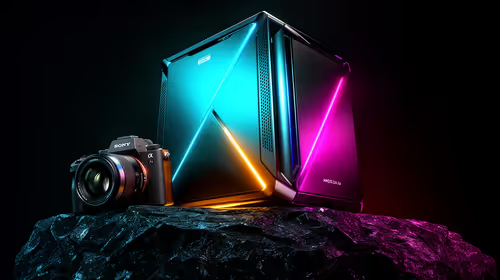
FPS drops on a Ryzen 9 9950X3D build often have a fixable cause. Check settings, drivers, thermals, background tasks, network conditions, and bottlenecks before assuming a part must be replaced.

The difference between PCIe 5.0 and PCIe 4.0 for SA gamers is mostly bandwidth headroom. Compare GPU slot needs, NVMe speed, motherboard support, and upgrade timing before paying extra for a newer platform.

Gaming PC stuck pixel checks in South Africa should confirm the monitor fault first. Use colour tests, screenshot comparison, cable swaps, display menu checks, and clear photos before deciding on support.

AMD's current driver now lists a Radeon RX 9050 4GB, while product coverage details a narrowed memory system. SA buyers should weigh the low VRAM ceiling against current local Radeon options.

Samsung Display has demonstrated a 16-inch 2.5K OLED laptop panel running at 300Hz. SA buyers should wait for a named notebook, full panel specifications and a local price before planning an upgrade.

Microsoft says some Windows 11 game crashes after recent updates are linked to RGB-related drivers. Affected SA gamers should confirm the update and driver before using the published registry workaround.
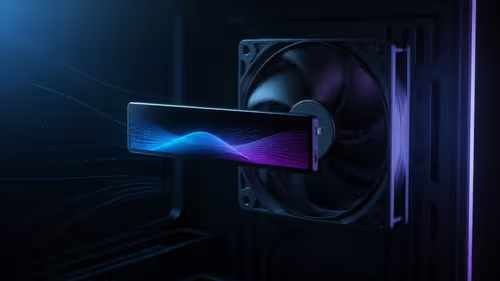
Thermalright's Fan Frame Vision-1 adds a 640x172 status screen to a standard 120mm fan. SA builders should check clearance, USB routing and local support before treating it as an easy upgrade.
1000W for RTX 5090 needs a full-build check, not a simple yes. Review GPU guidance, CPU draw, transient load, connectors, PSU quality, and upgrade plans before deciding.
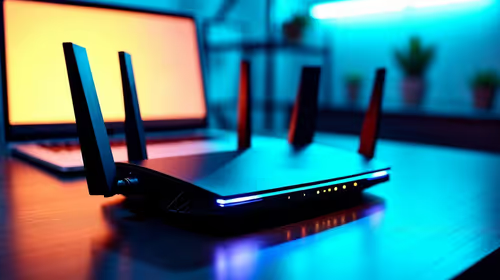
Wi-Fi 6E vs Wi-Fi 6 matters for 4K video editing when files move across a network. The real-world difference between Wi-Fi 6E and Wi-Fi 6 for video editing in 4K depends on NAS access, cloud uploads, router range, and SA creator workflows.
RTX 5080 Super with a 750W PSU is more comfortable than lower wattage if the unit is quality. SA builders should still confirm GPU guidance, CPU draw, connector type, airflow, and upgrade room.
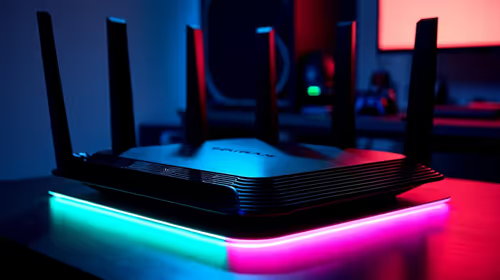
Wi-Fi 6E vs Wi-Fi 6 for Video Editing in 4K comes down to router support, latency, client devices, band support, and home network layout. SA buyers should match the choice to their setup instead of assuming one option always wins.