


1000W PSU Planning for RTX 5090 Builds in SA
1000W for RTX 5090 needs a full-build check, not a simple yes. Review GPU guidance, CPU draw, transient load, connectors, PSU quality, and upgrade plans before deciding.
Read moreWhen a NAS storage pool crashes, do not click Repair or Rebuild - writing to surviving drives at this stage can overwrite the parity data needed for recovery and turn a recoverable situation into permanent data loss.
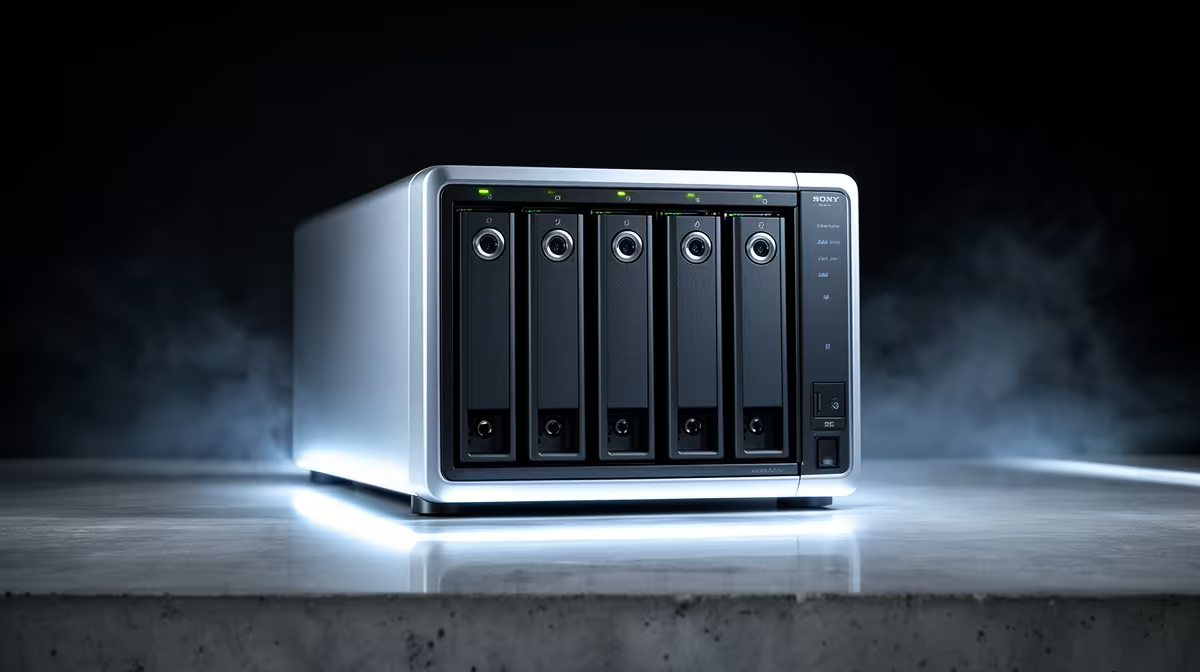
The most expensive mistake you can make with a sick NAS is the instinctive one: seeing a red "Crashed" status and immediately clicking Repair or Rebuild. With a crashed storage pool, that single click can write over the very parity data a recovery would have needed, turning a salvageable situation into permanent loss. Stop, breathe, and read the status carefully before you touch anything.
If your NAS reports the storage pool as crashed, do not click Repair or Rebuild yet. A crashed pool means the array is already inactive, and forcing a repair can overwrite parity and finish off your data. Power down, note which drives failed, get the important data copied off first, and only then consider repair or professional recovery.
This distinction decides everything. A degraded pool has lost one drive but is still online and readable, because the remaining drives plus parity can reconstruct the missing data. Degraded is the state where Repair is the correct, intended action: you swap the bad drive and rebuild from parity.
A crashed pool is past that point. It usually means a second drive started failing during normal use or a scrub, and a single-parity array cannot survive two faulty members. The system marks the array inactive and reports the pool as crashed. At that stage the friendly Repair button no longer does what its label implies, and hammering it can do harm.
When a pool crashes, your remaining good data is still sitting on the surviving drives, held together by parity relationships. Any write to those drives, including a rebuild attempt, changes that delicate state. If the rebuild assumes a drive is healthy when it is marginal, the process can scramble parity across the array and overwrite the exact blocks a recovery tool would have read.
There is a second trap. Rebuilds put heavy, sustained load on the surviving drives for hours. If those drives are already tired (which is common when one has just died), the strain can push a marginal drive over the edge mid-rebuild, taking the rest of the pool with it. So the safe order is always: secure the data, then repair, never the reverse.
Power the NAS down to stop any background activity, then check which bays show faults so you know how many drives are genuinely bad. If the data is irreplaceable, your priority is getting a copy off the array before any write happens, ideally by imaging the drives or using a recovery workflow rather than the built-in Repair. Keep a spare drive ready so you are not tempted to reuse a suspect one, and you can size up a fresh diskless NAS or replacement unit at Evetech if the chassis itself is suspect. A fast SSD from the bestsellers shelf is also worth having on hand for staging the rescued files off the array.
If two or more drives have hard-failed and the data matters, this is the moment to involve professional recovery rather than experimenting. Only once the data is safe, or you have accepted the loss, should you rebuild the pool from scratch.
No, not as a first move. A rebuild writes to the surviving drives and can overwrite parity needed for recovery, and it stresses tired drives that may then fail. Copy the data off first, then rebuild.
Repair and Rebuild both attempt to restore redundancy by writing reconstructed data to the array. They are appropriate for a degraded pool that is still online, but on a crashed (inactive) pool they can do more harm than good.
The NAS status tells you. Degraded usually shows a warning state with the pool still accessible, while crashed marks the pool inactive and unreadable. Repair is intended only for the degraded state.
Yes, keep them exactly as they are. A recovery process may need to read from a partially failed drive, so do not wipe, reformat or reuse it until your data is safely off the array.
Protecting data on a NAS that just threw a crash warning? Browse NAS units, surveillance-grade drives and staging SSDs in the storage range at Evetech and build in the redundancy that gives you room to recover next time.
No, not as a first move. A rebuild writes to the surviving drives and can overwrite parity needed for recovery, and it stresses tired drives that may then fail. Copy the data off first, then rebuild.
Repair and Rebuild both attempt to restore redundancy by writing reconstructed data to the array. They are appropriate for a degraded pool that is still online, but on a crashed (inactive) pool they can do more harm than good.
The NAS status tells you. Degraded usually shows a warning state with the pool still accessible, while crashed marks the pool inactive and unreadable. Repair is intended only for the degraded state.
Yes, keep them exactly as they are. A recovery process may need to read from a partially failed drive, so do not wipe, reformat or reuse it until your data is safely off the array.
1000W for RTX 5090 needs a full-build check, not a simple yes. Review GPU guidance, CPU draw, transient load, connectors, PSU quality, and upgrade plans before deciding.
Read more
RTX 5080 Super with a 750W PSU is more comfortable than lower wattage if the unit is quality. SA builders should still confirm GPU guidance, CPU draw, connector type, airflow, and upgrade room.
Read more
How to fix FPS drops after a RX 9070 XT starts with driver cleanup, chipset updates, thermals, and power checks. For SA gaming PCs, confirm PCIe seating, monitor refresh, frame caps, and per-game graphics settings before replacing parts.
Read more
How to fix low FPS Windows 11 Wi-Fi 7 issues starts by checking whether the problem is frame rate or network lag. Test ping, drivers, power settings, Ethernet, and game FPS before adjusting visuals.
Read more
AM5 is smart for SA builders because it supports newer Ryzen CPUs, DDR5 memory, and a longer upgrade path. Compare board cost, cooling, gaming needs, and local part availability before choosing your next PC platform.
Read more
AM5 gives Randburg gaming builders a longer upgrade path. For SA buyers, DDR5 support, newer board features, and future CPU options can justify the platform. Weigh board cost, cooler support, BIOS maturity, and upgrade timing before choosing.
Read more
RTX 5090 on a 550W PSU leaves almost no practical room for OC plans. Treat the setup as constrained, with CPU draw, power spikes, cable quality, thermals, and stability checks more important than chasing extra clocks.

FPS drops on a Ryzen 9 9950X3D build often have a fixable cause. Check settings, drivers, thermals, background tasks, network conditions, and bottlenecks before assuming a part must be replaced.

The difference between PCIe 5.0 and PCIe 4.0 for SA gamers is mostly bandwidth headroom. Compare GPU slot needs, NVMe speed, motherboard support, and upgrade timing before paying extra for a newer platform.

Gaming PC stuck pixel checks in South Africa should confirm the monitor fault first. Use colour tests, screenshot comparison, cable swaps, display menu checks, and clear photos before deciding on support.

AMD's current driver now lists a Radeon RX 9050 4GB, while product coverage details a narrowed memory system. SA buyers should weigh the low VRAM ceiling against current local Radeon options.

Samsung Display has demonstrated a 16-inch 2.5K OLED laptop panel running at 300Hz. SA buyers should wait for a named notebook, full panel specifications and a local price before planning an upgrade.

Microsoft says some Windows 11 game crashes after recent updates are linked to RGB-related drivers. Affected SA gamers should confirm the update and driver before using the published registry workaround.
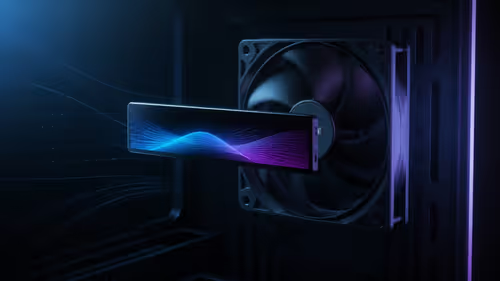
Thermalright's Fan Frame Vision-1 adds a 640x172 status screen to a standard 120mm fan. SA builders should check clearance, USB routing and local support before treating it as an easy upgrade.

Shokz OpenFit Air 2 earbuds weigh 7.2g each and use a redesigned dual-driver open-ear layout. SA buyers should choose them for comfort and awareness, not maximum isolation.

A fake 113GB GTA VI ISO reportedly used empty padding around a small malware payload. SA gamers should delete unofficial builds, keep Windows security active and wait for official channels.

The ROG Flux Charger Dock combines 260W total output, 140W laptop charging and HDMI 2.1. SA buyers should check laptop USB-C limits, display needs and local warranty first.

ASRock's Rock 360 Digital AIO adds a 1.05-inch CPU temperature display, 360mm radiator and simplified wiring. SA builders should check case fit, socket support and local warranty.