Paying more for 120Hz makes sense only when the source, connection and player turn extra updates into a repeated benefit. A 120Hz portable gaming monitor buying guide should place motion beside resolution, response, portability and total cost. This UPERFECT UColor O2 comparison uses its R7,199 price.
Quick Answer
The 120Hz premium is worthwhile when the gaming source can exceed 60 frames and the owner notices smoother motion, scrolling or faster visual feedback.
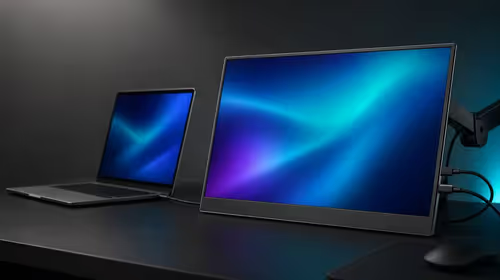
The UColor O2's 120Hz refresh is worth considering when the intended game source can deliver useful frame rates and smoother motion matters to the owner. Its R7,199 price also covers 3K OLED, a 1ms response specification and a 16-inch format. Withhold the value verdict until host compatibility, input feel, room use and travel protection are tested.
🧭 Price the motion benefit
Use one game and compare 60Hz with 120Hz at fixed resolution and settings. Record frame delivery, motion clarity and comfort over a real session. A quick menu impression should not carry the whole premium decision.
If the source remains far below the selected refresh, note that constraint. The panel cannot create missing frames.
Build wider comparisons from Evetech's portable gaming displays after defining the same source test.
🧭 Avoid double-counting 1ms
For panel transitions, the UColor O2 provides a 1ms specification. Refresh frequency has a different role, and complete input latency includes the rest of the gaming system. Give trailing and control response separate scores.
Keep controller, cable and game mode unchanged between candidates so the monitor remains the main variable.
🧭 Include image and connection value
Beyond gaming, the 2880x1800 OLED surface combines 10-bit support with a 500-nit HDR specification. Direct checks still determine gamut, calibration and behaviour under strong room light.
With the exact host, test whether one USB-C lead delivers stable panel power, picture and the selected sound route. Only then should the connection receive a convenience score.
🧭 Score the travel system
At 6.5mm, the monitor is thin, yet no weight or impact result follows. Add the protective sleeve or compartment, cable and required source equipment to the carried setup. When portability is optional, use the Evetech desktop-screen category for fixed gaming comparisons.
The extra cost is justified when the whole mobile arrangement clears more important conditions than the cheaper alternative.
Set a premium ceiling before comparison
Decide how much extra the owner will pay for motion that passes the controlled test. Keep that ceiling separate from OLED, resolution and travel value. If another monitor offers the required 120Hz result but fails the connection or bag test, its lower price does not automatically make it better.
Attach the dated price and complete configuration to each candidate. This prevents later price changes from being mixed with old performance observations.
Run a remove-120Hz exercise
Use the UColor O2 at 60Hz for one normal session, then return to 120Hz without changing graphics quality. Note which actions become easier or more comfortable. If the difference rarely affects play, the buyer can give more weight to 3K workspace, OLED image or travel convenience.
Removing the feature temporarily is often clearer than asking whether a headline sounds worth it. The lost benefit becomes visible in the routine itself.
Compare value after an update
Keep one saved replay and the original source settings. After a graphics driver, game or operating-system update, rerun the 60Hz and 120Hz comparison before changing the monitor profile. This shows whether a new motion result belongs to the source rather than the display.
If the benefit becomes weaker or stronger, update the value score with the new evidence. Do not erase the dated result; the change history is useful for understanding how software affects the premium.
Price the tested cable and protection beside the monitor, because a cheaper headline loses meaning when the working mobile system needs extra pieces.
The UColor O2 pairs its refresh with a 1ms OLED response, reducing a panel-side source of trailing and smearing. Its native 3K resolution may limit frame rate on weaker mobile hardware, so test the actual game at 2880x1800 and at any acceptable lower mode. The extra cost should buy visible fluidity in frequently played titles, not an unused setting left at 60Hz.
Frequently Asked Questions
Does 120Hz guarantee a smoother game?
It raises the display update ceiling, while actual frame delivery and consistency depend on the source and game.
Should 1ms receive a separate value score?
Yes. It addresses panel response, while refresh frequency and end-to-end latency remain distinct.
Can the OLED screen justify the price alone?
Only if its dark-scene, scaling and measured colour behaviour matter to the buyer's repeated use.
What belongs in the complete travel cost?
Include the tested cable, protection and source equipment required by the actual mobile routine.
Ready to decide whether 120Hz earns its premium?
Compare Evetech portable and desktop gaming monitors with one fixed game, source and connection path.