The RX 9070 XT earns its value label by spending silicon on visible 1440p performance rather than asking buyers to pay primarily for a feature ecosystem. Its 16GB memory pool and RDNA 4 design make it a strong long-term raster card, but the answer changes if ray tracing quality or creator software is the priority.
Quick Answer
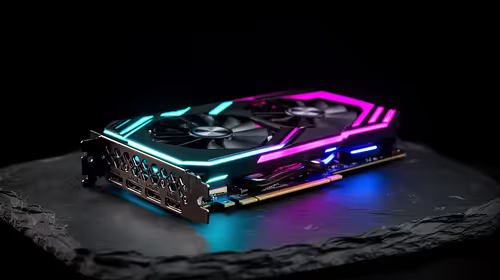
The RX 9070 XT remains a compelling high-refresh 1440p choice in 2026, especially for buyers who value conventional rendering performance and 16GB of VRAM. AMD specifies 64 compute units, 16GB of GDDR6 and FSR support for the card. Evetech's July 2026 graphics-card range had a median price of R13,299, so the 9070 XT should be judged as an enthusiast purchase that needs a fast monitor to repay the premium.
🎮 Where the value appears
Value at this tier is not the cheapest Rand figure. It is the amount of useful performance bought before the price curve becomes steep. The 9070 XT is designed for 1440p with high settings and enough headroom to explore 4K, which makes it more sensible than a flagship for many premium builds.
The 16GB buffer matters because it separates the card from 12GB alternatives when texture packs, large worlds or creator workloads enter the picture. Buyers should compare the full graphics-card range by memory, power and intended resolution rather than by brand loyalty.
✨ The feature trade-off
AMD's FSR and frame-generation tools can raise performance in supported games, while the RDNA 4 ray accelerators improve the weak point of earlier Radeon generations. That does not automatically make every ray-traced title equal across vendors. If a favourite game or production application strongly prefers a particular ecosystem, that software should overrule broad value claims.
The durable decision is workload-first. Pure and lightly ray-traced gaming favours the 9070 XT's memory and raster strengths. A build centred on heavy path tracing or specialised creator acceleration needs a title-by-title check.
🖥️ Match it to a screen that can show the gain
A 1440p 180Hz or 240Hz display gives this class of GPU a reason to exist. A 60Hz panel does not. Before buying, use the GPU best-seller list as a local market check and inspect the Radeon RX 9000 category for the available AMD options.
Case clearance, power supply quality and monitor capability should be treated as part of the GPU cost. The best-value card becomes poor value when another component prevents it from being used.
Frequently Asked Questions
Is the RX 9070 XT good for 1440p gaming?
Yes. High-refresh 1440p is its clearest target, with enough memory and rendering capacity to avoid treating every new game as a settings rescue exercise.
How much VRAM does it have?
AMD specifies 16GB of GDDR6. That capacity is a meaningful ownership advantage for demanding textures and mixed gaming-creator use.
Does it support FSR?
Yes. AMD positions the RX 9000 series around its current FSR gaming technologies and frame-generation features in supported titles.
Should I choose it for ray tracing?
Choose it only after checking the games you play most. Its ray tracing is improved, but software behaviour matters more than a general brand verdict.
Ready to build for high-refresh 1440p rather than a logo?
Compare AMD options in Evetech's graphics-card range and confirm the monitor, case and power supply can turn the purchase into visible performance.