


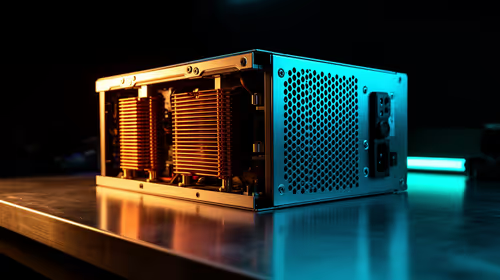
1000W PSU Planning for RTX 5090 Builds in SA
1000W for RTX 5090 needs a full-build check, not a simple yes. Review GPU guidance, CPU draw, transient load, connectors, PSU quality, and upgrade plans before deciding.
Read moreMany modern DirectX 12 and Vulkan games compile shaders the first time your graphics card actually encounters them, causing brief stutter in the opening hour even on strong hardware. Some titles include a precompilation step at launch that reduces this considerably.
The first hour of a new PC game can stutter while shaders are being prepared. Modern graphics APIs give developers more control, and some engines compile a shader when a material, lighting effect or pipeline appears for the first time. A fast GPU cannot display a frame while the CPU is busy building that missing work.
Let any launch-time shader compilation finish. Keep the game and driver on a fast local drive, avoid clearing shader caches as routine maintenance, and replay the same route. Stutter that fades on the second pass points towards compilation or caching; a hitch that repeats in the same place needs a wider diagnosis.
Use the NVIDIA graphics-card catalogue and frequently chosen GPU list when performance remains too low after the cache settles. A new card will not fix an engine that blocks the frame for runtime shader work.
Shader compilation often creates a sharp, isolated frame-time spike when an effect appears. The first explosion, enemy type or weather change hitches, then the same scene runs better after the compiled result enters the cache.
Asset streaming and traversal stutter can look similar. Storage stalls may recur as you cross an area boundary. A CPU limit can create sustained uneven pacing. Use a frame-time graph and repeat one short route before attaching a label.
Driver updates and game patches can invalidate cached work because the shader code or compiler changed. The first session after either may need to rebuild data. Allow the process to finish rather than restarting it several times.
Storage-cleaning tools can erase driver and game shader caches. That may help when a cache is corrupted, but frequent deletion forces recompilation and can bring the stutter back. Treat clearing as a targeted repair.
Keep enough free space on the system and game drive. Do not copy shader-cache folders between unrelated PCs or drivers; the contents can be hardware and version specific.
Some games prepare shaders at launch or after a driver change. Leave the progress screen open until completion. If the game offers a restart after compilation, take it before benchmarking.
Check the game's patch notes when compilation repeats at every launch. That can be a known engine fault, permission issue or cache-path problem. Verify files and ensure the cache folder is writable before reinstalling the whole game.
No guarantee. Compilation can block on CPU and engine work before the GPU receives a frame.
No. The driver manages invalidation, and routine clearing can force more first-run compilation.
Shaders and assets encountered during the first pass may now be cached. Report both cold and warm results when comparing systems.
Finish the game's precompilation, run the same route twice and keep the shader cache intact unless repeatable evidence points to corruption.
No guarantee. Compilation can block on CPU and engine work before the GPU receives a frame.
No. The driver manages invalidation, and routine clearing can force more first-run compilation.
Shaders and assets encountered during the first pass may now be cached. Report both cold and warm results when comparing systems. {{PRODUCTS: { facets: { query: "gaming graphics card for smooth frame times" }, limit: 12, title: "Explore Gaming GPUs", style: "4" } }}
1000W for RTX 5090 needs a full-build check, not a simple yes. Review GPU guidance, CPU draw, transient load, connectors, PSU quality, and upgrade plans before deciding.
Read more
RTX 5080 Super with a 750W PSU is more comfortable than lower wattage if the unit is quality. SA builders should still confirm GPU guidance, CPU draw, connector type, airflow, and upgrade room.
Read more
How to fix FPS drops after a RX 9070 XT starts with driver cleanup, chipset updates, thermals, and power checks. For SA gaming PCs, confirm PCIe seating, monitor refresh, frame caps, and per-game graphics settings before replacing parts.
Read more
How to fix low FPS Windows 11 Wi-Fi 7 issues starts by checking whether the problem is frame rate or network lag. Test ping, drivers, power settings, Ethernet, and game FPS before adjusting visuals.
Read more
AM5 is smart for SA builders because it supports newer Ryzen CPUs, DDR5 memory, and a longer upgrade path. Compare board cost, cooling, gaming needs, and local part availability before choosing your next PC platform.
Read more
AM5 gives Randburg gaming builders a longer upgrade path. For SA buyers, DDR5 support, newer board features, and future CPU options can justify the platform. Weigh board cost, cooler support, BIOS maturity, and upgrade timing before choosing.
Read more
RTX 5090 on a 550W PSU leaves almost no practical room for OC plans. Treat the setup as constrained, with CPU draw, power spikes, cable quality, thermals, and stability checks more important than chasing extra clocks.
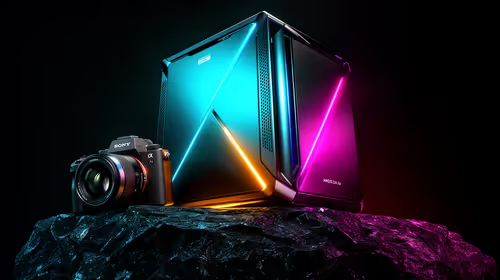
FPS drops on a Ryzen 9 9950X3D build often have a fixable cause. Check settings, drivers, thermals, background tasks, network conditions, and bottlenecks before assuming a part must be replaced.

The difference between PCIe 5.0 and PCIe 4.0 for SA gamers is mostly bandwidth headroom. Compare GPU slot needs, NVMe speed, motherboard support, and upgrade timing before paying extra for a newer platform.

Gaming PC stuck pixel checks in South Africa should confirm the monitor fault first. Use colour tests, screenshot comparison, cable swaps, display menu checks, and clear photos before deciding on support.

AMD's current driver now lists a Radeon RX 9050 4GB, while product coverage details a narrowed memory system. SA buyers should weigh the low VRAM ceiling against current local Radeon options.

Samsung Display has demonstrated a 16-inch 2.5K OLED laptop panel running at 300Hz. SA buyers should wait for a named notebook, full panel specifications and a local price before planning an upgrade.

Microsoft says some Windows 11 game crashes after recent updates are linked to RGB-related drivers. Affected SA gamers should confirm the update and driver before using the published registry workaround.
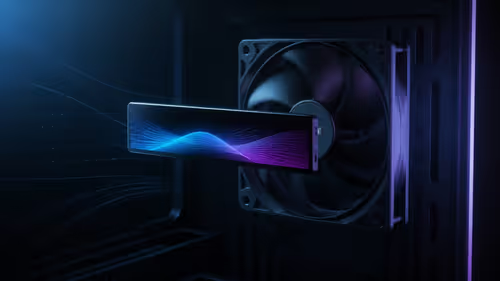
Thermalright's Fan Frame Vision-1 adds a 640x172 status screen to a standard 120mm fan. SA builders should check clearance, USB routing and local support before treating it as an easy upgrade.

Shokz OpenFit Air 2 earbuds weigh 7.2g each and use a redesigned dual-driver open-ear layout. SA buyers should choose them for comfort and awareness, not maximum isolation.

A fake 113GB GTA VI ISO reportedly used empty padding around a small malware payload. SA gamers should delete unofficial builds, keep Windows security active and wait for official channels.

The ROG Flux Charger Dock combines 260W total output, 140W laptop charging and HDMI 2.1. SA buyers should check laptop USB-C limits, display needs and local warranty first.

ASRock's Rock 360 Digital AIO adds a 1.05-inch CPU temperature display, 360mm radiator and simplified wiring. SA builders should check case fit, socket support and local warranty.