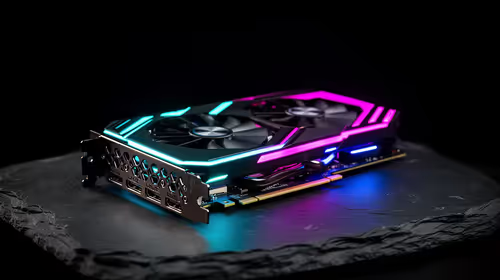
Keeping a capable RTX 40 series card is often the more disciplined upgrade than replacing it with the next number. A new generation can add features and efficiency without changing the experience enough to justify a full purchase. The relevant question is not whether RTX 50 exists; it is whether the current card misses a target you can name.
Quick Answer
Skip the RTX 50 series if an RTX 4070-class or faster 40-series card already meets your resolution and refresh-rate goals. Upgrade when memory capacity, ray-tracing performance or a move to a faster display creates a measurable shortfall. Evetech's July 2026 snapshot priced the Palit RTX 5060 Infinity 2 OC at R6,999, while the in-stock graphics-card category median was R13,299, illustrating how quickly a generational change can become a major new spend.
📊 Measure the problem before buying the cure
Record GPU utilisation, frame times and memory use in the games that matter. If the card holds the desired frame rate and the monitor is already saturated, a replacement produces better benchmark numbers without improving play.
Compare the available NVIDIA graphics-card range only after identifying the shortfall. "I want 1440p 240Hz with ray tracing" is a useful target. "My card is one generation old" is not.
🧠 Features are valuable only when used
Newer architectures bring updated frame generation, encoding and ray-tracing capabilities. Those can matter for a specific title, streaming workflow or high-refresh target. They carry little value when the existing library runs well and the user does not rely on the new feature.
Memory is a more durable reason to change. An 8GB card struggling with texture-heavy 1440p workloads has a clearer replacement case than a 16GB card that remains smooth.
🔁 Why waiting another generation can be smarter
Skipping one generation turns the next purchase into a larger architectural and performance jump. It also gives the rest of the system time to reveal its next bottleneck. A stronger GPU may expose an ageing processor or slow monitor, turning one upgrade into three.
Review the GPU best sellers for local market context, then keep the 40-series card until evidence says otherwise. Money not spent on an unnecessary GPU can improve the monitor, storage or complete build later.
Frequently Asked Questions
Should an RTX 4070 owner skip RTX 50?
Usually yes if 1440p performance remains satisfactory. Upgrade only for a defined feature, memory or frame-rate requirement.
Which 40-series owners benefit most?
Owners of lower-memory models, or anyone moving to a much faster or higher-resolution display, have the strongest case.
Are new frame-generation features enough reason?
Only if supported games you play benefit meaningfully and the trade-offs suit you. A feature list is not the same as an improved experience.
Is waiting two generations safer?
It often produces a clearer performance jump, though no future release is guaranteed. The sensible rule is to replace hardware when it fails the workload.
Ready to prove whether an upgrade is necessary?
Benchmark your present card, compare the results with Evetech's current GPU range and spend only when the new hardware solves a measured limit.