Quick Answer
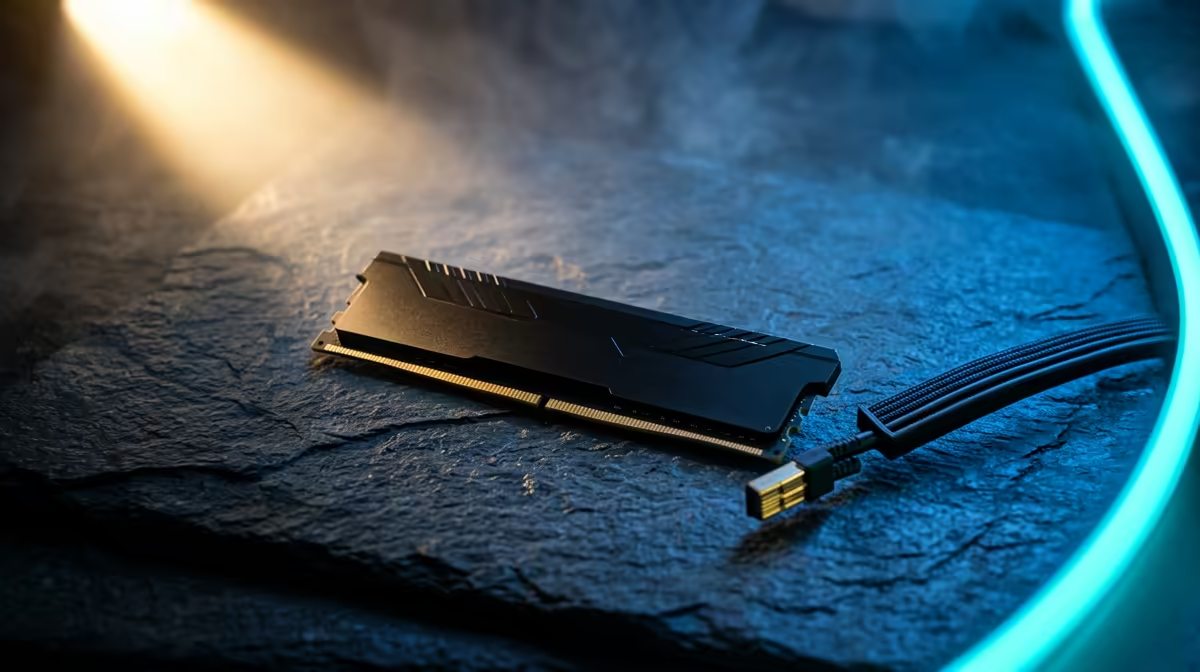
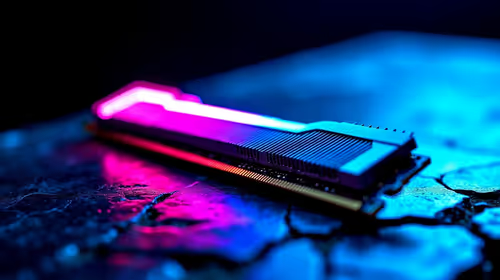
For engineering simulations, what matters most in DDR5 is capacity: target 64GB DDR5-6000, around R4,000, so large models do not force slow disk swapping. Once capacity is sufficient, a stable DDR5-6000 profile matters more than chasing the highest speed rating.
Why Capacity Leads for Simulations
Finite-element analysis, fluid dynamics, and large CAD assemblies are memory hungry, and the moment RAM runs out the system swaps to disk and performance collapses. So capacity is the priority: 64GB suits most serious engineering coursework, 32GB is a tight entry, and 128GB is for very large models. Buy a matched kit for stability across the slots you populate.
Speed and Build Balance
After capacity, DDR5-6000 with EXPO is a sensible speed on AM5; pushing to DDR5-7200 offers little for memory-bound simulations. Pair the RAM with a strong multi-core CPU, since simulations scale with cores, and a fast NVMe drive for loading large models and writing results.
Sizing to Your Models
If your projects routinely exceed 32GB in use, step up to 64GB so you avoid disk swapping. Confirm your board supports the capacity and the kit's speed across the DIMMs you use.
FAQ
How much RAM do engineering simulations need?
64GB DDR5-6000 suits most serious simulation work, with 32GB as a tight floor and 128GB for very large models. Running out of memory forces slow disk swapping, so size up if in doubt.
Is capacity or speed more important?
Capacity, for memory-bound simulations. Having enough RAM to avoid disk swapping matters far more than squeezing out extra speed. DDR5-6000 is a sensible target once capacity is covered.
Does the CPU matter alongside RAM?
Yes. Simulations scale with cores, so pair ample RAM with a strong multi-core CPU and a fast NVMe drive. Memory prevents swapping; the CPU drives the actual computation speed.
DDR5-6000 for engineering simulations to avoid disk swapping, and pair it with a strong multi-core CPU.