USB-C 65W on a monitor is useful only when the laptop, cable and daily workload all fit the same power-and-display plan. What South African buyers should check before choosing a USB-C 65W monitor therefore starts beyond the connector shape. The Dahua LM49 offers the feature at R14,999.
Quick Answer
Check that the laptop supports the intended USB-C display and charging route, use a suitable cable and compare its workload with the 65W ceiling. The R14,999 LM49 adds 5120 x 1440 DQHD, RJ-45 Ethernet and Picture-By-Picture. Test video, battery direction and network separately.
🔌 Match the laptop and cable
Identify the laptop port used for its monitor and charging workflow. Similar USB-C connectors can serve different purposes, and cables can support different combinations of power, data and video. Begin with a direct connection rather than a chain of adaptors.
Label the lead after it carries the complete workload successfully. Compare USB-C displays through Evetech's curved monitor range.
⚡ Measure power under real demand
Start from a known battery level and observe it during light work and the heaviest normal session. A charging icon may accompany a rising, steady or slowly falling battery, so the trend matters more than the symbol.
Keep the original laptop charger for travel, diagnosis and workloads outside the desk's 65W plan. Do not remove it after a short idle test.
🌐 Check the rest of the dock
The LM49 has built-in RJ-45 Ethernet. Connect an active network lead to the monitor, attach the laptop over USB-C and disable Wi-Fi briefly to prove the wired path. Restore the intended network policy afterwards.
The Dahua monitor selection places this network feature alongside the R14,999 screen.
🖥️ Choose the monitor before the charger
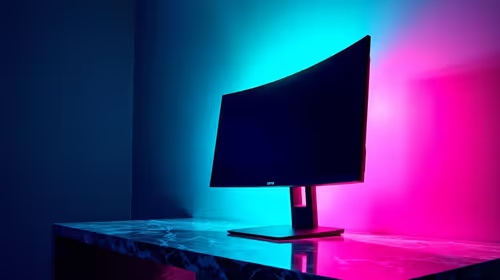
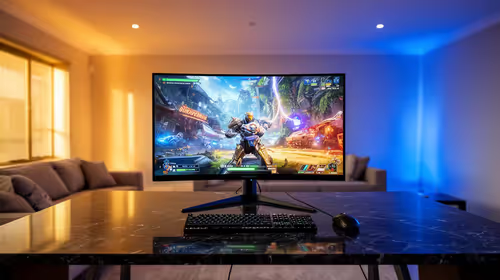
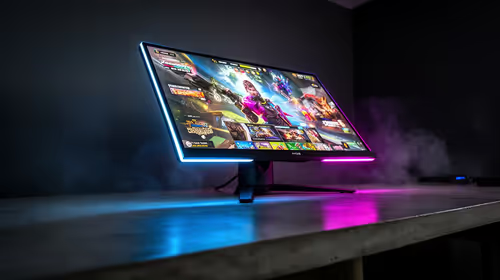
The 49-inch curved panel provides 5120 x 1440, and Picture-By-Picture can show two sources. Make sure that width, desk footprint and source plan suit the work. Charging convenience cannot correct a screen format that feels wrong.
The LM49 also offers 99% sRGB coverage, Delta-E under 2 accuracy and tilt/swivel adjustment. Browse Evetech's gaming monitor catalogue for alternative combinations.
Run sleep, restart and redocking tests. Confirm the correct image, battery state and wired network after each transition. Leave service slack for monitor movement and avoid a cable route that pulls on the laptop port.
Record the working laptop port, cable and monitor input. A short baseline helps distinguish a later cable issue from a power-demand change or a missing network route.
Check the recovery path before removing old equipment
Let the laptop sleep through a normal break and verify that display, charging and Ethernet return. Restart with the cable attached, then undock for several minutes and reconnect. Record any service that needs a manual step.
Keep the original charger and a known network alternative nearby during the trial week. These provide clean comparisons when one monitor function changes. Remove redundant desk equipment only after the USB-C route survives ordinary transitions.
Inspect physical fit and cable strain
Place the laptop where it will be used, open and close its lid, and check that the USB-C connector is not pulled sideways. Leave a service loop behind the monitor so tilt and swivel remain available. Route the cable away from the mouse area and chair paths.
Ask another regular user to follow the input and cable labels without explanation. A docking monitor is easier to share when the preferred laptop port, power ceiling and network check are visible at the desk.
Finally, compare the full panel format with the work. The right 65W monitor must also be the right 49-inch DQHD monitor, not merely a convenient charger attached to an unsuitable screen.
Repeat the acceptance cycle after the next laptop or graphics update. Keep the successful port, cable and monitor-input combination unchanged while checking new behaviour.
Record every changed result.
Frequently Asked Questions
Is 65W suitable for every laptop?
No. Compatibility, laptop power design and workload determine whether the route fits.
Can an ordinary charge cable carry the display?
Not necessarily. Use a cable intended for the full video and charging workload.
Should the original charger remain available?
Yes. Keep it for travel, recovery and different power demands.
Does the LM49 include wired networking?
Yes. Its RJ-45 port supports the planned Ethernet route through the monitor setup.
What does the Dahua cost?
The LM49 costs R14,999.
Ready to make 65W pass a full workday instead of a five-minute charging test?
Compare Evetech USB-C monitors, label the proven cable, and accept the setup only after video, power and Ethernet recover together.