Quick Answer
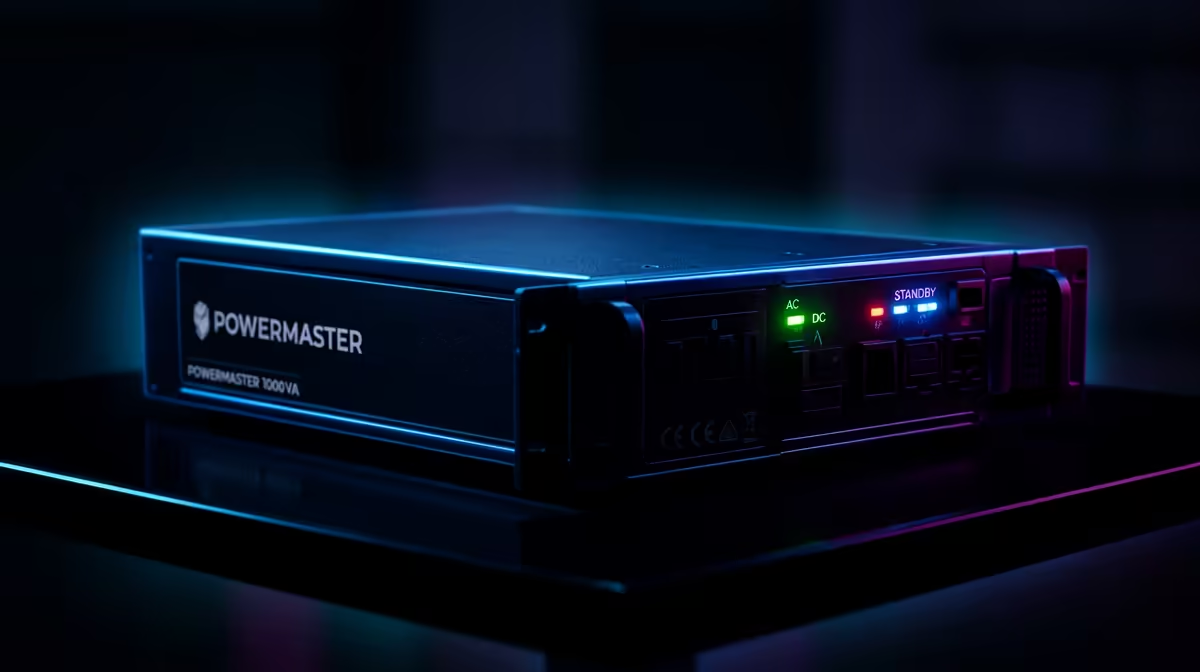
When buying a UPS for Minecraft with shaders, ignore headline VA bragging, RGB lighting and very long runtime claims; focus on usable watts, AVR and battery-backed outlet count. A 1000VA/600W line-interactive unit (about R1,900 to R2,900 currently stocked at Evetech) with AVR covers a typical 300W rig with a clean shutdown window.
Specs That Are Mostly Noise
Ignore the raw VA figure in isolation, since the usable wattage matters more; a 1500VA unit might only deliver 900W. Ignore long-runtime marketing, because for a safe shutdown you need 3 to 5 usable minutes, not 30. Ignore cosmetic LCD bling and lighting. What you should not ignore: AVR (automatic voltage regulation) for SA's swinging mains, the joule rating for surge protection, whether the battery is user-replaceable, and the count of battery-backed versus surge-only outlets.
What Actually Matters For Minecraft With Shaders
For Minecraft with shaders, prioritise a line-interactive design with AVR, enough usable watts for your load plus 30% headroom, and the right number of battery-backed outlets. Map your tower, monitor and router draw, multiply watts by about 1.6 for a VA target, and choose the smallest unit that clears it. That keeps the spend honest at roughly R1,900 to R2,900 currently stocked at Evetech for most desks.
FAQ
Do I need a pure sine wave UPS?
For most ATX power supplies a simulated sine wave 1000VA unit is fine. If you run an active-PFC PSU that beeps or trips on battery, step up to a pure sine wave model; those sit roughly R3,500 to R6,000 currently stocked at Evetech.
How big a UPS for a gaming PC plus monitor?
A 1000VA/600W line-interactive unit covers a 300W tower plus a 30W monitor with headroom and gives 6 to 9 minutes for a calm shutdown. A 450W high-end rig wants the 1500VA/900W class.
Will a UPS protect against surges as well as dips?
Yes, line-interactive units add AVR and surge protection alongside the battery, so they clamp spikes and correct mild brownouts. Check the joule rating and that your gear is on the battery-backed outlets, not surge-only ones.
device that must survive a power dip, count only the battery-backed outlets, and pick the smallest unit that leaves about 30% spare wattage.