A business does not need an industry trend to justify specialist hardware. It needs an application problem, a measurable production effect and a purchase that addresses both. South African teams considering a professional workstation GPU should focus on their own support requirements and project evidence rather than assume that other companies have already validated the decision.
Quick Answer
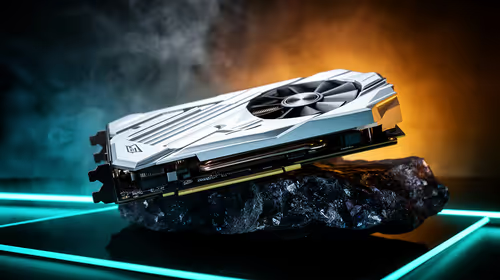
The RTX A1000 gives South African businesses a R12,099 professional card for CAD, engineering, 3D and content creation, packaged as a compact 50W single-slot design.
A business should consider a workstation GPU when supported software and recurring paid projects reveal a graphics-resource need. The RTX A1000 costs R12,099 and pairs its 2304 CUDA cores with Ampere architecture. Graphics memory is 8GB GDDR6 on a 128-bit interface. One card does not prove a national trend.
🧭 Connect hardware to a business process
Name the employee task affected by the current workstation. It may be a slow viewport, a render queue, an editing stage or a supported compute operation. Record how often the delay occurs and whether it affects delivery, rework or the number of projects a team can complete.
This changes the conversation from "professional cards are better" to "this operation needs these resources". A small studio and a large engineering team can reach different conclusions even when they use software from the same category.
🧭 Set technical gates before cost
Start with the application vendor's current GPU guidance. Add the largest normal file, required features and any internal support policy. Graphics memory and CUDA resources should be evaluated only after these mandatory conditions are written.
The A1000 offers 8GB GDDR6 across a 128-bit path, with 2304 CUDA cores on Ampere. Use Evetech's workstation graphics card department to compare other professional candidates against the same technical gates.
🧭 Build a local value case
At R12,099, the PNY RTX A1000 is a defined line item. Compare that cost with the measured effect of the bottleneck, but do not promise a return before testing. The card may clear one team's need and be misaligned with another team's files.
Include installation, validation and staff workflow in the test plan. Run a representative project, check output correctness and keep a rollback path. A successful pilot is more persuasive than a broad claim about what South African businesses are choosing.
🧭 Know when the platform question is larger
Modern professional workflows can include local AI tools alongside graphics work. Each feature has its own compatibility and memory requirements. If CPU, system RAM and other acceleration resources also need review, an AI PC shortlist may be more relevant than a graphics-only purchase.
Document why the final choice was made. Application version, test file, result and budget create an audit trail for future upgrades. The business then owns evidence specific to its work instead of borrowing a market narrative.
Pilot with the person who owns the task
Choose a user who performs the affected workflow regularly and give the pilot a defined project. Technical staff can observe resource behaviour, while the operator judges whether the change preserves accuracy and fits normal working practice.
Collect comments after repeated use, not only the first launch. Novel hardware can feel faster before a deadline exposes a missing feature or awkward step. A short pilot captures both measurable timing and operational friction.
If the result is mixed, document which task improved and which did not. The business can then decide from its own priorities without turning a partial success into a universal claim.
For procurement consistency, reuse the same pilot form across departments but leave task fields blank. Each team fills in its own application, project and pass condition.
A common form standardises evidence without forcing standard results. It also helps management compare how different workloads justify the same R12,099 cost.
Its technical case includes 8GB GDDR6 with 192GB/sec bandwidth, 2,304 CUDA cores and dedicated RT and Tensor resources. Four Mini DisplayPort 1.4a outputs can drive up to four 5K displays, which is useful for dense professional workspaces. Broader adoption would require market evidence, but an individual business can judge this exact card through its supported software, project fit and power-efficient form.
Frequently Asked Questions
Why might a South African business consider a workstation GPU?
A team may consider one when supported professional applications and repeatable projects expose a graphics resource need that affects useful work.
What local amount applies to the A1000?
The PNY RTX A1000 costs R12,099. Its Ampere GPU includes 2304 CUDA cores alongside 8GB GDDR6.
Does a professional label prove business value?
No. Value depends on application support, project fit, measurable improvement and how often the affected task occurs.
Can national adoption be concluded from this card?
No. The product provides a buying reference, not evidence about how many South African businesses use professional GPUs.
Ready to test a professional GPU against a real business task?
Explore Evetech's workstation graphics selection with one paid workflow, a baseline result and clear technical gates already documented.