Quick Answer
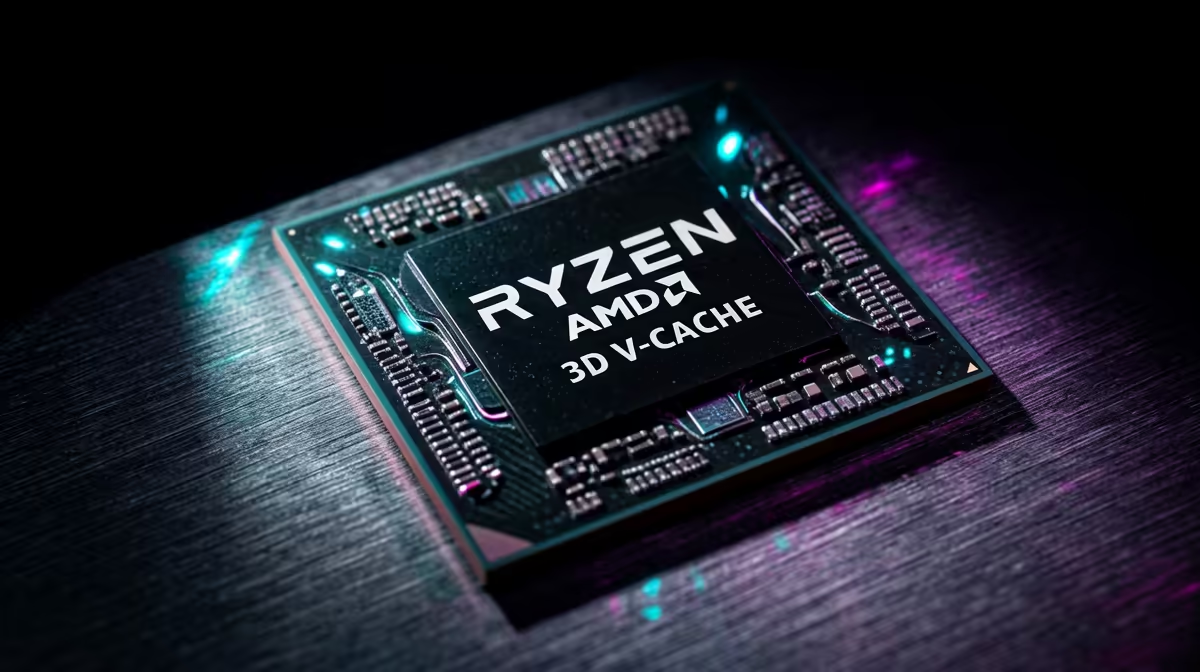
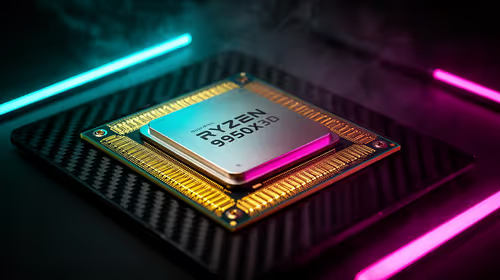
Ryzen X3D chips dominate gaming PCs because their extra 3D V-Cache improves frame pacing and 1 percent lows in CPU-sensitive games. Ryzen 7 7800X3D and Ryzen 7 9800X3D are the key gaming SKUs, with the 9800X3D often sitting in a broad R10,500-R14,500 SA band when available. For high-refresh 1080p and 1440p builds, X3D can matter more than adding another small GPU tier.
Why The Cache Helps
3D V-Cache gives the CPU more fast local memory for game data, which can reduce stutter and lift minimum frames in titles that lean hard on the processor. Games like Counter-Strike 2, Assetto Corsa Competizione, Microsoft Flight Simulator, and large strategy titles can show meaningful gains. The benefit is clearest with strong GPUs and 144 Hz, 165 Hz, or 240 Hz monitors.
Which X3D Chip To Compare
Ryzen 7 7800X3D remains a value reference, while Ryzen 7 9800X3D is the newer gaming-first step-up. Ryzen 9 X3D chips only make sense when gaming is mixed with heavy creative work. Pair these CPUs with B650 or X670 motherboards, updated BIOS support, 32 GB DDR5-6000, and a cooler that keeps boost clocks stable.
Rustenburg Buying Context
Rustenburg buyers should keep courier timing and support in mind; a common model is usually easier to live with than a niche one with weak availability. Do not buy X3D just to browse or play light esports at low settings on a weak GPU. It pays off when the rest of the PC can expose the CPU advantage.
FAQ
Is Ryzen X3D worth it for SA gamers?
Yes, for high-refresh gaming and CPU-heavy titles. It is less urgent for entry-level builds where the GPU is still the main limit.
Should I choose 7800X3D or 9800X3D?
Choose 7800X3D when the price is much lower and stock is good. Choose 9800X3D when you want the stronger current gaming option and the rest of the build is already balanced.
Does X3D help at 4K?
Sometimes, but the GPU usually becomes the bigger limit at 4K. X3D is most obvious at 1080p and 1440p high-refresh targets.