


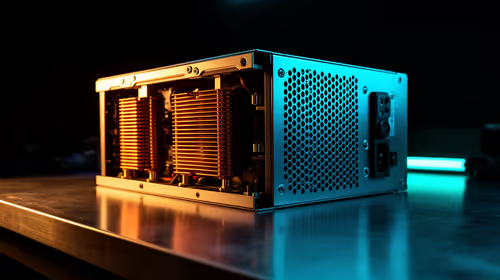
1000W PSU Planning for RTX 5090 Builds in SA
1000W for RTX 5090 needs a full-build check, not a simple yes. Review GPU guidance, CPU draw, transient load, connectors, PSU quality, and upgrade plans before deciding.
Read moreA 500-nit HDR figure is a brightness reference, but visibility still depends on lighting and reflections. The UColor O2 reaches that figure on a 16-inch OLED panel; judge bright-room and travel clarity in the intended environment.

Brightness specifications become meaningful only after reflections, viewing angle and room light enter the test. A 500-nit HDR portable monitor in bright rooms should be placed where it will actually be used. The R7,199 UPERFECT UColor O2 anchors this test.
Five hundred nits gives the OLED useful HDR highlight capacity, but bright-room clarity still depends on reflections, image content and where the traveller positions the screen.
The UColor O2 has a 500-nit HDR specification on a 16-inch OLED panel for R7,199. That figure is a useful comparison point, not proof of clarity in every bright room or travel location. Test the intended position with familiar dark and bright content, because no named HDR standard or glare result is defined by brightness alone.
Place the display at the working angle and identify windows, overhead lights and bright surfaces reflected in it. Move the screen or shade the direct source before pushing brightness upward. A small angle change can alter readability more than an isolated control adjustment.
Compare travel screens through the Evetech portable-monitor category under the same room conditions.
Open a dark scene containing subtle shadow detail and another frame with bright highlights. Inspect whether both remain readable without crushing or clipping. Keep the source file and application mode identical after each change.
OLED controls light per pixel, while the 500-nit figure describes another part of the experience. Neither supplies a universal sunlit result.
Establish a readable SDR profile for documents and interfaces. Enable HDR only with appropriate material and observe how the operating system maps ordinary content. Preserve the baseline so travel troubleshooting does not begin from an unknown state.
Ten-bit colour does not determine gamut or calibration, which remain creative-work checks.
Use the monitor in the cafe, office or temporary room without exposing it to deliberate heat, moisture or impact. Record reflection, angle and readability. Protect the 6.5mm panel in transit; its thickness is not a durability rating.
Browse fixed options in Evetech's PC-monitor range when a permanent bright-room desk is the real requirement.
Open a white document, dark interface and mid-tone webpage after the HDR scene. Check whether long reading remains comfortable at the selected brightness and angle. A travel display often spends more time on ordinary desktop work than on dramatic highlights.
Save a separate profile if the media setting makes neutral pages tiring. One mode does not have to serve every content type.
Record room, time of day, panel angle, major reflections and the reference content used. Compare several realistic destinations rather than declaring the monitor bright-room ready from a single office. Keep unsafe outdoor exposure out of the test.
The diary turns 500 nits into contextual evidence and shows whether repositioning solves a problem more effectively than changing the monitor controls.
Set a comfortable level for ordinary work, then use the HDR profile only when appropriate content requires it. Avoid treating maximum output as a default. Record which room and angle the setting serves so travel does not begin with an excessively bright screen in a dark environment.
The routine should be quick to restore after reconnection. A useful profile balances readability with comfort rather than chasing the highest available slider.
Choose a real candidate and place both screens at the same angle with the same reference. Do not assume a lower or higher nit figure determines the winner before reflection and tone behaviour are examined. Keep the source and application mode matched.
This controlled comparison gives the 500-nit result meaning without turning it into a generic claim about every room.
The self-luminous pixels create pure blacks and 100,000:1 contrast, preserving visual impact when the environment is controlled. Integrated brightness adjustment lets the user respond to office, hotel or travel conditions. Avoid direct sunlight where possible and judge near-black detail as well as bright highlights. A high peak figure cannot compensate for every reflection or guarantee outdoor readability at every angle.
No. Reflection geometry, ambient light, content and viewing angle all affect the result.
No. HDR behaviour depends on content and settings, while ordinary interfaces may need a separate profile.
Panel technology does not remove room reflections. Test placement and angle in the intended environment.
Avoid unsafe exposure. Use the realistic working location and inspect readability without risking the hardware.
Ready to judge brightness where the screen will work? Compare Evetech portable and fixed monitors under the same light, angle and reference content.
No. Reflection geometry, ambient light, content and viewing angle all affect the result.
No. HDR behaviour depends on content and settings, while ordinary interfaces may need a separate profile.
Panel technology does not remove room reflections. Test placement and angle in the intended environment.
Avoid unsafe exposure. Use the realistic working location and inspect readability without risking the hardware.
1000W for RTX 5090 needs a full-build check, not a simple yes. Review GPU guidance, CPU draw, transient load, connectors, PSU quality, and upgrade plans before deciding.
Read more
RTX 5080 Super with a 750W PSU is more comfortable than lower wattage if the unit is quality. SA builders should still confirm GPU guidance, CPU draw, connector type, airflow, and upgrade room.
Read more
How to fix FPS drops after a RX 9070 XT starts with driver cleanup, chipset updates, thermals, and power checks. For SA gaming PCs, confirm PCIe seating, monitor refresh, frame caps, and per-game graphics settings before replacing parts.
Read more
How to fix low FPS Windows 11 Wi-Fi 7 issues starts by checking whether the problem is frame rate or network lag. Test ping, drivers, power settings, Ethernet, and game FPS before adjusting visuals.
Read more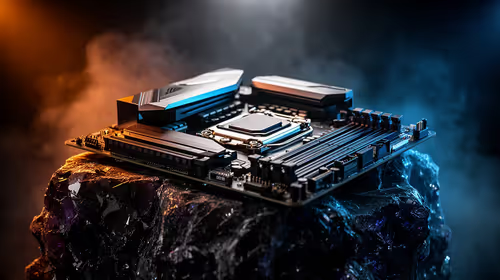
AM5 is smart for SA builders because it supports newer Ryzen CPUs, DDR5 memory, and a longer upgrade path. Compare board cost, cooling, gaming needs, and local part availability before choosing your next PC platform.
Read more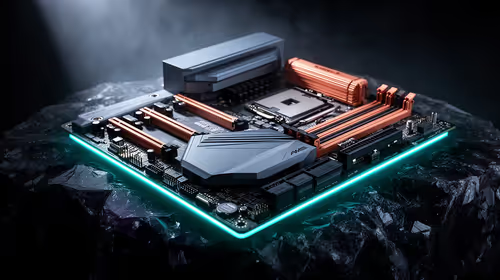
AM5 gives Randburg gaming builders a longer upgrade path. For SA buyers, DDR5 support, newer board features, and future CPU options can justify the platform. Weigh board cost, cooler support, BIOS maturity, and upgrade timing before choosing.
Read more
RTX 5090 on a 550W PSU leaves almost no practical room for OC plans. Treat the setup as constrained, with CPU draw, power spikes, cable quality, thermals, and stability checks more important than chasing extra clocks.
FPS drops on a Ryzen 9 9950X3D build often have a fixable cause. Check settings, drivers, thermals, background tasks, network conditions, and bottlenecks before assuming a part must be replaced.

The difference between PCIe 5.0 and PCIe 4.0 for SA gamers is mostly bandwidth headroom. Compare GPU slot needs, NVMe speed, motherboard support, and upgrade timing before paying extra for a newer platform.

Gaming PC stuck pixel checks in South Africa should confirm the monitor fault first. Use colour tests, screenshot comparison, cable swaps, display menu checks, and clear photos before deciding on support.

AMD's current driver now lists a Radeon RX 9050 4GB, while product coverage details a narrowed memory system. SA buyers should weigh the low VRAM ceiling against current local Radeon options.

Samsung Display has demonstrated a 16-inch 2.5K OLED laptop panel running at 300Hz. SA buyers should wait for a named notebook, full panel specifications and a local price before planning an upgrade.

Microsoft says some Windows 11 game crashes after recent updates are linked to RGB-related drivers. Affected SA gamers should confirm the update and driver before using the published registry workaround.
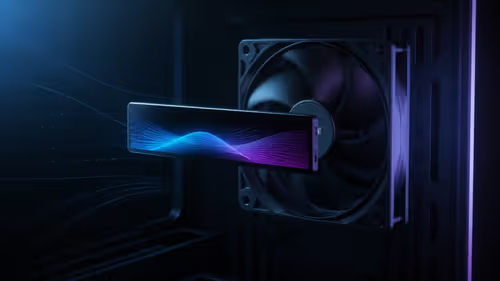
Thermalright's Fan Frame Vision-1 adds a 640x172 status screen to a standard 120mm fan. SA builders should check clearance, USB routing and local support before treating it as an easy upgrade.

Shokz OpenFit Air 2 earbuds weigh 7.2g each and use a redesigned dual-driver open-ear layout. SA buyers should choose them for comfort and awareness, not maximum isolation.

A fake 113GB GTA VI ISO reportedly used empty padding around a small malware payload. SA gamers should delete unofficial builds, keep Windows security active and wait for official channels.
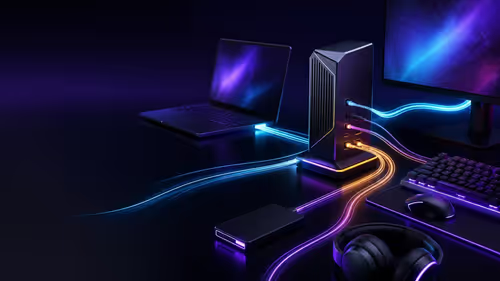
The ROG Flux Charger Dock combines 260W total output, 140W laptop charging and HDMI 2.1. SA buyers should check laptop USB-C limits, display needs and local warranty first.

ASRock's Rock 360 Digital AIO adds a 1.05-inch CPU temperature display, 360mm radiator and simplified wiring. SA builders should check case fit, socket support and local warranty.