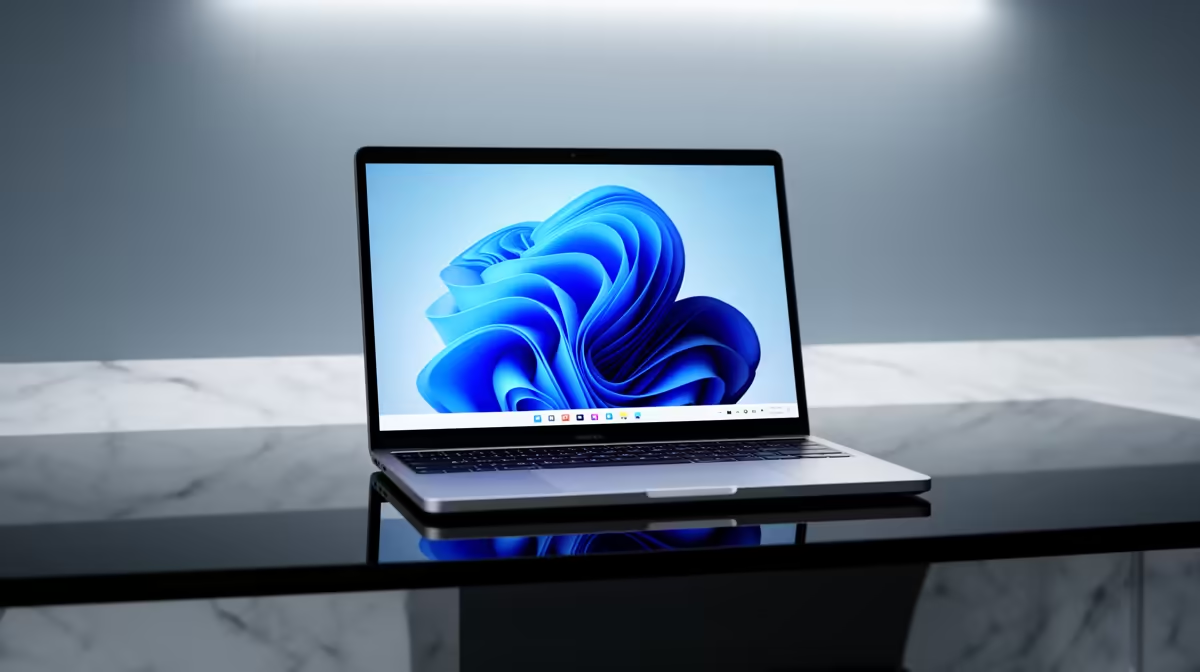
Run Microsoft's PC Health Check on an older machine and the rejection usually lands on one line: TPM or Secure Boot. The Windows 11 minimum requirements are not a loose suggestion, they are enforced at install time, and a PC that misses one item gets blocked rather than warned. The good news is that most of the checklist is satisfied by any machine bought from 2018 onward, and the items that trip people up are often just switched off in the BIOS.
Quick Answer
Windows 11 needs a supported 64-bit CPU (Intel 8th Gen or newer, AMD Ryzen 2000 or newer), 4GB of RAM, 64GB of storage, TPM 2.0, Secure Boot, and UEFI firmware, plus a DirectX 12 graphics adapter. Every item is checked at installation. Meeting all of them keeps the PC receiving Microsoft's feature updates and security patches.
The full checklist
Here is everything the installer verifies:
- Processor: 1GHz or faster, 2 or more cores, 64-bit, and on Microsoft's supported list. In practice that means Intel 8th Gen and newer or AMD Ryzen 2000 and newer, broadly 2018 onward. On 24H2 and later the CPU must also support the SSE4.2 and POPCNT instructions.
- RAM: 4GB minimum. Comfortable everyday use wants 8GB or more.
- Storage: 64GB or larger. After updates and apps you will want well beyond that.
- TPM: Trusted Platform Module version 2.0.
- Secure Boot: must be supported and enabled.
- Firmware: UEFI, not legacy BIOS.
- Graphics: DirectX 12 compatible with a WDDM 2.0 driver.
The two that trip people up
TPM 2.0 and Secure Boot reject more machines than anything else, and usually for the wrong reason. TPM 2.0 is very often already present but switched off. On most modern boards it is firmware-based rather than a separate chip, labelled Intel PTT on Intel systems and AMD fTPM on AMD systems. Enable that setting in the BIOS and the "TPM missing" error frequently disappears.
Secure Boot is similar. It requires UEFI firmware with Secure Boot capability, and many PCs ship with it disabled or running in legacy BIOS mode. Switching the firmware to UEFI and enabling Secure Boot often clears the block, though a machine installed in legacy mode may need its disk converting before the option becomes available.
What to do if you fail the check
If your CPU simply is not on the supported list, no BIOS toggle fixes that, because the cutoff is the processor generation itself. Microsoft does not support Windows 11 on CPUs older than the 2018 cutoff, and unsupported installs miss feature and security updates. For an ageing machine, the dependable answer is newer hardware, and a compact, fully Windows 11 ready option is one of the small-footprint systems in the mini PC range at Evetech.
Before spending anything, confirm what you actually have. Check the CPU model against the supported generations, then look in the BIOS for the firmware TPM and Secure Boot settings before assuming the machine is incompatible. If you do decide to replace it, the best-selling PCs at Evetech all ship meeting the full Windows 11 checklist out of the box.
Frequently Asked Questions
What are the minimum requirements for Windows 11?
A supported 64-bit CPU, 4GB of RAM, 64GB of storage, TPM 2.0, Secure Boot, UEFI firmware, and a DirectX 12 graphics adapter. All of these are checked when you install, and the CPU must be on Microsoft's supported list.
Why does Windows 11 say my PC does not have TPM 2.0?
Usually the TPM is present but disabled in the BIOS. It is often firmware-based, shown as Intel PTT or AMD fTPM. Enable that setting and the requirement is typically satisfied without any new hardware.
Can I run Windows 11 without Secure Boot?
The official requirement is UEFI with Secure Boot capability, checked at install. Many PCs simply have it switched off or are running legacy BIOS. Enabling UEFI and Secure Boot usually clears the block.
My CPU is too old for Windows 11. What now?
A processor older than the 2018 cutoff is not on the supported list, and no setting changes that. An unsupported install misses updates, so the reliable path is newer hardware such as a compact mini PC that meets the full checklist.
How much RAM and storage does Windows 11 really need?
The minimums are 4GB of RAM and 64GB of storage, but those are floors. For comfortable everyday use, 8GB or more of RAM and well over 64GB of storage after updates and apps is sensible.
Stuck on the Windows 11 compatibility check? If your current PC cannot meet it, browse the ready-to-go systems in the mini PC range at Evetech and start on the right side of the checklist.