Your gaming laptop is fully charged. How long can you last in The Lands Between before the battery dies? With new AI tools like DLSS and FSR, the answer is… complicated. These smart technologies promise higher frame rates, but what about the AI gaming tools' battery life impact in South Africa? Do they drain your power faster, or could they be the secret to extending your unplugged gaming sessions? Let's investigate. ✨
Understanding AI's Role in Modern Gaming
Before we dive into battery life, let's quickly demystify these "AI tools." Technologies like NVIDIA's DLSS (Deep Learning Super Sampling), AMD's FSR (FidelityFX Super Resolution), and Intel's XeSS are designed to do one thing brilliantly: give you more frames per second (FPS).
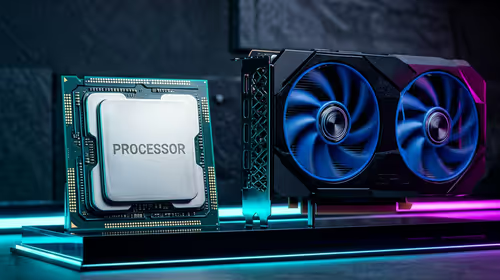
They work by rendering your game at a lower internal resolution and then using sophisticated AI algorithms to upscale the image to your screen's native resolution. The result often looks just as good (sometimes even better) than native, but it's much less demanding on your graphics card. This performance-boosting magic is built directly into the architecture of the latest NVIDIA GeForce cards and is a cornerstone of AMD's Radeon lineup. More performance is great, but the real question for laptop gamers is about power consumption.
The Surprising Impact of AI Gaming Tools on Battery Life
Common sense suggests that more complex processing must use more power, right? Not necessarily. The impact of AI gaming tools on battery life is a fascinating trade-off. While the AI cores on a GPU do consume some power, the overall workload on the main GPU shaders is drastically reduced because they're rendering fewer pixels.
Imagine this:
- Without AI: Your GPU runs at 100% to push 45 FPS at native 1080p, draining your battery fast.
- With AI: Your GPU renders at 720p and uses AI to upscale to 1080p. It now hits a smooth 70 FPS, but it's only running at 75% capacity.
This efficiency headroom is the key. By using AI, your GPU can achieve the same target performance using significantly less power. This is a huge benefit for the latest gaming laptops, which are designed with power efficiency in mind. The less stress on your components, the longer you can game unplugged.
How South African Gamers Can Optimise for Longer Playtime 🔋
It’s not just about flipping a switch; it’s about being smart with your settings. The secret isn't just enabling DLSS or FSR... it's about pairing it with a frame rate cap.
Here’s the strategy:
- Enable Your AI Upscaler: Go into your game's graphics settings and turn on DLSS, FSR, or XeSS. Choose a "Performance" or "Balanced" mode.
- Cap Your Frame Rate: This is the most crucial step! Use your graphics card's control panel or an in-game setting to lock your FPS to your screen's refresh rate (e.g., 60 FPS).
By doing this, you're telling your GPU: "Hey, just work hard enough to give me a perfect 60 FPS with AI's help, and then chill." Instead of running flat-out to produce frames you can't even see, it hits the target efficiently and then throttles down. This simple tweak can dramatically reduce power consumption, giving you that extra 30-60 minutes you need to finish a raid. Even the most powerful machines in our laptop specials benefit from these clever power-saving optimisations.
Battery-Saving Pro Tip ⚡
To maximise battery life with AI tools, use an external frame rate limiter like NVIDIA Control Panel or AMD Software's Radeon Chill. Set a cap just below your screen's refresh rate (e.g., 58 FPS for a 60Hz display). This prevents the GPU from working unnecessarily, giving you smoother frame times and saving precious battery power for that final boss fight.
Desktop Power and Your Electricity Bill 🚀
This conversation isn't just for laptop owners. For desktop gamers in South Africa, the rising cost of electricity is a real concern. While battery life isn't an issue, power consumption from the wall definitely is. The same principles apply: using DLSS or FSR to achieve your target frame rate means your GPU draws less power.
Less power draw means a lower electricity bill at the end of the month. A high-end GPU running at full tilt can use as much power as a small appliance. Taming that power draw without sacrificing performance is a massive win. It’s something to keep in mind when browsing energy-efficient pre-built PC deals or considering components for our customisable gaming PC deals. In short, the positive AI gaming tools' battery life impact also translates to real-world ZAR savings for desktop users.
Ready for AI-Powered Gaming?
The impact of AI gaming tools on battery life is clear: when used correctly, they're a massive win for gamers. Ready to experience longer, smoother, unplugged gaming sessions? Explore our massive range of laptop specials and find the perfect machine to conquer an unexpected outage.