Heard the buzz about AI? 🧠 From creating stunning art to powering smarter games, it's everywhere in South Africa. But what happens when your hardware can't keep up? The secret to unlocking true machine learning speed isn't just your CPU or GPU... it's the data pipeline. Enter PCIe 5.0 for AI, the new standard that's about to supercharge your entire workflow, moving massive datasets at speeds we've only dreamed of until now.
What is PCIe 5.0 and Why Does it Matter for AI?
Think of PCIe (Peripheral Component Interconnect Express) as the main highway inside your computer. It connects your most important components—like your graphics card and SSD—to your processor. For years, PCIe 4.0 has been a fast, reliable multi-lane highway.
PCIe 5.0 is like doubling the number of lanes overnight. 🚀
It offers twice the bandwidth of its predecessor, hitting theoretical speeds of up to 14,000 MB/s. For everyday tasks and most gaming, this might seem like overkill. But for artificial intelligence and machine learning, this extra bandwidth is critical. AI models are trained on gigantic datasets, and the faster you can feed that data from your storage to your processor and GPU, the less time you spend waiting.
How PCIe 5.0 Supercharges Machine Learning Workloads
The real magic of PCIe 5.0 for AI appears when you're dealing with demanding tasks. Training a complex model or processing high-resolution video requires constant, rapid access to storage. A delay here creates a bottleneck that slows down your entire system, no matter how powerful your GPU is.
By eliminating this bottleneck, PCIe 5.0 allows for:
- Faster Model Training: Less time waiting for data means your GPU is utilised more efficiently, cutting down training times significantly.
- Real-Time Data Analysis: For professionals working with live data streams, the low latency of Gen5 is a massive advantage.
- Smoother Creative Workflows: High-resolution video editing, 3D rendering, and complex simulations all benefit from the instant access to assets.
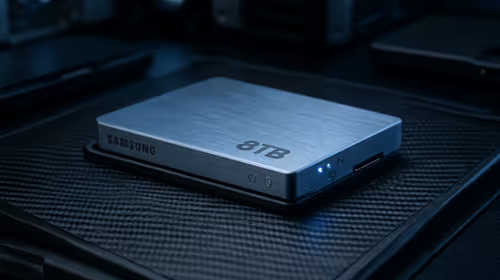
While the future is Gen5, the current generation of storage still offers incredible performance for most users. For a blistering-fast gaming and content creation experience, a top-tier Gen4 drive like the Klevv CRAS C925G 1TB delivers exceptional speed and value right now.
Building Your AI-Ready PC in South Africa 🔧
Jumping to PCIe 5.0 isn't just about buying a new SSD. It requires a modern platform. To take full advantage of these next-gen speeds, you'll need a compatible motherboard (like an AMD X670E or Intel Z790 series) and a processor that supports the standard (AMD Ryzen 7000 series or Intel 13th/14th Gen and newer).
When building your rig, it pays to choose components from manufacturers focused on pushing performance boundaries. Here in South Africa, we're seeing amazing products from innovative brands like Klevv, who are consistently at the forefront of memory and storage technology.
Check Your Slots! ⚡
Not all M.2 slots on a PCIe 5.0 motherboard are created equal. Often, only the primary slot connected directly to the CPU will offer Gen5 speeds. The other slots might run at PCIe 4.0 speeds. Always check your motherboard's manual to ensure you're installing your new Gen5 SSD in the correct slot for maximum performance!
Is it Time to Upgrade? PCIe 5.0 vs PCIe 4.0
So, should you rush out and upgrade today? The answer depends on your needs.
For the majority of gamers and everyday users, a high-quality PCIe 4.0 SSD offers more than enough speed for near-instant load times and a snappy system. The performance difference in gaming is currently minimal.
However, if you are a data scientist, an AI developer, a professional video editor, or a tech enthusiast who wants to build a future-proof system, the argument for PCIe 5.0 for AI becomes much stronger. It's an investment in a platform that will be ready for the next wave of software and AI-driven applications. If you're unsure which path is right for you, it's always a good idea to check out our wide selection of SSDs to compare the latest prices and specs.
Ready to Find Your Perfect Match?
The Mac vs Windows debate is complex, but for maximum power, choice, and value in South Africa, Windows is hard to beat. Explore our massive range of laptop specials and find the perfect machine to conquer your world.