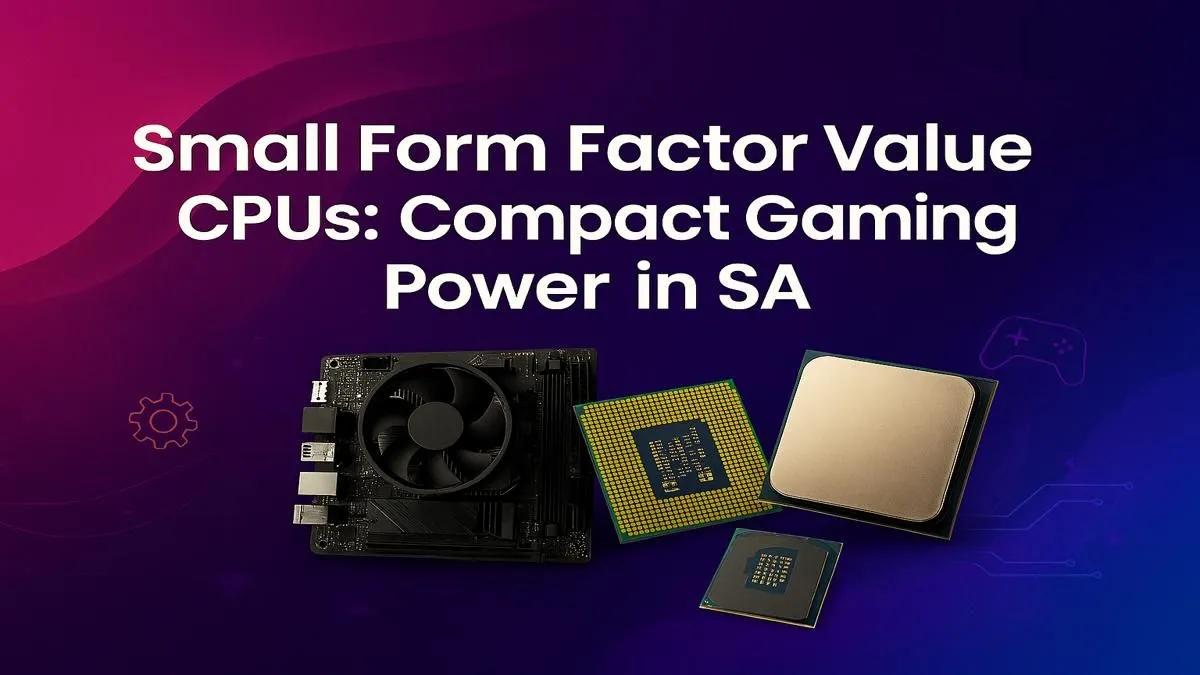
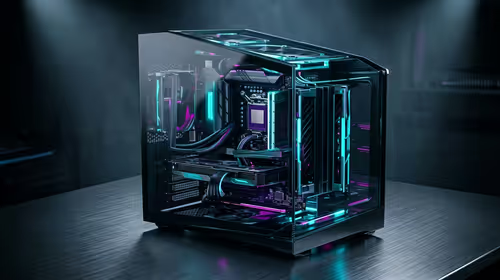
Building a Small Form Factor (SFF) PC in South Africa is a unique challenge. You want a rig that’s small enough to tuck onto a desk or next to the TV, but powerful enough to run the latest titles without sounding like it’s about to take off. The secret? It all starts with choosing the best value SFF CPU. This single component dictates your power, heat, and ultimately, your entire build’s success. Let's dive in. 🚀
Why Go Small? The SFF Advantage
Before we get into the silicon, why are so many local gamers choosing compact builds?
- Space Saving: Perfect for apartments, dorm rooms, or just creating a minimalist, clean setup.
- Portability: Remember LAN parties? An SFF rig is infinitely easier to haul to a friend's place than a massive tower.
- Aesthetics: Let's be honest, a well-built SFF PC just looks incredibly cool and sleek.
The trade-off, however, is airflow. A cramped case has less room for cooling, which makes your CPU choice absolutely critical.
Finding the Best Value SFF CPU: Key Factors
In a tiny case, raw clock speed isn't the only thing that matters. You need to find the sweet spot between performance, power consumption, and thermal output. The goal is to find a compact gaming power solution that sips power instead of guzzling it.
Here’s what to look for:
- TDP (Thermal Design Power): This is a measure of how much heat a CPU produces under load. For SFF, lower is almost always better. Aim for CPUs in the 65W range. They are easier to cool and won't turn your PC case into an oven.
- Core Count & Performance: You still need enough muscle for modern gaming. A modern 6 or 8-core processor is the ideal target for a high-performance, best value SFF CPU.
- Integrated Graphics (or lack thereof): If you're using a dedicated graphics card (which you should be for gaming), you might not need powerful integrated graphics. This can sometimes save you a bit of cash.
Top Contenders for Compact Gaming Power in South Africa
So, which chips hit that perfect balance? In the current market, two families stand out for their efficiency and gaming prowess.
Team Red: AMD's Efficient Ryzen CPUs
AMD has been a champion of efficiency for several generations. Their non-X series Ryzen chips are fantastic for SFF builds because they offer nearly the same gaming performance as their beefier "X" siblings but at a much lower 65W TDP. Models like the Ryzen 5 7600 or Ryzen 7 7700 are prime candidates, delivering incredible performance without demanding an enormous cooler. Check out the latest specs and prices on AMD's Ryzen processors to see how they fit your budget.
Team Blue: Intel's Versatile Core Series
Intel is also a strong competitor in the SFF space, especially with their non-K processors. A CPU like the Core i5-14400 or i5-13400 provides a brilliant mix of performance and efficiency cores, making it great for both gaming and multitasking. Like AMD's non-X chips, these run at a stock 65W TDP, making them easy to tame in a small chassis. You can explore the full Intel's Core series to find the perfect fit for your build. 🔧
Cooler Clearance is Key 📏
Before you buy any CPU cooler for your SFF build, check your case's specification sheet for the maximum cooler height. Many popular low-profile coolers, like the Noctua NH-L9i or NH-L12S, are designed specifically for these tight spaces. Double-checking this one number can save you a massive headache... and a return shipment!
Ultimately, the choice between them often comes down to current pricing and motherboard availability. The good news is that you can’t really go wrong with either option. Both platforms offer a clear path to building a quiet, powerful, and compact gaming rig. When you're ready to compare, you can browse our full range of CPU processors to see all the options in one place.
Ready to Build Your Compact Powerhouse?
Choosing the best value SFF CPU is the first step to an amazing build. Now it's time to pair it with the right motherboard, RAM, and a sleek case. Explore our massive range of PC components and start designing the compact rig of your dreams today.