Is Your Gaming Rig Bottlenecking? Let's Talk CPU & GPU Balance ✨
Struggling to get smooth frame rates on your new rig, even with a beastly graphics card? Or maybe you're planning an upgrade, stressing about which processor won't hold back your dream GPU? You're not alone, fellow South African gamer! That frustrating performance gap often boils down to a CPU GPU bottleneck. Let's unpack how to perfectly pair your components for peak gaming glory. No more stuttering. Just pure, unadulterated speed.
Understanding Performance Bottlenecks
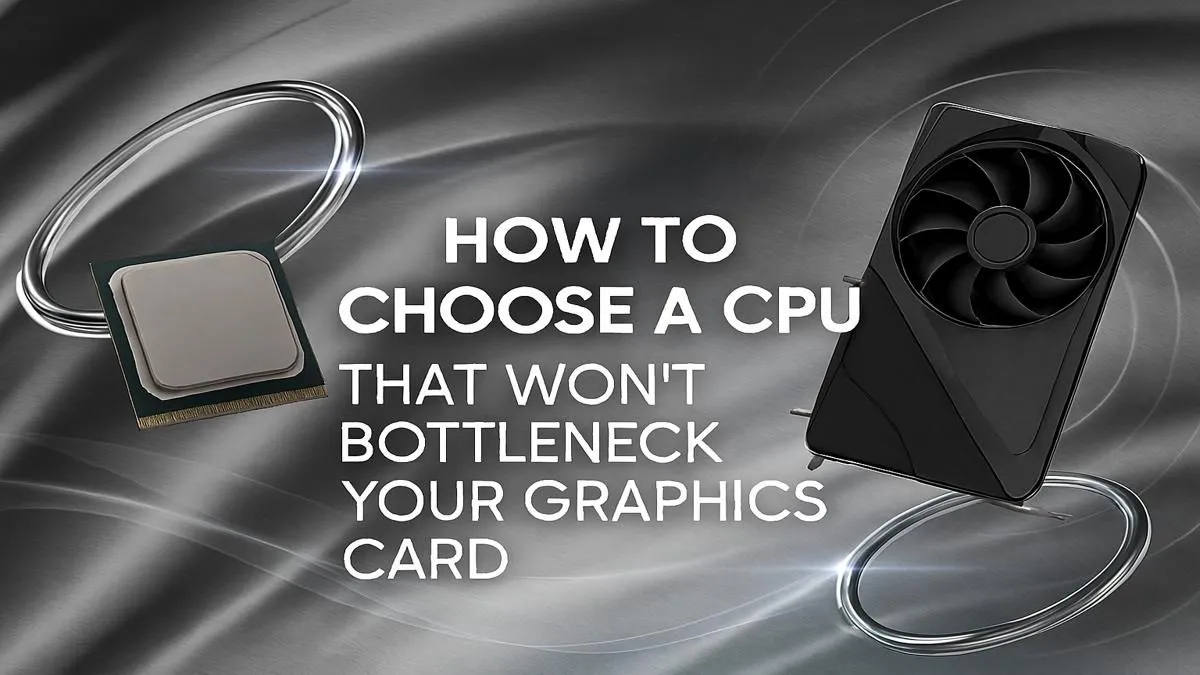
Think of your PC as a team. The CPU (Central Processing Unit) is the strategist, handling game logic, AI, physics, and telling your GPU what to draw. The GPU (Graphical Processing Unit) is the artist, rendering all those beautiful pixels onto your screen. A performance bottleneck happens when one component can't keep up with the other, limiting overall system performance. If your CPU is too slow, it can't feed instructions fast enough to your powerful GPU, leaving your graphics card underutilised. Conversely, a weak GPU will struggle to render the frames your mighty CPU is preparing.
It’s like pouring a bucket of water (data) through a narrow funnel (the slower component). No matter how big the bucket, the funnel limits the flow. This often means you're not getting the FPS you paid for.
Signs You Might Have a Performance Bottleneck 📉
How do you spot this digital slowdown? Look out for these tell-tale signs:
- Low GPU Usage, High CPU Usage: Your monitoring software (like MSI Afterburner or HWMonitor) shows your GPU sitting at 50-70% usage, while your CPU cores are pegged at 90-100%. That's a classic CPU bottleneck. Your CPU is the limiting factor.
- Inconsistent Frame Rates (Stutters): Even if your average FPS looks okay, sudden drops in busy scenes, especially in open-world games, often point to your CPU struggling to process environmental data.
- Poor Performance in CPU-Intensive Games: Strategy games, simulations, or titles with lots of NPCs (like Cyberpunk 2077 or Assassin's Creed Valhalla) tend to lean heavily on the CPU. If these run poorly despite a strong GPU, it's time to investigate.
I remember a mate, Thabo, who got a shiny new RTX 4070. He paired it with an older i5 and complained about Baldur's Gate 3 stutters. A quick check confirmed his CPU was constantly maxed out. Upgrading his processor fixed it instantly!
How to Choose the Right CPU for Your GPU: The Balancing Act ⚖️
This is where the magic happens. The goal isn't just buying the most expensive parts, but finding the perfect synergy. To choose the right CPU for your GPU, consider these points:
Your Resolution and Refresh Rate Matter
Playing at 1080p with a high refresh rate monitor (144Hz+) is generally more CPU-bound. The CPU has to prepare many more frames per second for the GPU. At 4K, the GPU takes on most of the heavy lifting, as it's pushing millions more pixels per frame. So, for high refresh rate 1080p/1440p gaming, you’ll want a stronger CPU. For 4K, prioritise a powerful GPU, but don't completely neglect the CPU.
Gaming Versus Other Workloads
Are you purely gaming, or do you also stream, edit videos, or run demanding professional software? If it's the latter, investing in a CPU with more cores and threads (like a high-end Intel i7/i9 or AMD Ryzen 7/9) becomes even more critical. Evetech offers a fantastic range of processors for every need, whether you lean towards the raw power of Intel CPUs or the multi-threaded prowess of AMD CPUs.
Research Benchmarks & Compatibility
Before you buy, always check reviews and benchmarks. Look for tests that specifically pair your desired GPU with various CPUs at your target resolution. Sites like TechRadar or Gamers Nexus provide excellent, in-depth comparisons. Also, ensure your chosen CPU is compatible with your motherboard's socket (e.g., AM5 for current-gen AMD, LGA1700 for current-gen Intel).
Don't Neglect Your Power Supply!
A powerful CPU and GPU combo needs adequate, stable power. Check the recommended PSU wattage for your chosen components – undershooting can lead to crashes or system instability. A good 750W-850W PSU is a solid starting point for most modern mid-to-high-end builds.
Future-Proofing (Within Reason) & Budget Allocation
While true future-proofing is a myth, you can make smart choices. Don’t buy a top-tier CPU if you’re only getting a mid-range GPU and vice-versa, unless you plan to upgrade the weaker component very soon. A balanced system offers the best value.
A good rule of thumb for a dedicated gaming PC is to allocate slightly more of your budget to the GPU, especially for 1440p and 4K gaming. For example, if your budget is R25,000, aiming for around R10,000-R12,000 for your graphics card and R5,000-R7,000 for your CPU might offer a solid balance. Remember, a component mismatch can quickly make even expensive components feel sluggish. You can browse all available CPU processors online to find the perfect fit for your budget and performance goals.
The Takeaway: Harmony is Key 🚀
Ultimately, building a PC without a component bottleneck is about harmony. Each part needs to pull its weight without holding back the others. Do your research, understand your gaming habits, and don't be afraid to ask for expert advice. Evetech's team is always here to guide you towards that perfectly balanced, lag-free gaming experience.
Upgrade Your Rig, Ditch the Bottleneck!
Ready to experience gaming how it's meant to be? Build a balanced, high-performance PC that eliminates any CPU GPU bottleneck and unleashes true power. Shop all CPUs at Evetech today for performance that leaves lag in the dust.