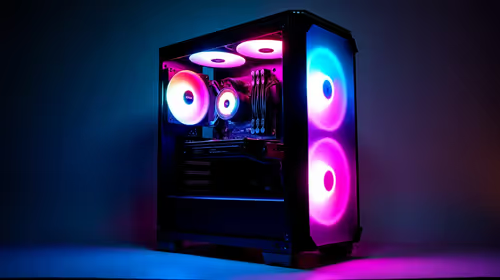
Tired of your PC sounding like a jet engine taking off from OR Tambo during a summer heatwave? High-airflow chassis are brilliant for cooling, but without proper fan curve optimization, they can be unnecessarily loud. Tuning your fans ensures your components stay frosty while your room stays quiet. Let’s dive into how you can master your thermal performance without losing your mind to fan whine... it is easier than you think. 🔧
Why Fan Curve Optimization for High-Airflow Chassis Matters
In South Africa, ambient temperatures can easily hit 30°C during the peak of summer. If you have invested in one of the many high-quality computer cases available today, you already have the hardware for success. However, default BIOS settings are often too aggressive. They ramp up speeds at the slightest temperature spike... causing annoying noise fluctuations. Proper tuning creates a smooth, predictable acoustic profile that matches your specific environment.
The Balance of Pressure and Silence
High-airflow builds usually feature mesh panels. These are great for breathing but offer little sound dampening. If you are using premium options like Fractal Design PC cases, you likely have high-quality fans that move a lot of air even at lower RPMs. The goal is to keep a steady flow of cool air entering the front while exhausting heat out the back and top. You do not need 100% fan speed to achieve this... often 50% is more than enough for gaming.
Optimising for Value and Performance
You do not need to spend a fortune to get great thermals in our local climate. Many Gamdias gaming cases come pre-installed with multiple fans that work perfectly with custom curves. If you are building on a budget, you can find excellent airflow cases under R1500 that punch well above their weight. The trick is to set a "flat" curve for your case fans until the CPU hits 60°C. This prevents the fans from constantly revving up during basic web browsing or Netflix sessions. ⚡
The Hysteresis Secret ⚡
Most modern BIOS settings allow you to adjust "Fan Step Up Down" times. By increasing the delay to 2 or 3 seconds, you prevent your fans from reacting to tiny, momentary temperature spikes. This results in a much more pleasant, consistent sound profile while you work or play.
Fine-Tuning Your Custom Curve
To start your fan curve optimization for high-airflow chassis, head into your BIOS or use software like Fan Control. Identify your "Idle" temperature... usually between 35°C and 45°C. Set your fans to their lowest audible RPM at this range. Create a gradual slope up to 75°C... and only set a "fail-safe" 100% speed if the temperature exceeds 85°C. This ensures silence during daily tasks and maximum protection during intense 4K gaming sessions. 🚀
Ready to Build Your Ultimate Rig? Optimising your airflow is the final step to a perfect build. Whether you are looking for premium aesthetics or budget-friendly performance, we have the chassis to keep your components cool. Explore our massive range of PC cases and start your next build with Evetech today.