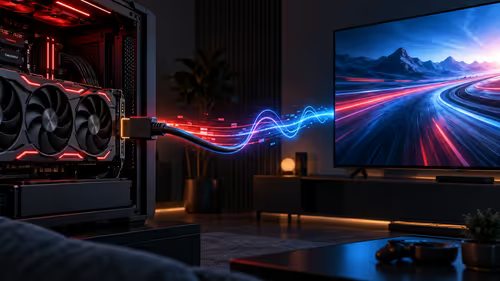
So, you’ve just dropped a fat stack of ZAR on a beastly GPU, ready to crank Cyberpunk 2077 or Warzone up to glorious 4K. But then you see it… that ugly, horizontal line slicing across your screen during fast action. That, my friend, is screen tearing. It’s the visual equivalent of nails on a chalkboard. The fix? Adaptive Sync. But this is where the big debate kicks off: FreeSync Premium vs G-Sync. Which one is right for your rig?
Understanding the Core Tech: What is Adaptive Sync? 🔧
Before we dive into the FreeSync Premium vs G-Sync showdown, let's quickly cover the basics. Adaptive Sync technology, also known as Variable Refresh Rate (VRR), is a brilliant solution to a classic problem.
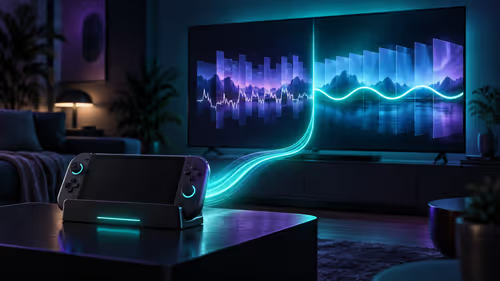
Your graphics card (GPU) renders frames at a variable rate, while your monitor traditionally refreshes its image at a fixed rate (e.g., 144Hz). When these two are out of sync, you get visual artifacts like screen tearing or stuttering. Adaptive Sync forces your monitor to match its refresh rate to your GPU's output in real-time, creating a buttery-smooth, tear-free experience.
Team Green: NVIDIA G-Sync Explained
NVIDIA's G-Sync was the first to market and set a high standard. To earn the G-Sync badge, a monitor must include a proprietary hardware module from NVIDIA. This module handles the sync process, ensuring a rigorously tested, premium experience.
- Key Benefit: The dedicated hardware often provides superior performance, especially with Low Framerate Compensation (LFC) and variable overdrive, which keeps motion blur consistent across a wide range of frame rates.
- The Catch: That hardware module adds to the cost, making G-Sync monitors typically more expensive. It also historically locked you into using an NVIDIA GPU.
For many gamers, the guaranteed performance is worth the price, and you can explore all our gaming monitors to see the difference for yourself.
Team Red: AMD FreeSync Premium's Rise
AMD's FreeSync is an open-standard alternative built on VESA's Adaptive-Sync protocol. This means monitor manufacturers don't need to pay for a special chip, making FreeSync displays more common and affordable.
The "Premium" tier is the direct competitor to G-Sync. For a monitor to be certified FreeSync Premium, it must support:
- A refresh rate of at least 120Hz at a minimum of 1080p resolution.
- Low Framerate Compensation (LFC), which prevents stutter when your FPS drops below the monitor's minimum refresh rate.
This makes it a powerful and budget-friendly choice. You'll find it on a massive range of PC monitors today.
Pro Tip: Enable 'G-Sync Compatible' Mode
Got an NVIDIA GPU but a FreeSync monitor? You might be in luck! In the NVIDIA Control Panel, navigate to "Set up G-SYNC" and check "Enable G-SYNC, G-SYNC Compatible". This allows your NVIDIA card to use the FreeSync protocol. It’s not guaranteed to be perfect on all screens, but it works brilliantly on certified models.
The 4K Monitor Comparison: Which is Best for You? ✨
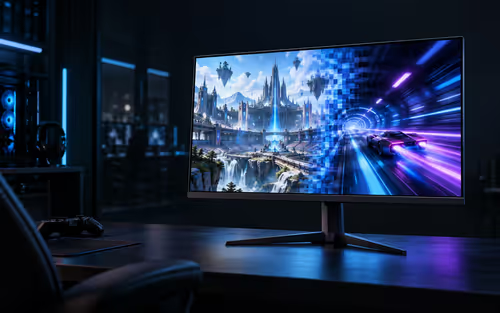
When it comes to a 4K monitor comparison, the FreeSync Premium vs G-Sync debate gets interesting. Pushing pixels at 4K is demanding, and your frame rate will fluctuate more. This makes LFC absolutely critical.
So, how do you choose?
- Item
- Consider Your Budget: G-Sync monitors command a premium. If you're looking for the best PC monitor deals, you'll find more options in the FreeSync Premium camp.
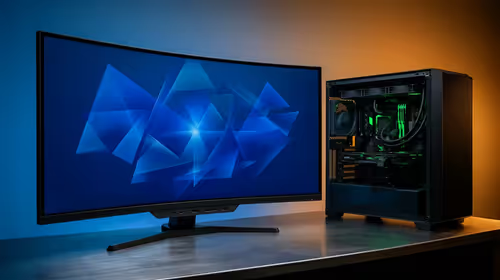
- Think About Form Factor: Do you want an ultra-wide view? Many of the best curved monitors leverage FreeSync to keep costs down while delivering immersive gameplay. Even some high-end portable monitors are adopting the technology.
Ultimately, both technologies do an excellent job of eliminating screen tearing. Don't forget to complete your setup with the right cables and stands from our range of monitor accessories to get the perfect viewing angle.
The Verdict: Who Wins in South Africa? 🚀
There’s no single winner in the FreeSync Premium vs G-Sync battle. The real winner is you, the South African gamer, because competition has given us incredible choice at every price point.
- Choose G-Sync if you have an NVIDIA card and want the most rigorously tested, no-fuss premium experience.
- Choose FreeSync Premium if you have an AMD card, or if you have an NVIDIA card and want maximum value and flexibility.
The performance gap has narrowed significantly. Today, a high-quality FreeSync Premium monitor offers an experience that is virtually indistinguishable from its G-Sync counterpart for most gamers.
Find Your Perfect 4K Display
Ready to experience flawless, tear-free 4K gaming? Explore our massive selection of stunning 4K and 5K displays for performance that leaves lag in the dust.