


Clean Gaming Keyboard: Guide for Dusty & Humid Conditions
Clean gaming keyboard quickly and safely in dusty or humid conditions with step-by-step tips, tool checklist, and maintenance routines to prevent corrosion and switch failure. 🧼💨
Read moreHigh CFM airflow reduces fan RPM and turbulence, delivering quieter gaming PCs without sacrificing cooling. Learn fan layouts, selection, and tuning tips to build a silent rig. 🔧🎧

Is your gaming PC so loud it sounds like a jet is taking off from OR Tambo? You're not alone. Many builders focus on raw power, only to end up with a rig that screams under pressure. The secret to a cool, whisper-quiet machine isn't just about more fans… it's about smarter fans. Understanding high CFM airflow is the key to building a powerful and quiet gaming PC that won't ruin your immersion.
Before we dive deeper, let's clear the air. What is CFM? It stands for Cubic Feet per Minute, and it's a simple measure of how much air a fan can move in 60 seconds. A higher CFM number means the fan moves more air. Simple, right?
But here's the catch: not all airflow is created equal. You might also see a spec called "static pressure," which is a fan's ability to push air against resistance, like a dense heatsink or radiator. For case fans with little obstruction, high CFM is king. For radiators and coolers, a balance of both is ideal. Getting this balance right is crucial when selecting the right CPU coolers for your build.
This sounds backwards, but stick with us. How can moving more air result in a quiet gaming PC? The magic lies in efficiency. 🔧
Imagine two fans:
The result? Fan B delivers the same cooling performance with significantly less noise. By investing in components designed for high CFM airflow, you allow your fans to work smarter, not harder. This means your PC stays frosty during those intense Warzone drops without sounding like it's about to achieve liftoff. It's why so many seasoned builders in South Africa look to premium options from Corsair for their quiet-focused builds.
Your motherboard's BIOS or software like Fan Control allows you to create custom fan curves. Set your fans to spin at a very low, inaudible speed for everyday tasks like browsing. Then, create a gentle curve that ramps them up smoothly only when your CPU or GPU temperatures climb during a gaming session. This is the ultimate way to optimise for silence.
Chasing the absolute highest CFM number isn't always the answer. The goal is to find the sweet spot between performance, noise, and your budget. Larger fans (like 140mm models) generally move more air at lower speeds than their 120mm counterparts, making them an excellent choice for a silent build.
Don't forget about your case! A well-designed case with mesh panels and plenty of ventilation makes your fans' job much easier. You can achieve amazing results without breaking the bank, with many builders finding great value choices from GAMDIAS that deliver excellent airflow without the hefty price tag.
The principles of high CFM airflow apply to both traditional air coolers and All-In-One (AIO) liquid coolers.
Ultimately, whether you choose a beefy air cooler or one of the ever-popular 240mm AIO coolers, pairing it with a smart airflow strategy is the final piece of the puzzle for a truly quiet and powerful gaming rig. ✨
Ready to Build Your Silent Beast? A quiet gaming PC isn't a luxury... it's an upgrade to your entire experience. Armed with the knowledge of high CFM airflow, you can finally build a rig that performs without the noise. Explore our massive range of CPU coolers and find the perfect parts to chill your components in silence.
High CFM airflow measures how much air moves per minute. High CFM airflow helps lower fan RPM and reduces noise while keeping temps in check.
Higher CFM can move the same cooling with lower fan RPM, cutting turbulence and noise. Pair with fan rpm tuning for best results.
Choose high static pressure for dense radiators or tight filters, and high CFM fans for open case airflow and case airflow optimization.
Aim for balanced airflow: 40–80 CFM per intake/exhaust fan as a guideline, adjusted by case size and component heat output.
No direct damage, but stronger airflow can increase dust if filters are poor. Use proper filters and manage positive vs negative pressure.
Measure with an anemometer and multiply by fan intake area, or use manufacturer specs. For accuracy follow measuring cfm pc fans guides.
Yes. Larger fans typically deliver higher CFM at lower RPM, reducing noise. Look for high cfm fans for pc builds.
Clean gaming keyboard quickly and safely in dusty or humid conditions with step-by-step tips, tool checklist, and maintenance routines to prevent corrosion and switch failure. 🧼💨
Read more
Best gaming keyboard features to prioritize when building a high-end setup: mechanical switches, low latency, hot-swap, RGB, macros, durability and ergonomics 🎮⌨️
Read more
Custom actuation point keyboard setup guide: learn to set per-key actuation on your analog gaming keyboard for faster, precise inputs and better control 🎮⚙️
Read more
Cable management for home entertainment helps you eliminate cable clutter quickly and safely. Learn routing, concealment, and product picks to tidy your setup fast 📺🔌
Read more
conference room setup Microsoft Teams Zoom: Upgrade AV, camera, mic, and network to ensure seamless meetings, clear audio, and crisp video 🎯🔧
Read more
• Audit setup • Link accounts • Configure ViewBoard • Test workflows Integrate Google Workspace with ViewSonic ViewBoard to enable secure SSO, calendar and Drive sync, and smooth collaborative whiteboarding 🔗📋
Read more
Discover webcams that automatically adjust light and color for crystal-clear video calls 🎥✨. Boost your streaming quality today!

Discover webcams that blend into your workflow 🎯 Capture moments while you work, stream, or create. Upgrade your setup with smart, multitasking tech!
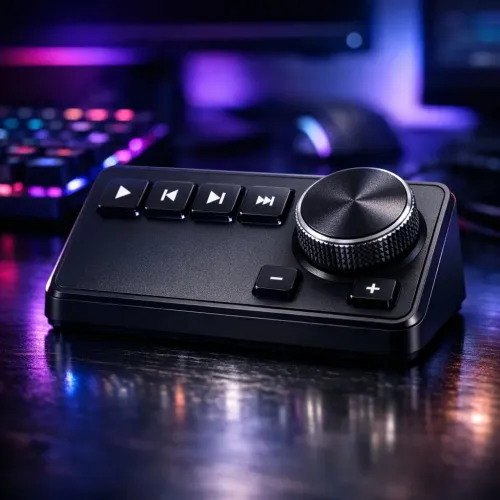
Dedicated media keys give streamers one-touch control to mute, switch scenes, clip highlights, and adjust audio — cutting task time and boosting consistency 🎛️⚡

PBT vs ABS keycaps: Clear, local guide for South African gamers—compare feel, sound, durability and where to buy. Find the best material for your budget and playstyle 🎮🇿🇦

- Multi-Function Digital Dial: define benefits - Show gamer setups and macros - Offer buying and setup tips Multi-Function Digital Dial puts programmable control at your fingertips for faster actions and smoother streaming. 🎮⚙️

- Explain benefits; - Show the science; - Compare options; - Recommend picks. Magnetic wrist rest for gaming cuts wrist strain and boosts comfort during long sessions 🕹️✨