Quick Answer
For portable gaming while travelling, do not overspend on a Wi-Fi router: most hotel and guest networks cap your speed anyway, so a R600 to R1,200 travel router or a phone hotspot is enough. Buy a R2,000-plus home router only for your fixed setup, not for the road.
Match The Router To Where You Actually Game
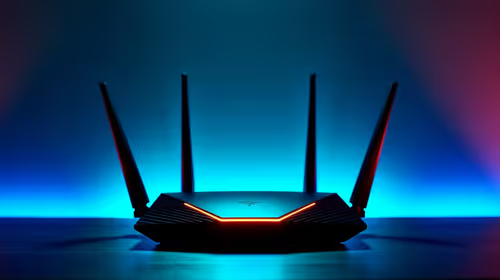
On the move you rarely control the network, so a flagship R3,000 to R6,000 router does nothing for a capped hotel line. A pocket travel router around R600 to R1,200 lets you create a private network from a wall Ethernet port or share a single login across devices, which is the real travel need. Reserve the expensive Wi-Fi 6 or Wi-Fi 7 router for your home, where your fibre line can use its 800Mbps-plus throughput.
For online gaming, latency matters more than raw speed; a wired connection to a travel router holds latency at 5ms to 20ms over a stable line, far better than congested venue Wi-Fi.
Where The Money Is Wasted
Headline features like Wi-Fi 7, 10-gig ports, and gaming dashboards mean nothing on a borrowed network. You also do not need tri-band or eight antennas in a hotel room. Spend instead on a small router that fits a bag, supports 2.4GHz and 5GHz, and can run off a power bank so a brief outage at the venue does not drop you mid-match.
What Actually Helps On The Road
A travel router plus a short Ethernet cable beats venue Wi-Fi nearly every time, since a wired uplink cuts the jitter that kills online play. If only Wi-Fi is available, a router that bridges and rebroadcasts a single login keeps all your devices connected without re-entering credentials. Pair it with mobile data as a backup so a flaky venue line does not end the session.
FAQ
Do I need an expensive router for gaming while travelling?
No. Travel networks cap your speed regardless, so a R600 to R1,200 travel router or a phone hotspot is enough. Save the R2,000-plus router for your home line where its full speed is usable.
Is a travel router better than hotel Wi-Fi for gaming?
Usually yes, especially if you can plug it into a wall Ethernet port for a wired uplink. That cuts the jitter and congestion that make shared venue Wi-Fi unreliable for online play.
What features actually matter in a travel router?
Compact size, dual-band 2.4GHz and 5GHz support, the ability to bridge a single login, and power-bank operation. Skip Wi-Fi 7, multi-gig ports, and gaming dashboards you cannot use on a borrowed network.
1m Ethernet cable with your travel router; plugging into a wall port for a wired uplink fixes more lag than any router spec while you are on the road.