Your new AI PC is a beast. It crunches through complex tasks and renders graphics at lightning speed. But there’s one problem… it sounds like a jet taking off from OR Tambo. That constant hum and whir of fans can ruin your focus and kill your gaming immersion. 😩
The good news? You don't have to live with the noise. We'll show you how to make your AI PC quieter with seven simple, actionable steps you can tackle this weekend.
Step 1: Give It a Good Clean 💨
Dust is the number one enemy of a quiet PC. It clogs up filters, suffocates heatsinks, and forces your fans to spin faster (and louder) to keep things cool.
Start with the basics:
- Power Down: Completely switch off and unplug your PC.
- Wipe Down Filters: Most modern cases have removable dust filters on the front, top, and bottom. Slide them out, give them a gentle wipe or rinse, and make sure they're completely dry before putting them back.
- Use Compressed Air: Use short, controlled bursts of compressed air to blow dust out of your CPU cooler, graphics card fins, and case fans. Always hold the fan blades still with a finger to prevent them from over-spinning.
A simple clean can dramatically reduce temperatures and, in turn, fan noise.
Step 2: Optimise Your Fan Curves
Your PC's fans don't need to run at 100% all the time. A "fan curve" is a setting that tells your fans how fast to spin based on the component's temperature. A gentle, gradual curve is key to making your AI PC quieter.
You can usually adjust these settings in your motherboard's BIOS/UEFI. Look for sections like "Hardware Monitor," "Q-Fan Control," or "Smart Fan." The goal is to keep fans at a low, inaudible speed during idle or light tasks, only ramping them up when temperatures climb during heavy AI workloads or gaming.
Software Control for Easier Tweaking 🔧
If digging into the BIOS feels a bit daunting, dedicated software can help. Apps like Fan Control (a popular open-source tool) or MSI Afterburner (for your GPU) give you a user-friendly interface to create custom fan curves directly from your Windows desktop. It makes fine-tuning your PC's acoustics much simpler.
Step 3: Improve Your Case Airflow
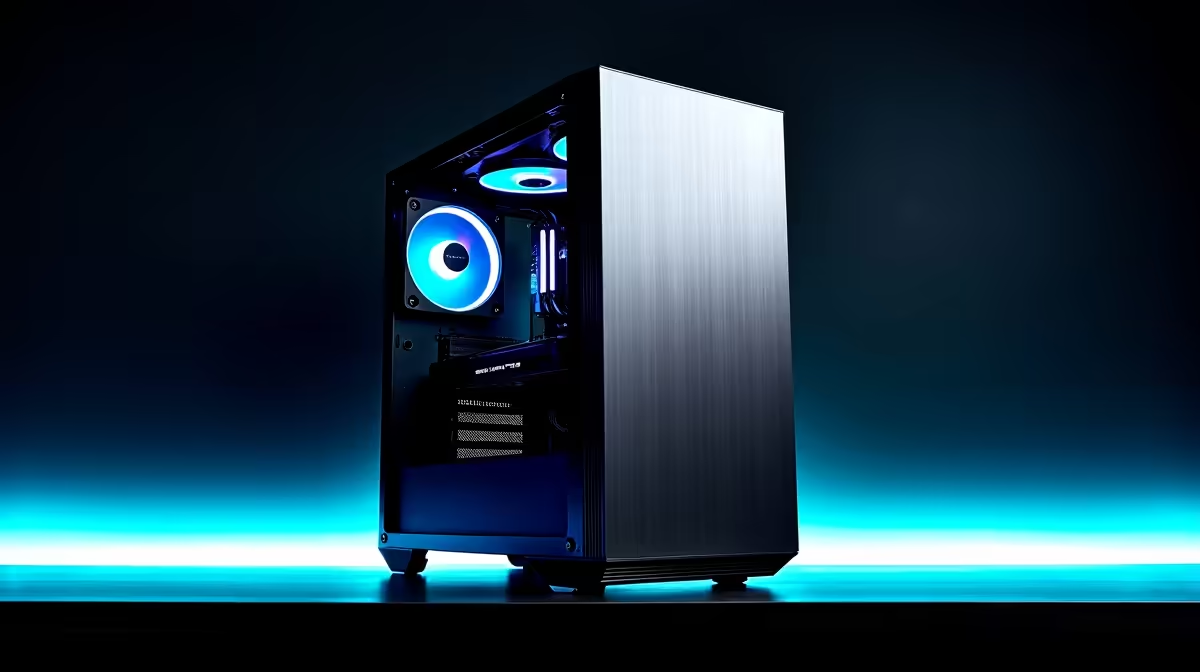
How air moves through your case is just as important as how fast your fans spin. Poor airflow traps hot air, forcing fans to work harder.
- Cable Management: Tidy up that "spaghetti" of cables behind your motherboard. Use cable ties or velcro straps to bundle them together and keep them out of the main airflow path. A clean build isn't just for looks; it's for performance.
- Fan Orientation: Ensure you have a clear airflow path. Typically, this means front fans pulling cool air in (intake) and rear/top fans pushing hot air out (exhaust).
Step 4: Upgrade Your Case Fans
The stock fans that come with many PC cases are designed to be cheap, not quiet. Investing in a set of high-quality aftermarket fans from brands like Noctua, be quiet!, or Corsair can make a world of difference. Look for fans with "PWM" (Pulse Width Modulation) in their name, which allows for more precise speed control, and check their decibel (dBA) rating—lower is better.
Step 5: Swap to a Better CPU Cooler 🤫
The stock cooler that came with your CPU is often the loudest component in the entire system. Upgrading to a large aftermarket air cooler or an All-in-One (AIO) liquid cooler is one of the most effective ways to reduce noise. These larger coolers have more surface area to dissipate heat, allowing their fans to spin much slower and quieter.
This is a standard upgrade for many high-performance builds, including the powerful NVIDIA GeForce gaming PCs designed to handle intense gaming and creative workloads without sounding like a hurricane.
Step 6: Consider Your Power Supply (PSU)
Is your PSU fan always spinning? A cheap or old power supply can be a sneaky source of constant noise. Modern, high-quality PSUs often feature a "zero-RPM" or "hybrid" mode. This means the fan doesn't even spin until the PSU reaches a certain load or temperature, making it completely silent during everyday tasks like browsing or watching videos. When building well-balanced AMD Radeon gaming PCs, selecting a quality PSU is a critical step for a stable and quiet experience.
Step 7: Isolate Vibrations ✨
Sometimes the noise isn't from the airflow itself, but from the vibrations of fans or hard drives rattling against the metal case.
- Rubber Mounts: Replace standard metal fan screws with soft rubber or silicone anti-vibration mounts.
- HDD Dampening: If you're still using mechanical hard drives, ensure they are mounted in drive sleds with rubber grommets.
These small details are often standard in premium builds like our professional-grade Workstation PCs, where silent operation is just as important as raw power.
By following these steps, you can transform your noisy rig into a whisper-quiet powerhouse, letting you focus on what really matters… dominating the competition or training the next big AI model.
Ready for a Whisper-Quiet Powerhouse? Tired of tweaking and troubleshooting? A professionally built PC from Evetech is optimised for quiet performance and maximum power right out of the box. Explore our incredible range of custom gaming PCs and find the perfect silent beast for your setup.