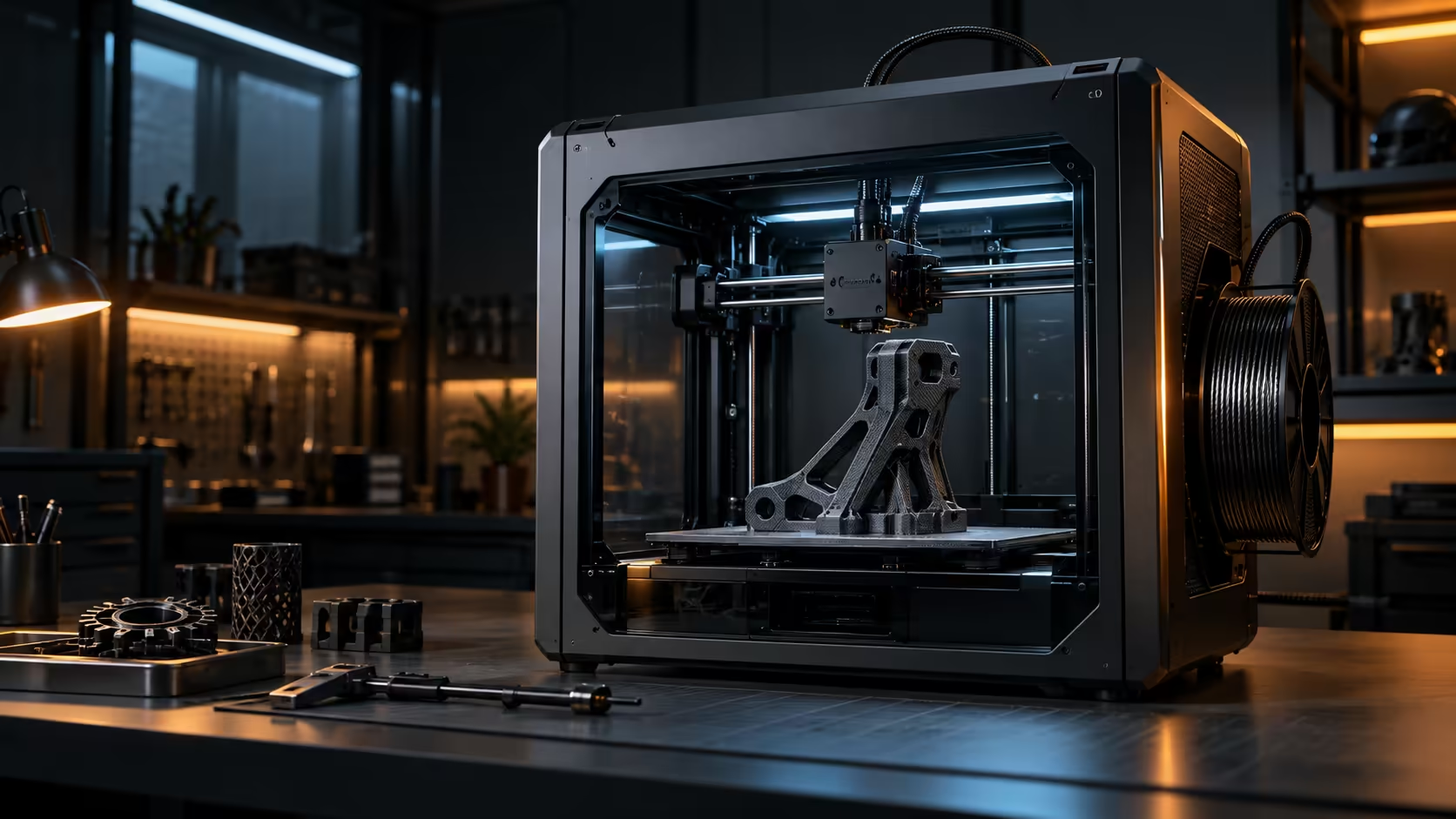
The bench matters more than the slicer profile on a fast machine, and that surprises people. An enclosed CoreXY 3D printer moving at 600mm/s throws its gantry left and right hundreds of times a minute, and every one of those direction changes pushes back into whatever the printer is standing on. The Creality K1C accelerates at 20000mm/s2 and costs R12,599, so it is fast enough that a springy desk shows up as ripples on a wall long before the machine is at fault.
Quick Answer
Put the printer on a rigid, heavy surface before you touch a single setting. A CoreXY at 600mm/s and 20000mm/s2 transfers real force into its stand, and a flexing desk produces ringing that no profile change will remove. The K1C is R12,599, prints in a 220x220x250mm volume, and runs a 300C tri-metal nozzle with a 50N direct drive extruder.
🏗️ Start with the surface, not the settings
A CoreXY moves its toolhead with two belts driving the X and Y axes together, which is what lets the moving mass stay low and the speeds stay high. The trade is that the reaction forces go somewhere, and that somewhere is the frame and then the table.
You want mass and stiffness. A solid wooden workbench, a heavy desk, or a 20kg paving slab laid on a cheap table all work, and the slab is the cheapest fix of the three. A folding trestle table, a plastic garden table or a tall narrow shelf do not, and they are the usual explanation for a pattern of faint vertical ripples spaced a few millimetres apart beside every sharp corner on a print.
Level matters separately from stiffness. A machine sitting on a surface that rocks even slightly on one corner will fight its own bed levelling, and you will chase the problem in software for a week. Put a spirit level across the top in both directions and shim the feet rather than adjusting anything in the menu.
Give it room to breathe too. An enclosed machine vents its heat somewhere, and pushing it flush against a wall in a corner traps warm air around the electronics. A hand's width behind and on the sides is enough.
🔥 What the hotend is really for
The headline on the K1C is not the speed, it is the nozzle. A tri-metal Unicorn nozzle rated to 300C paired with a metal direct drive extruder pushing 50N of force is a combination built for materials that chew through a standard setup.
Carbon-fibre reinforced filament is the obvious one. Chopped carbon fibre is abrasive, and it will wear a brass nozzle into an oval within a few hundred grams, at which point extrusion width drifts and nothing prints to size any more. Running it needs a hardened nozzle, which is what the hardened stainless steel option in the box is for, and swapping to it is the first thing to do if PA-CF or PET-CF is the reason you bought the machine.
The 300C ceiling opens up the rest: ABS, ASA, PETG, TPU, PA and PC all have a place, and each one wants the enclosure closed rather than open. The 50N extruder matters most for flexible filament, where a weak drive gear lets TPU buckle rather than feed.
If you are printing PLA only, none of this is doing anything for you, and the honest version is that a cheaper machine prints PLA just as well. The hotend is the reason to pay for this one.
🌡️ The enclosure, ventilation and a South African room
An enclosure does two jobs. It holds warmth around the print so ABS and ASA do not warp or split between layers, and it contains what those materials give off while printing.
The K1C has a built-in air filter, which handles a good deal of that, but filters are consumables and a filter that has not been changed in a year is doing very little. Treat it as a replaceable part with a schedule, the way you would a vacuum cleaner filter.
Placement is where a lot of SA homes come unstuck. A printer running ABS overnight in a small closed bedroom is the wrong arrangement regardless of what the filter does. A spare room, a garage or a study with a window that can be cracked open is the right one, and a garage has the second advantage of being the easiest place to put a genuinely heavy bench.
Ambient temperature swings the other way in summer. A closed garage in the Highveld can sit well above 30 degrees through a February afternoon, and a hot chamber plus hot ambient is where PLA starts softening near the extruder and jamming. If the same machine prints ABS beautifully and PLA badly, ambient is usually why, and running PLA in the cooler part of the day fixes it without any setting change.
🧰 First print, and what to keep on the shelf
Run a small calibration cube first, not the 12-hour model you bought the machine for. You are checking three things: that the first layer is squashed evenly across the whole bed, that corners are sharp without ringing, and that the dimensions come out to size.
If corners ring, go back to the bench. If the first layer is uneven along one side, go back to the level. Only after both of those are clean does changing a slicer setting tell you anything useful.
Keep spares in the drawer from the start. A second hardened nozzle, a spare PTFE section if your setup uses one, and a fresh air filter are the three things that stop a project in its tracks, and the local filament range is worth checking for what is actually stocked here before designing a part around an exotic blend. Machines and build volumes sit in the 3D printer range, and if the printer is going on a desk rather than a bench, the sturdier options in the desk range are a better starting point than a folding table.
Frequently Asked Questions
Does the table really affect print quality?
On a fast CoreXY, yes. Direction changes at 20000mm/s2 transfer force into the stand, and a flexing surface shows up as ripples beside sharp corners.
Do I need a hardened nozzle for carbon-fibre filament?
Yes. Chopped carbon fibre is abrasive and wears a brass nozzle quickly, which changes extrusion width and ruins dimensional accuracy.
Can I run this printer in a bedroom?
For PLA, with ventilation, many people do. For ABS or ASA, choose a spare room, study or garage with a window rather than a small closed sleeping space.
Why does PLA jam in summer when ABS is fine?
PLA softens at a lower temperature, so a hot chamber plus a hot room can let it soften above the nozzle. Printing in the cooler part of the day usually solves it.
Is the 220x220x250mm volume limiting?
For functional parts and prototypes it is generous. For large single-piece props or signage, plan on splitting the model or looking at a larger machine.
Ready to get a fast printer producing parts instead of ripples?
Sort the bench and the level first, run a calibration cube, and keep a hardened nozzle and a spare filter on the shelf.