Client records, case files, medical notes, financial statements: the moment any of that touches a third-party AI cloud, you have handed sensitive data to someone else's servers. A private AI flips that around by running the model entirely on your own office machine, so client information never leaves your network. For small SA firms with confidentiality obligations under POPIA, that is the difference between safe and exposed.
Quick Answer
Run a local AI by installing an open-source language model on a capable office PC, so it processes client records on your own network with nothing sent to an external cloud. The setup supports POPIA compliance, needs no coding to get running, and an AI-ready PC with a strong GPU handles a useful model comfortably.
Why Local Beats Cloud for Confidential Work
When you use a typical cloud AI, your prompts and documents travel to a provider's servers to be processed. For a casual query that is fine; for a client's ID number, medical history, or contract, it means personal information has left your control. POPIA holds you responsible for how that data is handled, and "we sent it to an overseas AI service" is a weak position to defend.
A local model removes the network hop entirely. The AI runs on hardware you own, in your office, so the data is processed and discarded without ever crossing the internet. You keep the productivity of an AI assistant while keeping the confidentiality your clients expect.
Step-by-Step: Standing Up a Private AI
1. Get the Right Hardware
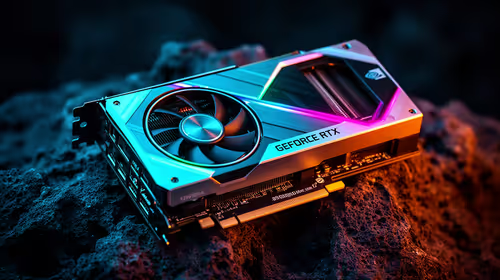
A local model leans hardest on the GPU and its VRAM, with system RAM and a fast SSD close behind. An AI-ready PC with a modern GPU carrying ample VRAM runs a capable mid-size model smoothly. A higher VRAM figure opens the door to bigger, more powerful models with stronger reasoning, so size the machine to the workload you genuinely expect rather than the bare minimum. This is a one-time purchase that then runs without ongoing per-query fees.
2. Install a Local AI Runner
No programming knowledge is required. Several free desktop applications install a local model with a standard installer and present a chat window that feels familiar to anyone who has used an online AI tool. Select a model from the built-in catalogue, download it once, and it runs offline on your machine from that point. A non-technical team member can have the whole thing working in an afternoon.
3. Choose a Model That Fits Your Hardware
Local models come in different sizes, measured roughly by parameter count. Smaller models run on modest hardware and answer fast; larger ones are more capable but need more VRAM. Start with a mid-size general model, test it on your real tasks, and step up only if you need more capability. The runner app tells you which models your machine can handle.
4. Keep It Off the Network for Sensitive Jobs
Once the model is downloaded, it does not need an internet connection to run. For confidential work you can disconnect the machine from the internet entirely and the AI still functions, which is a strong, simple guarantee that nothing leaves the building. Connect only when you want to update the software or pull a new model.
5. Set Simple Usage Rules
Decide who can use the machine, what kinds of documents go through it, and where outputs are saved. Because everything stays local, your controls are physical and policy-based rather than dependent on a vendor's terms. Write a short internal note so staff know the private AI is for the confidential work and the cloud tools are for everything else.
What a Private AI Can Realistically Do
A local model handles the bulk of everyday office AI work: summarising long documents, drafting and rewriting correspondence, extracting key points from records, answering questions about pasted text, and tidying notes. It will not match the very largest cloud models on the hardest reasoning, but for confidential document work that ceiling rarely matters. The win is that sensitive material gets AI assistance without ever leaving your control.
For SA firms in law, accounting, healthcare, or any field bound by POPIA, this is a practical path to using AI responsibly. The hardware suited to local AI work is listed in the AI-ready PC section at Evetech, and if you want a feel for what current office machines are packing at each price point, the PC best sellers page is a quick way to benchmark the field.
Frequently Asked Questions
Does a private AI really keep client data off the cloud?
Yes. A local model runs entirely on your own hardware, so documents and prompts are processed in your office and never sent to an external server. You can even disconnect the machine from the internet during sensitive work and the AI still functions.
Do I need to be a programmer to set this up?
No. Free desktop applications install a local model with a standard installer and give you a familiar chat window. A non-technical staff member can get one running in an afternoon and pick models from a built-in list.
How does a private AI help with POPIA compliance?
POPIA holds you responsible for protecting personal information. Keeping client data on a local machine instead of sending it to a third-party cloud removes a major point of exposure, since the data never leaves your control. It supports compliance, though you should still pair it with sensible internal policies.
What hardware do I need to run a local AI?
A modern GPU with ample VRAM is the key component, backed by sufficient system RAM and a fast SSD. An AI-ready PC sized to the model you want runs everyday document tasks smoothly. A GPU with a higher VRAM capacity unlocks access to larger and more powerful models when your tasks demand it.
Is a local model as capable as a big cloud AI?
For everyday office work like summarising, drafting, and extracting information, a good mid-size local model is more than capable. It will not match the very largest cloud models on the hardest reasoning, but for confidential document work that gap rarely matters.