


Clean Gaming Keyboard: Guide for Dusty & Humid Conditions
Clean gaming keyboard quickly and safely in dusty or humid conditions with step-by-step tips, tool checklist, and maintenance routines to prevent corrosion and switch failure. 🧼💨
Read moreDeciding on PCIe 5.0 vs 4.0 for gaming? We break down the total platform cost—from motherboards to SSDs—to see if the performance gains justify the price. Discover which standard offers the best value for your next build and avoid overspending! 💰💻
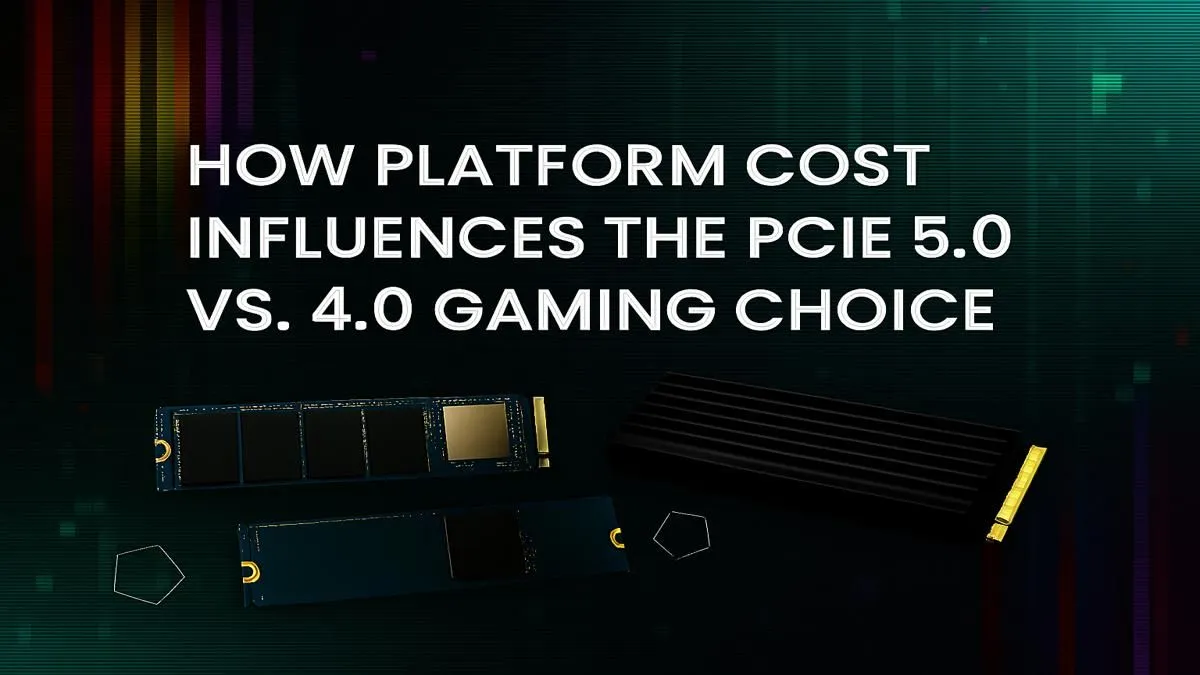
Building a new rig in South Africa? You’ve seen the hype: PCIe 5.0 is here, promising mind-blowing speeds. But with the higher platform cost, is it actually a smart move for your gaming experience? When comparing PCIe 5.0 vs 4.0 gaming performance today, the answer isn't so simple. Let's break down whether the extra Rands translate into real-world FPS gains, or if you're better off saving that cash for a beefier GPU. 🤔
At its core, the difference is all about bandwidth. Think of the PCIe slot on your motherboard as a highway for data.
This super-fast lane is primarily for two components: your graphics card and your NVMe SSD. More bandwidth means your components can talk to your CPU faster. But the key question is, do current games and hardware even need this much speed?
This is the make-or-break question for most PC builders. Let's be direct: for pure gaming in 2024, the impact of PCIe 5.0 is minimal.
Even the most powerful consumer GPU on the market, the NVIDIA GeForce RTX 4090, doesn't fully saturate a PCIe 4.0 x16 slot. When you run benchmarks comparing the same card on a PCIe 4.0 vs a 5.0 slot, the performance difference is often within the margin of error... usually 1-2%. That's a handful of frames you'd never notice in the heat of battle. The bottleneck for gaming performance is almost always the GPU itself, not the PCIe lane. Therefore, choosing the right motherboard is less about the PCIe generation and more about features that support your chosen CPU and GPU.
This is where PCIe 5.0 shines on paper. A Gen5 NVMe SSD can hit read/write speeds over 12,000 MB/s, which is ludicrously fast compared to the ~7,000 MB/s of a top-tier Gen4 drive.
However, for game loading times, we hit a point of diminishing returns. The leap from a standard SATA SSD to a Gen4 NVMe is huge. The leap from Gen4 to Gen5? Not so much. You might shave a second or two off a loading screen, but it's not the transformative experience you might expect. Technologies like Microsoft's DirectStorage API are designed to leverage these speeds, but widespread adoption is still on the horizon. 🚀
For a pure gaming rig, your budget is almost always better spent on the next tier of graphics card rather than on a PCIe 5.0 motherboard and SSD. A top-tier PCIe 4.0 platform with an RTX 4070 Ti SUPER will deliver a vastly better gaming experience than a PCIe 5.0 platform with a standard RTX 4070. Focus your Rands where the frames are!
Upgrading to PCIe 5.0 isn't just about one component; it's a full platform investment. This is where the debate over PCIe 5.0 vs 4.0 gaming gets serious for South African buyers.
To get PCIe 5.0, you need a compatible motherboard and CPU. For Team Blue, that means looking at higher-end Intel motherboards from the Z690/Z790 series paired with a 12th Gen or newer CPU. These boards often carry a premium for the more robust power delivery and complex wiring needed for Gen5 speeds.
It's a similar story for Team Red. You'll need one of the latest AMD motherboards on the AM5 socket, which also requires more expensive DDR5 RAM. A mature AM4 build with a Ryzen 5000 series CPU and DDR4 RAM on a PCIe 4.0 board offers incredible value-for-money right now.
So, should you spend the extra cash? It depends entirely on who you are.
For most South African gamers, the PCIe 5.0 vs 4.0 gaming debate is settled by simple economics. PCIe 4.0 delivers virtually identical gaming performance for a fraction of the platform cost.
Ready to Build Your Next Powerhouse? Whether you're siding with the incredible value of PCIe 4.0 or future-proofing with the raw speed of PCIe 5.0, the perfect foundation for your build is waiting. Explore our massive range of PC components and find the ideal hardware to conquer your world.
For most current games, PCIe 5.0 is not necessary. Modern GPUs don't fully saturate the bandwidth of PCIe 4.0, making it the more cost-effective choice for pure gaming today.
The main cost difference lies in the motherboards and the requirement for newer CPUs. PCIe 5.0 motherboards often use premium chipsets and require DDR5 RAM, increasing the total platform cost.
While PCIe 5.0 SSDs have much higher sequential speeds, the impact on gaming load times is minimal for now. The difference is often less than a second compared to a fast PCIe 4.0 NVMe SSD.
Yes, PCIe is backward and forward compatible. You can safely use a PCIe 4.0 graphics card in a PCIe 5.0 slot, and it will run at PCIe 4.0 speeds without any issues.
Yes, choosing a PCIe 5.0 platform can be a good strategy for future-proofing. It ensures your system is ready for next-generation GPUs and SSDs that will eventually leverage the extra bandwidth.
For a budget gaming build, PCIe 4.0 is unequivocally the better choice. It offers excellent performance at a much lower total platform cost, allowing more budget for the GPU.
Clean gaming keyboard quickly and safely in dusty or humid conditions with step-by-step tips, tool checklist, and maintenance routines to prevent corrosion and switch failure. 🧼💨
Read more
Best gaming keyboard features to prioritize when building a high-end setup: mechanical switches, low latency, hot-swap, RGB, macros, durability and ergonomics 🎮⌨️
Read more
Custom actuation point keyboard setup guide: learn to set per-key actuation on your analog gaming keyboard for faster, precise inputs and better control 🎮⚙️
Read more
Cable management for home entertainment helps you eliminate cable clutter quickly and safely. Learn routing, concealment, and product picks to tidy your setup fast 📺🔌
Read more
conference room setup Microsoft Teams Zoom: Upgrade AV, camera, mic, and network to ensure seamless meetings, clear audio, and crisp video 🎯🔧
Read more
• Audit setup • Link accounts • Configure ViewBoard • Test workflows Integrate Google Workspace with ViewSonic ViewBoard to enable secure SSO, calendar and Drive sync, and smooth collaborative whiteboarding 🔗📋
Read more
Discover webcams that automatically adjust light and color for crystal-clear video calls 🎥✨. Boost your streaming quality today!
Read more
Discover webcams that blend into your workflow 🎯 Capture moments while you work, stream, or create. Upgrade your setup with smart, multitasking tech!
Read more
Dedicated media keys give streamers one-touch control to mute, switch scenes, clip highlights, and adjust audio — cutting task time and boosting consistency 🎛️⚡
Read more
PBT vs ABS keycaps: Clear, local guide for South African gamers—compare feel, sound, durability and where to buy. Find the best material for your budget and playstyle 🎮🇿🇦
Read more
- Multi-Function Digital Dial: define benefits - Show gamer setups and macros - Offer buying and setup tips Multi-Function Digital Dial puts programmable control at your fingertips for faster actions and smoother streaming. 🎮⚙️
Read more
- Explain benefits; - Show the science; - Compare options; - Recommend picks. Magnetic wrist rest for gaming cuts wrist strain and boosts comfort during long sessions 🕹️✨
Read more