You’ve done it. You’ve saved up, picked out that beast of a graphics card, and scored a powerful CPU. Your dream PC build is so close you can almost smell the thermal paste. But hold on… what about the power supply? Skimping on this one component is one of the biggest gambles in PC building. The risk of PSU failure damage is real, and a cheap, no-name unit can turn your high-end rig into a very expensive paperweight. 💀
What a Power Supply Unit Actually Does
Think of the Power Supply Unit (PSU) as the heart of your PC. It doesn’t just pump electricity; it takes the raw, high-voltage AC power from your wall socket in your Mzansi home and meticulously converts it into stable, low-voltage DC power that your sensitive components need to survive.
Your motherboard, CPU, and GPU all rely on different, precise voltages (like the +12V, +5V, and +3.3V rails). A good PSU delivers this power cleanly and consistently. A bad one… well, that’s where the trouble begins.
The Silent Killers: How PSU Failure Causes Damage
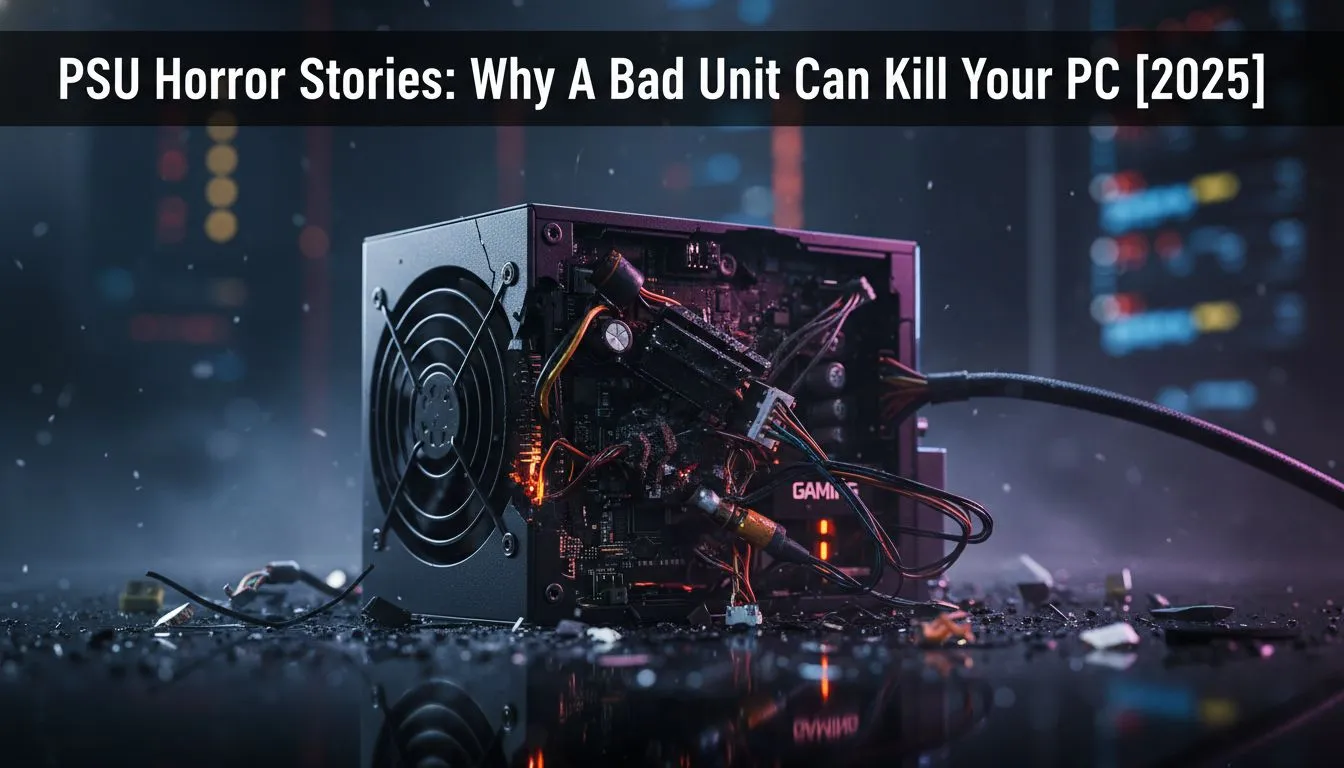
When a cheap PSU gives up the ghost, it rarely goes quietly. The resulting PSU failure damage can be catastrophic, wiping out multiple components in a single, fatal surge. Here’s how it happens:
Overvoltage Catastrophe
This is the most dramatic type of power supply failure. The unit fails and sends a massive voltage spike down the lines, far exceeding what your components are rated for. Your motherboard’s delicate circuits are fried instantly. Your CPU and GPU, which you spent thousands of rands on, are next. There’s no coming back from this; it’s a total knockout. Quality units from brands like Corsair offer robust protection circuits specifically to prevent this from happening.
Slow Poison: Ripple and Instability
Sometimes, the damage is more subtle. A low-quality PSU delivers "dirty" power, full of electrical noise and voltage fluctuations called ripple. This unclean power puts constant stress on your components, especially the capacitors on your motherboard and graphics card. It leads to random crashes, blue screens of death, and significantly shortens the lifespan of your entire system. This is a slower, more insidious form of bad PSU damage.
Red Flags: Spotting a Failing PSU Before It's Too Late 🔧
Your PC will often give you warning signs before a complete meltdown. If you notice any of these, shut down your system and investigate immediately:
- Random Restarts: Your PC suddenly reboots without warning, especially when you start a game.
- Strange Noises: A distinct buzzing, whining, or clicking sound coming from the back of your PC.
- A Burning Smell: This is the most urgent red flag. Unplug your PC from the wall immediately!
- System Instability: Frequent freezes or crashes that you can't trace to software.
Even reputable budget-friendly options from brands like GAMDIAS often have better build quality and are less likely to exhibit these issues than generic, uncertified units.
PSU Sizing Pro Tip ⚡
Use an online PSU calculator to estimate your power needs. Add up the wattage of your CPU, GPU, and other components. Then, add a 20-30% buffer on top. This headroom ensures your PSU runs at its most efficient curve (usually 50-70% load) and gives you space for future upgrades without needing a new power supply.
Choosing Wisely: How to Avoid PSU Failure Damage
Protecting your investment is simple: treat the PSU as a priority component, not an afterthought. Saving R500 on a power supply isn't a bargain if it ends up costing you a R15,000 graphics card.
The easiest mark of quality is the 80 PLUS certification. This rating guarantees a certain level of power efficiency, meaning less electricity is wasted as heat. More importantly, manufacturers have to use better components to meet this standard. As a baseline for any gaming PC, always look for 80 PLUS Bronze certified power supplies or higher. It’s a simple step that drastically reduces the risk of PSU failure damage. ✨
Ready to Power Up Safely?
The risk of PSU failure damage isn't worth the small saving on a cheap unit. Protect your high-end components with a power supply you can trust. Explore our massive range of reliable PSUs and build your dream PC with peace of mind.