A part that curls off the plate at the corners and one that delaminates cleanly between layers look like the same complaint, "it fell apart", but they come from different physics and need different fixes. Warping and poor layer adhesion in large prints are two separate problems wearing one name.
Quick Answer
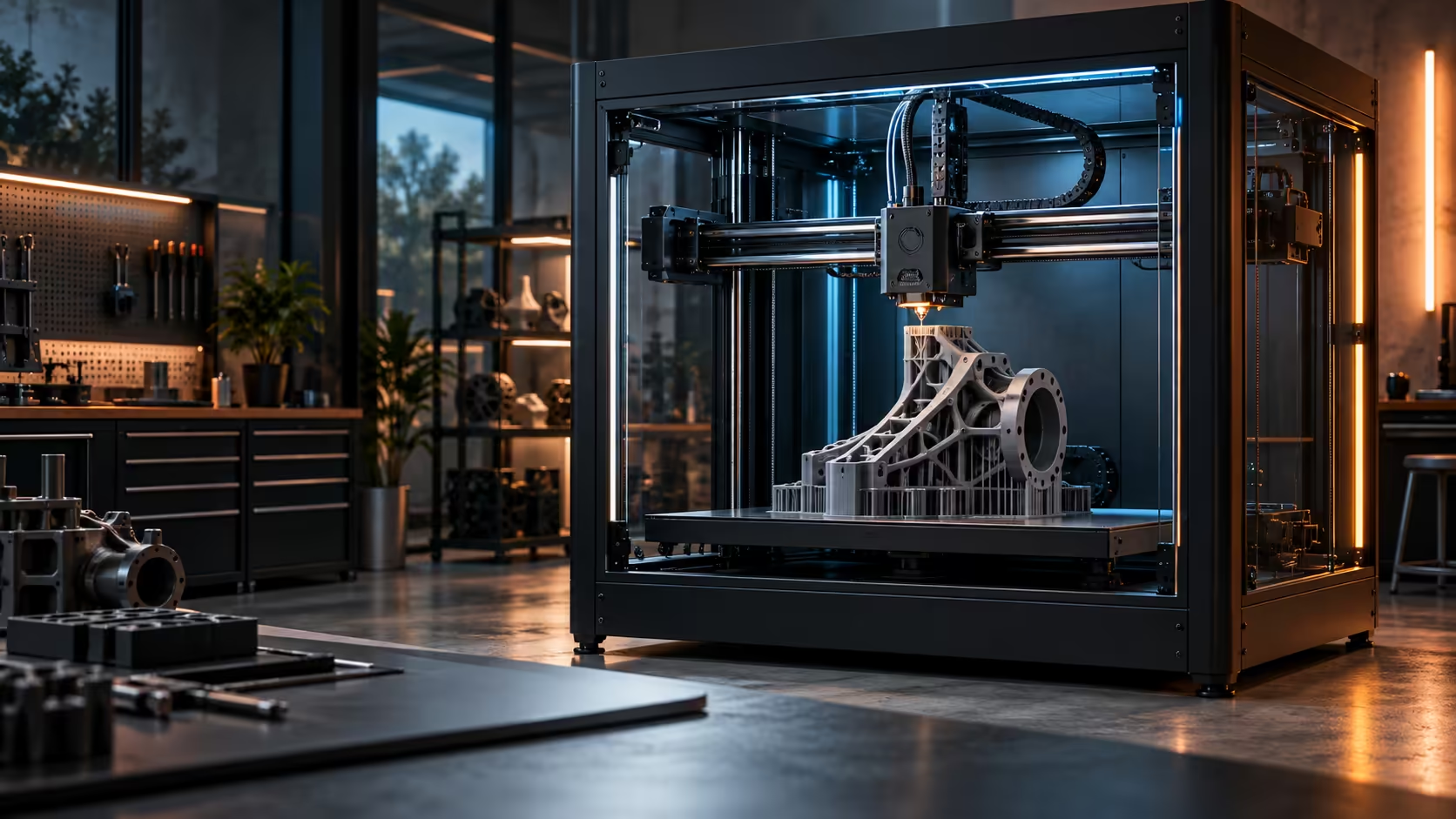
Warping is uneven cooling, not weak adhesion, so the fix is a stable warm chamber rather than a stickier plate or more glue. Layer adhesion is a heat problem between successive layers, and it needs the previous layer still slightly warm when the next one lands rather than fully cooled. Large parts suffer both more than small ones because they pull harder at the corners and take longer to print, which is why the R13,999 Creality K1 Max prints enclosed rather than open.
🌀 Warping: why the corners lift first
Plastic such as ABS shrinks by roughly 0.5 to 0.8% as it cools from around 250C down to room temperature, and a large flat base has far more edge length pulling inward than a small one does. The corners are where that pull concentrates, since they are furthest from the centre and have the least material anchoring them down.
An enclosed, heated chamber slows that cooling and keeps it even across the whole part, rather than letting the edges cool faster than the centre. A room with a draught, an open window near the printer, or a cold South African evening working against a bed heater all make this worse regardless of how well the plate itself is prepared.
🧱 Layer adhesion: a different kind of heat problem
Delamination, layers separating cleanly rather than corners lifting, happens when a new layer at around 0.2mm thick lands on one that has already cooled too far below its target temperature. The two need to bond while there is still enough shared warmth between them, which on a large part is harder to guarantee because the print head takes longer than 60 seconds to travel back across a wide layer.
Slowing part cooling fans slightly on materials prone to this, and keeping ambient chamber temperature stable, both help the next layer bond rather than sit as a separate, weakly attached piece.
☀️ Why a South African summer makes both worse
An enclosed printer sitting near a window through a Highveld summer afternoon deals with ambient swings that a small, unheated print never has to survive. Direct sun on one side of the enclosure heats that side faster than the other, recreating the same uneven-cooling problem warping already causes, just from outside the machine rather than inside it.
Move the printer away from direct sun and drafts before troubleshooting settings, since environmental placement fixes some warping issues that no slicer setting will touch. Check the 3D printer range for enclosed options if an open-frame machine is the reason large ABS or ASA parts keep failing, and a resin printer sidesteps this issue entirely for small, detailed parts where FDM warping is not a factor at all.
🧱 Brims, rafts and when each one actually helps
A brim, a thin single-layer skirt attached to the base of a part, increases the surface area gripping the plate and is the first thing worth trying on a part that lifts specifically at the corners rather than across the whole base. It adds a small amount of post-print cleanup but costs almost nothing in print time, which makes it the cheapest fix to try before reaching for anything more involved.
A raft, a thicker sacrificial layer printed underneath the whole part, solves a different problem: a first layer that is uneven or a material that struggles to bond directly to the plate at all. Rafts cost more time and filament than a brim and leave a rougher finish on the bottom of the part once removed, so they are worth reserving for parts that a brim alone does not fix rather than using them as the default for every large print.
Choosing between the two comes down to where the problem actually shows up: corners lifting points to a brim, the whole base failing to stick or a rough, inconsistent first layer points to a raft or to fixing bed levelling directly. Stock filament that adheres predictably for the material you print most, since a brim or raft compensates for a marginal setup but works best paired with filament that was not already fighting you from the start.
Frequently Asked Questions
Is warping the same problem as poor layer adhesion?
No, warping is uneven cooling pulling the base off the plate, while adhesion failure is layers separating from each other; they need different fixes.
Does an enclosure fix both problems?
It helps both by keeping temperature stable, but adhesion also depends on part-cooling fan settings and print speed, not the enclosure alone.
Why do large parts warp more than small ones?
They have more edge length pulling inward at the corners and take longer to print, giving temperature more time to become uneven across the part.
Can placement near a window really cause warping?
Yes, direct sun heating one side of an enclosure faster than the other recreates the same uneven-cooling problem from outside the machine.
Losing large parts to curling corners or split layers?
Separate the two problems first, then fix temperature stability before touching the slicer.