A DDR5 upgrade should be the simplest part of a build, yet mismatched kits and a forgotten BIOS setting turn it into a troubleshooting session. Diagnosing the real cause before buying more memory saves both Rands and posting headaches.
Quick Answer
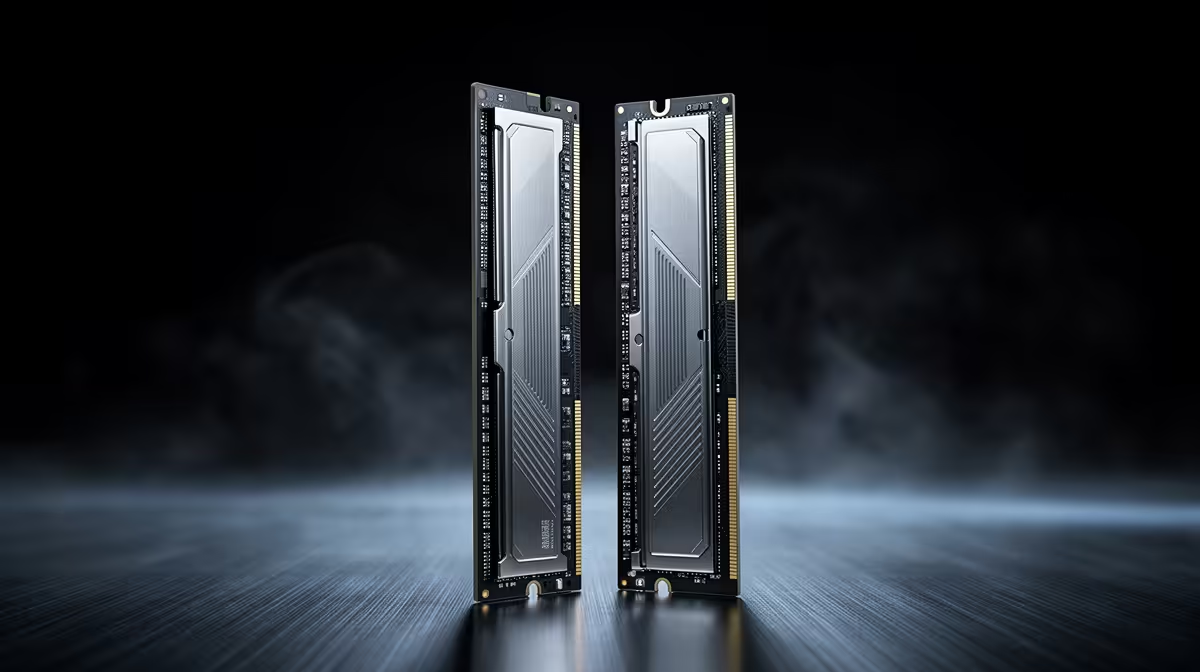
Most DDR5 upgrade problems come from mixing kits or ignoring the motherboard's QVL: adding a second kit often drops the speed from 6000MT/s to a stable 4800MT/s or fails to post. Buy a single matched 32GB kit (2x16GB) rather than mixing, and enable EXPO or XMP after a BIOS update. Expect about R1,100 to R1,800 for a solid 32GB 6000MT/s kit.
Why DDR5 Upgrades Misbehave
DDR5 is fussier than DDR4 about how you populate it. Running four single-rank sticks, or mixing two different kits, often forces the memory controller to drop speed for stability, so a rated 6000MT/s pair can settle at 4800MT/s. The motherboard's QVL lists the kits validated for high speeds; straying from it is where instability starts. Capacity (16GB, 32GB, 64GB), speed in MT/s and timings all interact, and the controller, not the sticks, sets the real ceiling.
Diagnose Before You Buy More
Before adding RAM, check three things. First, confirm whether your kit's EXPO or XMP profile is actually enabled in the BIOS, since many systems run at the JEDEC 4800MT/s default until you switch it on. Second, update the motherboard BIOS, because early AM5 and some Intel boards shipped with weaker memory training. Third, decide between a higher-speed 32GB kit and a 64GB kit; for gaming, 32GB at 6000MT/s usually beats 64GB at a lower speed. Buy a single matched kit rather than mixing.
A Stable Upgrade Path
If you have 16GB and stutter in modern games, the clean move is a single 32GB 6000MT/s kit (around R1,100 to R1,800) rather than adding a mismatched stick. Update the BIOS first, then enable EXPO or XMP and run a memory test to confirm stability. Only step to 64GB if you do heavy multitasking, virtual machines or large creative projects, since games rarely use it. Matching the kit to the board's QVL keeps the upgrade boring, which is exactly what you want from RAM.
Tailored To Diagnose before you upgrade
Match the choice to how, where and how often this kit is used in your space, since the right fit for your routine beats a spec sheet that flatters a different use case. For this use, match the spec to the room and routine rather than the headline number, and confirm current pricing and stock at Evetech.
FAQ
Why did my RAM slow down after adding a second kit?
Mixing kits or filling all four slots often forces the memory controller to drop speed for stability, so a 6000MT/s pair can fall to 4800MT/s. A single matched kit avoids this.
Do I need to enable EXPO or XMP?
Yes. Without it, DDR5 usually runs at the 4800MT/s JEDEC default rather than its rated speed. Enable the profile in the BIOS after updating the firmware.
Is 32GB or 64GB better for gaming?
For gaming, 32GB at 6000MT/s is the sweet spot and beats 64GB at a slower speed. Choose 64GB only for heavy multitasking, virtual machines or large creative workloads.
BIOS, enable EXPO or XMP, and buy a single matched 32GB 6000MT s kit from the board's QVL rather than mixing sticks.