Quick Answer
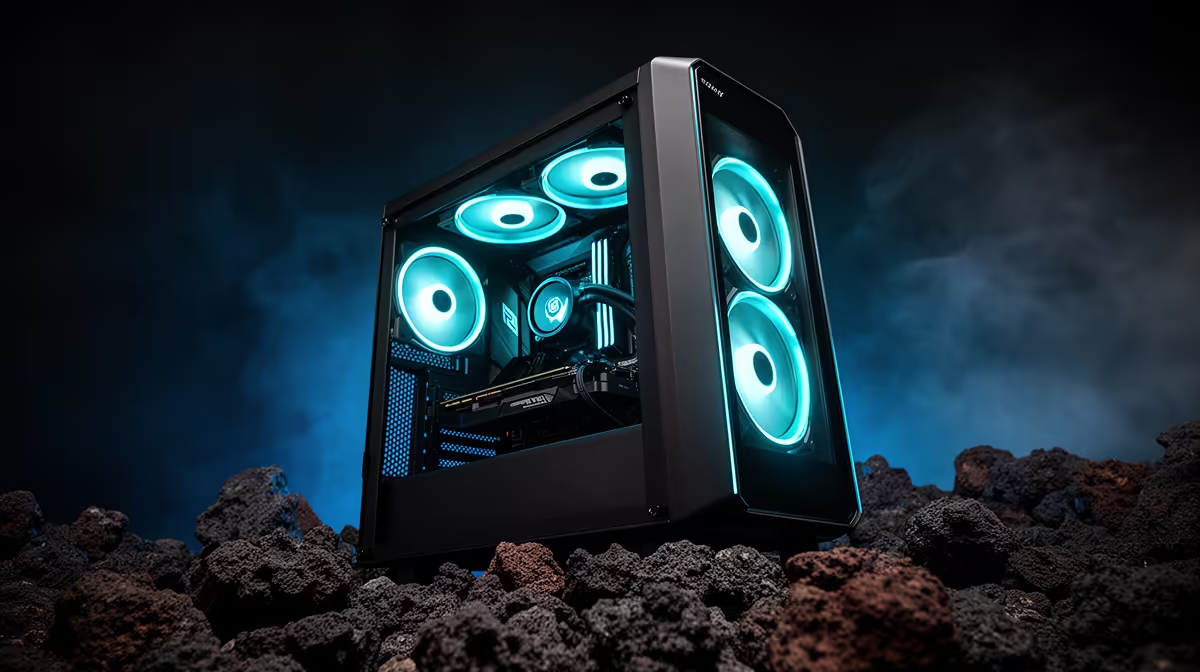
Quick take: for a Wits Architecture student, the best R20,000 build is a Ryzen 5 7600, RTX 4060 Ti 8GB, 32GB DDR5, 1TB NVMe. This spec puts the money where Architecture coursework needs it. Spend where the workload actually lands, not on the loudest spec.
Where the Architecture budget should go
Architecture is the one degree here that genuinely needs a graphics card. Revit viewports, Rhino models and Lumion or Enscape renders all lean on the GPU, with RAM and cores close behind. In practice that means Revit and AutoCAD, Rhino or SketchUp, Lumion or Enscape and Photoshop and InDesign, all of which lean on a real GPU, plenty of RAM and CPU cores - and a discrete graphics card is essential for 3D viewports and rendering.
Inside the R20,000 spec
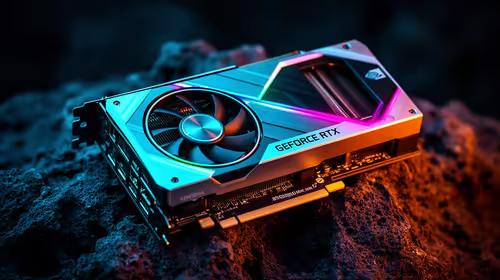
At R20,000 you reach 32GB and a faster card - Ryzen 5 7600, RTX 4060 Ti 8GB and a 1TB NVMe SSD. Heavy software and 1440p gaming both stop feeling tight. The 32GB DDR5 keeps it responsive and the 1TB NVMe loads projects fast. Start at 16GB if budget is tight, but 32GB is the real target for complex models and live rendering.
Gaming and rendering headroom
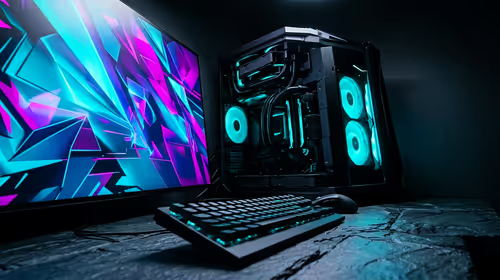
With an RTX 4060 Ti you'll get a smooth 1440p High experience at 65-95 fps and 120+ fps at 1080p. That same GPU power speeds up your render previews and 3D viewports, so it's never wasted on study days.
Soweto buyer notes
Living in Soweto keeps you close to the Wits campus, so a desktop is the smart buy over an expensive laptop. Delivery from Evetech is normally next working day. Fibre from Openserve or Vumatel is the norm here; a 5G router covers you until it's connected.
FAQ
Do Architecture students need a graphics card?
Yes - Architecture is GPU-dependent. 3D viewports and render engines all use the card, so an RTX 4060 8GB is the sensible starting point and an RTX 4070 12GB is better if you render often.
How much RAM should an Architecture student get?
16GB is the floor; 32GB stops Revit and a render engine from choking on a big model. DDR5 is standard on current AM5 boards.
Should an Architecture student buy a desktop or a laptop?
A desktop gives far more performance per rand at R20,000 and is easy to upgrade later. A cheap laptop for lectures plus a desktop at home is the combination most students settle on.
Confirm the motherboard supports a future CPU upgrade before you buy - it's what lets you drop in a faster chip in third year without a full rebuild.