Quick Answer
Yes, a R15,000 build comfortably handles Wits Engineering coursework and after-hours gaming. Aim for a Ryzen 5 5600 or Core i5-12400F, 16GB DDR4 of RAM and 1TB NVMe SSD, paired with an RTX 3050 / RX 6600-class GPU for 60-90fps at 1080p on most modern games. That covers MATLAB, Solidworks, ANSYS, Simulink and CAD-heavy coursework today and still has room to grow.
What a Wits Engineering degree actually demands
Students reading Engineering spend their days in MATLAB, Solidworks, ANSYS, Simulink and CAD-heavy coursework, so raw study throughput matters more than chasing one benchmark. The build for Faerie Glen households in Pretoria East should prioritise a high-clock multi-core CPU for simulation, a workstation-friendly GPU for CAD viewports, and 32GB RAM headroom for FEA work. ANSYS meshes and large assemblies push memory hard, and 16GB stalls mid-solve, which is why this R15,000 plan puts memory and storage ahead of flashy extras.
How to spend R15,000 sensibly
With R15,000 on the table, split it roughly as a balanced CPU and GPU pairing, then back it with 16GB DDR4 and 1TB NVMe SSD. For Engineering the an RTX 3050 / RX 6600-class GPU delivers 60-90fps at 1080p on most modern games while leaving the CPU free for compiles, renders or simulation. ANSYS meshes and large assemblies push memory hard, and 16GB stalls mid-solve, so do not skimp on memory even if it means a slightly cheaper graphics card. Solidworks and CAD navigation reward a capable GPU far more than esports titles do.
Setup notes for Faerie Glen
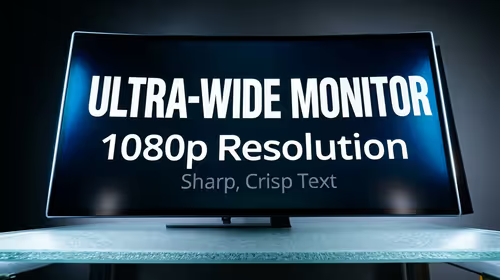
For Faerie Glen households in Pretoria East, two practical points beat any spec sheet. First, a a 100Hz 1080p panel gives you both crisp text for long study sessions and smooth motion for games. Second, plan cable routing and airflow so the machine stays quiet during back-to-back lectures and crit weeks. Buying as a complete desktop from a single supplier also keeps the whole system under one warranty, which saves headaches when a part needs attention.
FAQ
Is R15,000 enough for a Wits Engineering student?
For coursework, yes. A balanced CPU and GPU at this budget cover both study and gaming, and 16GB-plus of RAM with a fast SSD keeps daily work smooth. The only trade-off at the lower end is gaming performance, which you can lift later with a GPU upgrade.
Can I upgrade this build later?
Yes. Choosing a quality power supply, a roomy case and a current-socket motherboard now means you can drop in a stronger GPU or extra RAM down the line. That upgrade path is the main reason to buy a desktop over a sealed laptop.
Do Engineering students need a powerful graphics card?
Solidworks and CAD navigation reward a capable GPU far more than esports titles do. If you also game after hours, a mid-range card earns its keep; if not, redirect that money toward RAM, storage and a better monitor.
Student buying tip
Before you commit, list the three heaviest apps you run for Engineering and confirm the build clears them with 30% headroom. Buying the whole desktop from Evetech under one warranty keeps support simple if anything needs a swap.