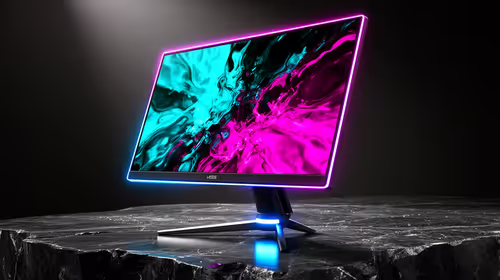
Best value in a Rand budget means buying the monitor behaviour that changes your own day. A QHD panel, reliable variable refresh, clean pixel response, usable inputs and a stand that fits the desk each provide practical value in different ways.
Quick Answer
For a ZAR budget, prioritise QHD detail, reliable adaptive sync and clean response before niche extras. South African buyers also gain practical value from an adjustable stand, useful ports and a local warranty that keeps a fragile 27-inch return out of customs. The R5,099 Lenovo Legion 27Q-10 offers QHD 240Hz IPS, multiple sync paths and a four-way stand, but value comes from matching those features to the PC and room.
🖥️ Resolution earns value across the whole day
At 27 inches, 2560x1440 gives more desktop room and a finer pixel structure than 1920x1080. Text, browsers, editing tools and detailed game scenes can all benefit. QHD has 3.69 million pixels per frame, about 78% more than Full HD, so it also asks more of the graphics card.
That trade-off should be tested rather than guessed. Run the games you play at 2560x1440, record sustained fps in a demanding scene and decide whether the settings needed are acceptable. If the PC remains comfortable, QHD can be the feature with the broadest daily payoff. Browse gaming monitors by the image and performance balance you can actually sustain.
🔄 Reliable sync is worth more than an unused peak
Refresh rate improves the opportunity for motion clarity, but uneven frame delivery can still create tearing or stutter-like pacing. The Legion carries AMD FreeSync Premium plus NVIDIA G-SYNC Compatible and VESA Adaptive Sync support. On a compatible system, variable refresh can let the display follow changing GPU delivery.
Configure it as a path: suitable direct cable, native resolution and refresh setting, monitor menu option, then graphics-driver option. Test a high-contrast camera pan in a real game. If a title exceeds 240fps repeatedly, test a cap below the ceiling. The feature has value only when it is configured and visible in the content you use.
⚙️ Clean response beats an extreme menu setting
The model lists 0.5ms MPRT, which concerns visible moving-picture persistence. It is not directly comparable to every grey-to-grey claim. Overdrive can shorten pixel transitions but may create inverse-ghosting halos when set too aggressively.
Test the normal overdrive position, one setting higher and one lower in the fps range you normally see. Look for dark trails, then separately for bright edges. The best value is a mode that remains clean across a full game session, not a mode that wins one static test.
🪑 Price the desk as part of the monitor
Height, tilt, swivel and pivot can save a buyer from adding an arm simply to achieve a comfortable position. Set the top portion of the active screen near normal eye level, control glare with placement before raising brightness, and leave enough cable slack for the stand to move. The Legion includes those four stand adjustments and has two HDMI 2.1 TMDS ports plus DisplayPort 1.4 HBR3.
For a South African buyer, current local warranty terms and the practical service route are also part of value. A fragile 27-inch screen is not a trivial overseas return. Confirm support conditions before relying on them; then include that reduced friction in the comparison instead of viewing price as the only Rand figure.
🎨 Add colour and HDR only when the role needs them
The product lists 99% sRGB, 90% DCI-P3, HDR10 and Dolby Vision support. These can make a monitor more flexible for web work and cinematic games. Colour-gamut coverage does not replace calibration, and HDR formats do not guarantee a particular contrast result. If creation work matters, set the correct colour space and reserve a colour meter for accuracy. If dark cinematic scenes matter most, inspect panel evidence rather than buying a format badge.
🧪 A comparison that finds real value
Make five rows for each candidate: QHD fps in your game, sync path, response test result, inputs and stand adjustment, then price plus local support. Add colour or HDR as a sixth only if it is a regular task. This method exposes a common bad purchase: a feature-rich monitor that has the wrong port, poor desk fit or a refresh rate the PC never approaches.
Use monitor deals and monitor best sellers as price comparisons only after the system checklist identifies which feature actually has value at your desk.
Frequently Asked Questions
Is the cheapest QHD 240Hz monitor always best value?
No. Check the PC performance, panel behaviour, ports, stand and support conditions. A lower upfront price can omit a feature you use every day.
Why test adaptive sync instead of trusting the badge?
The display, cable, driver and game profile all need to be configured correctly. A badge cannot prove the current setup is working.
Do colour coverage figures make a monitor good for professional work?
They are useful information, but professional colour work also needs the right workflow, room conditions and often a measured profile.
Which feature should lead a competitive purchase?
Start with sustained QHD fps and clean motion. Then choose the ports and physical adjustment that make that performance comfortable to use.
Ready to compare monitor value beyond a single price tag? Give every Rand to a feature your PC, desk and daily work can genuinely use.