Staring at your timeline, trying to perfect that sunset gradient, but a weird, blocky "banding" effect ruins the shot? You're not alone. For South African filmmakers and editors, the 10-bit vs 8-bit FRC monitor debate is crucial. Getting it right means silky smooth colour transitions and happy clients. Getting it wrong means endless headaches in post-production. Let's settle the score and find the perfect panel for your craft. ✨
What is Colour Depth, Really?
Before we dive into the technical battle, let's get the basics straight. Colour depth, measured in "bits," refers to the amount of colour information your monitor can display for each of the three primary colours (red, green, and blue).
Think of it like a box of crayons:
- An 8-bit panel has 256 shades per primary colour. This gives it a palette of roughly 16.7 million colours (256x256x256). It's the standard for most consumer displays and is perfectly fine for general use and gaming.
- A true 10-bit panel boasts 1024 shades per primary colour. The maths on that? A staggering 1.07 billion colours (1024x1024x1024).
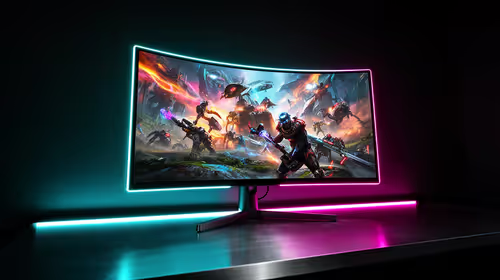
This massive difference is why the 10-bit vs 8-bit FRC question is so vital for professional work. When you need absolute precision, you need more colours in your digital paintbox. You can explore a wide variety of PC monitors with different colour depths right here at Evetech.
The Clever Trick: 8-bit + FRC Explained
So, where does 8-bit + FRC fit in? FRC stands for Frame Rate Control. It's a clever bit of tech that allows an 8-bit panel to simulate a 10-bit colour space. It works by rapidly flashing, or "dithering," between two adjacent colours so quickly that your eye perceives an intermediate shade that the panel can't physically produce on its own.
Is it as good as true 10-bit? Not quite. While 8-bit + FRC is a massive improvement over standard 8-bit and dramatically reduces banding, a trained eye can sometimes spot subtle noise or flicker in smooth gradients. It's a fantastic middle-ground, often found in high-refresh-rate gaming monitors where speed is as important as colour.
Why True 10-bit is the Gold Standard for Editors
For professional film editing, colour grading, and VFX work, true 10-bit is the undisputed champion. Why? Because there's no simulation involved. You are seeing the actual, precise colour value. This is non-negotiable when:
- Grading Log Footage: Camera footage shot in Log profiles (like S-Log or V-Log) contains immense amounts of colour information. A true 10-bit display lets you manipulate that data accurately without introducing banding.
- Creating Smooth Gradients: Think of a clear blue sky, a soft skin tone transition, or a subtle vignette. A 10-bit panel renders these flawlessly.
- Meeting Broadcast Standards: Professional delivery for broadcast or cinema often requires working in a 10-bit colour space from start to finish.
This level of precision is why most professional-grade 5K and 4K monitors are built with true 10-bit panels. They provide the detail and colour fidelity needed for high-stakes projects. 🎬
Check Your Entire Workflow! 🔧
A 10-bit monitor is just one piece of the puzzle. To get a true 10-bit signal, your graphics card, connection cable (DisplayPort is best), and editing software must all support and be configured for 10-bit colour output.
So, Which Panel Wins for Your Editing Suite?
The verdict in the 10-bit vs 8-bit FRC showdown depends entirely on your work.
- Choose 8-bit + FRC if: You're a YouTuber, a corporate video editor, or an aspiring filmmaker on a budget. It offers a huge step up from standard 8-bit, giving you a near-10-bit experience for a fraction of the price. It's a smart, cost-effective choice.
- Choose True 10-bit if: You're a professional colourist, a commercial editor, or anyone whose final product will be seen on the big screen or broadcast television. The investment guarantees colour accuracy and eliminates any guesswork.
Your workflow can also influence your choice. An immersive setup with curved monitors can make timeline navigation a dream, while a secondary portable monitor is perfect for on-set previews. And remember, no matter which panel you choose, regular calibration with proper monitor accessories is the key to consistent, trustworthy colour. 🚀
Ready to Upgrade Your View?
Stop fighting with colour banding and unlock your creative potential. Check out the latest PC monitor deals and find the perfect panel for your editing suite. Shop now at Evetech for professional performance you can trust.