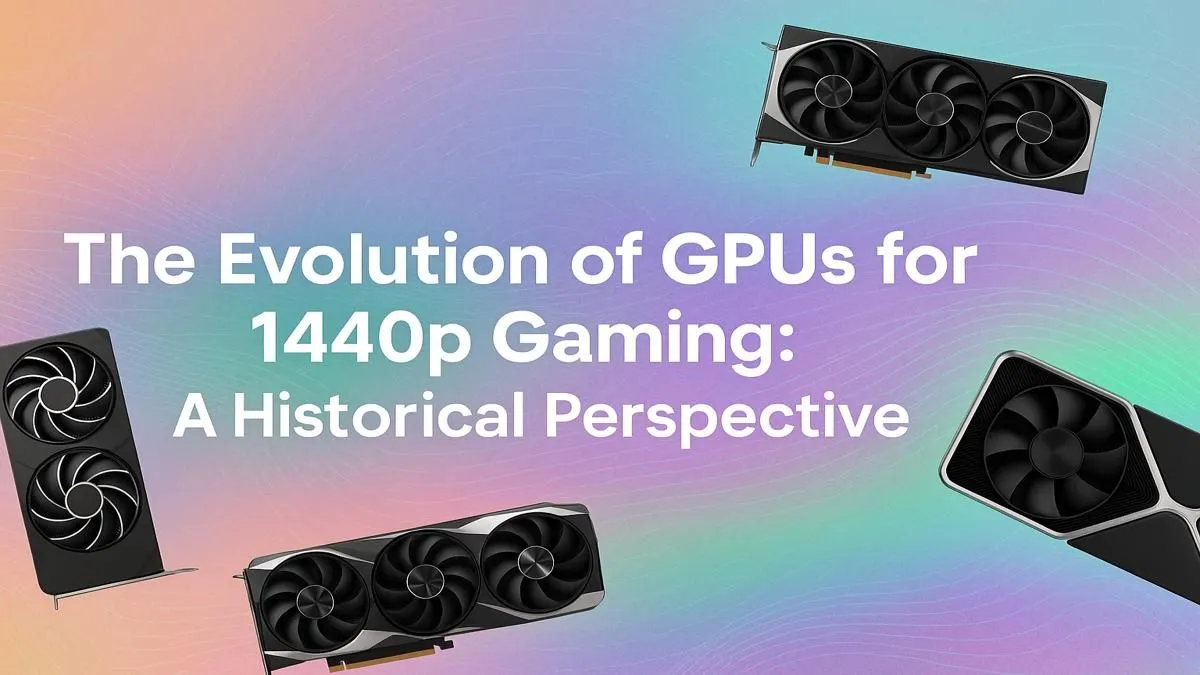
Remember the jump from a fuzzy 720p screen to crisp 1080p? For years, that was the gold standard for PC gaming in South Africa. But today, there's a new king: 1440p. It’s the perfect sweet spot, offering a massive visual upgrade without needing a monster rig that costs a fortune. But how did we get here? This is the 1440p gaming GPU evolution... a complete history of the cards that made it all possible. 🚀
The Dawn of QHD: The Early Pioneers
In the early 2010s, 1440p (or Quad HD) was a resolution reserved for professionals with expensive monitors and even more expensive hardware. For gamers, it was a dream. Cards of the era could technically run games at this resolution, but you'd have to slash settings to get playable framerates.
The real shift began with cards like the NVIDIA GeForce GTX 970 and 980. For the first time, a single GPU could deliver a decent 1440p experience in many titles. It wasn't always a locked 60 FPS on Ultra settings, but it was a solid taste of the future. This era laid the groundwork, proving the demand for pixels beyond 1080p was real. These pioneering NVIDIA GeForce GTX cards showed us what was possible and set the stage for the next big leap.
Making 1440p Mainstream: The Pascal Revolution 📈
If the 900-series knocked on the door of 1440p gaming, the NVIDIA 10-series kicked it wide open. The launch of the GeForce GTX 1070 and 1080 in 2016 was a monumental moment in the history of 1440p GPUs. Suddenly, high-refresh-rate 1440p gaming wasn't just viable; it was the new benchmark for any serious PC gamer in Mzansi.
You could finally crank up the settings in titles like The Witcher 3 and Battlefield 1 and enjoy a smooth, visually stunning experience. The performance uplift was so significant that many gamers who bought a GTX 1080 Ti are only just now considering an upgrade. This generation cemented the evolution of 1440p gaming, transforming it from a niche luxury into a mainstream goal for builders everywhere looking at modern graphics cards.
Check Your PSU! ⚡
Upgrading your GPU for 1440p? Don't forget your Power Supply Unit (PSU). Modern cards can be power-hungry. A good rule of thumb is to check the manufacturer's recommended PSU wattage for your chosen card and add a little headroom, about 100W, for system stability and future upgrades. An underpowered PSU can cause crashes and instability, especially under load.
The Red Team's Counter-Attack
For a while, NVIDIA dominated the high-end 1440p space. But AMD was gearing up for a comeback. While their Vega cards made some waves, it was the RDNA architecture in the Radeon RX 5700 XT that truly put them back on the map for 1440p gaming. It offered incredible performance that competed directly with NVIDIA's offerings, often at a more attractive price point here in South Africa.
This competition was fantastic for gamers. It pushed both sides to innovate and drove prices down. The subsequent RDNA 2 architecture (RX 6000 series) further solidified their position, with cards like the RX 6700 XT becoming a go-to choice for a high-performance 1440p build. This healthy rivalry ensured that AMD's powerful Radeon graphics cards became a key part of the 1440p story.
The Modern Era: Ray Tracing, AI, and New Players
Today, the 1440p gaming GPU evolution has reached an incredible stage. We're not just chasing frames anymore; we're chasing realism. Technologies like real-time ray tracing, once a pipedream, are now standard features. AI-powered upscaling like NVIDIA's DLSS and AMD's FSR allows even mid-range cards to push stunning visuals at high frame rates.
The market has also welcomed more competition, with the arrival of newcomers like Intel Arc graphics cards, giving South African builders more choice than ever. Whether you're looking at an RTX 4070, an RX 7800 XT, or an Arc A770, you're guaranteed a phenomenal 1440p experience that would have seemed like science fiction just a decade ago. 🇿🇦
More Than Just Gaming
It's important to remember that the power that drives incredible gaming experiences also benefits creators and professionals. The same GPU that renders beautiful worlds in Cyberpunk 2077 can accelerate video editing, 3D modelling, and complex data analysis. While gaming cards can handle these tasks well, the journey has also led to the development of specialised workstation graphics cards designed specifically for productivity, offering certified drivers and features for professional software.
The power of a modern GPU is truly versatile, making it the heart of not just a gaming rig, but a creative powerhouse too.
Ready to Join the 1440p Revolution?
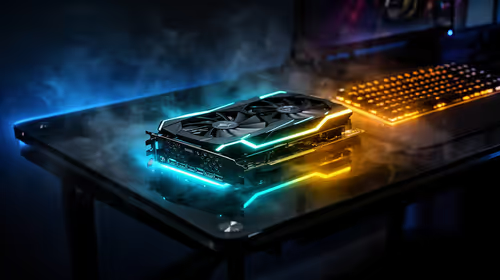
The journey of the 1440p gaming GPU has been incredible, and today's options are more powerful than ever. Whether you're Team Green, Red, or Blue, the perfect card for your rig is waiting. Explore our massive range of graphics cards and find the perfect GPU to conquer your world.