Quick Answer
For Bryanston gamers chasing competitive performance, a 240Hz monitor at 1080p or 1440p is a concrete upgrade for FPS titles — the step from 144Hz to 240Hz reduces motion blur and delivers 4.2ms less frame latency per cycle. The Samsung Odyssey G4 (1080p, 240Hz, IPS, ~R4,000) and LG UltraGear 27GP750-B (1080p, 240Hz, IPS, ~R4,500) are the two most-stocked SA options at this refresh tier.
GPU Requirements for 240Hz Gaming
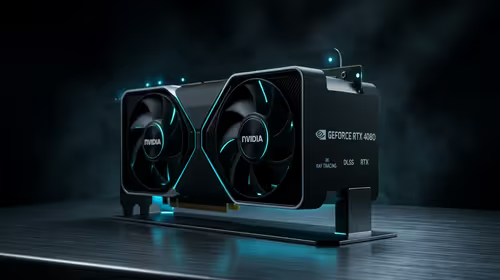
A 240Hz monitor only delivers its full benefit if your GPU can sustain 240 fps. In CS2, Valorant, and Apex Legends at 1080p with competitive settings (medium-low graphics), an RTX 4070 sustains 300–400 fps — easily saturating a 240Hz panel. At 1440p 240Hz, you need an RTX 4080 or better to consistently hit 240 fps in modern AAA titles. The RTX 4070 hits 200–240 fps at 1440p in esports titles like Valorant on high settings. Match your GPU to your resolution target before choosing a 240Hz monitor.
Panel Type at 240Hz: IPS vs OLED
IPS 240Hz panels (Samsung G4, LG GP750) offer 1ms GTG response and good colour at prices from R3,800–R5,000. Fast IPS and Nano IPS variants add better colour gamut without sacrificing speed. OLED 240Hz panels (Alienware AW2725DF, LG 27GR95QE-B) deliver 0.03ms response time and perfect contrast — at R12,000–R18,000. VA at 240Hz exists but is rare and typically has ghosting issues at these refresh rates. IPS is the practical standard for SA buyers in the R4,000–R8,000 range.
FreeSync and G-Sync at 240Hz
Adaptive sync prevents screen tearing when frame rates fluctuate below 240 fps — essential for a smooth experience in demanding titles. AMD FreeSync Premium Pro is the standard on most 240Hz IPS monitors. Nvidia's G-Sync Compatible programme also works with most FreeSync monitors for Nvidia GPU owners. Confirm the sync range: panels with a wide range (48–240Hz) are better than those starting at 144Hz minimum, which can introduce judder at lower frame rates.
FAQ
Is 240Hz worth it over 144Hz for competitive gaming in Bryanston?
For fast FPS titles like CS2 and Valorant, yes — the jump from 144Hz to 240Hz is measurably better for motion clarity and target tracking at high sensitivity. Research shows human visual perception does register the difference up to 240Hz for fast moving objects. For casual gaming and general use, 144Hz is largely sufficient.
Do I need HDMI 2.1 or DisplayPort 1.4 for 240Hz at 1440p?
DisplayPort 1.4 handles 1440p at up to 240Hz without compression. HDMI 2.1 also supports 1440p 240Hz. Standard HDMI 2.0 is limited to 1440p at 144Hz. For a PC gaming setup, use DisplayPort 1.4 — the cable is included or low-cost. HDMI 2.1 matters for console users who want 1440p 120Hz+ on PS5 or Xbox Series X.
What is the best 240Hz monitor under R5,000 for SA buyers?
The LG 27GP750-B (27-inch IPS, 1080p, 240Hz, 1ms GTG, G-Sync Compatible) at around R4,500 is among the top picks. It offers accurate IPS colour, 240Hz refresh, and works with both Nvidia and AMD GPUs via FreeSync Premium certification.
monitor to its native 240Hz in Windows Display Settings and enable FreeSync or G-Sync in your GPU control panel — many monitors default to 60Hz on first connection and the performance improvement only activates once you manually set the correct refresh rate.