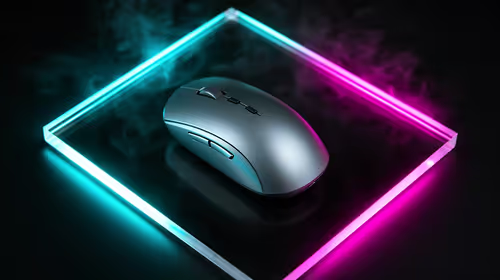
A 44,000 DPI ceiling is far beyond the sensitivity many players control comfortably. Asking whether 44,000 DPI is too much should separate available sensor range from the chosen profile. The Hero 44K does not force its maximum; it gives the user room to select a far lower setting.
Quick Answer
For most players, 44,000 DPI is unnecessary as a daily setting, though the broad range is not harmful when tuned responsibly. At R1,499, the G305 X SUPERLIGHT pairs that ceiling with 678 IPS tracking, three connection choices and reports reaching 8kHz; practical aim still comes from effective sensitivity, surface and grip.
🔹 Define effective sensitivity
DPI combines with game sensitivity. Change one layer at a time and measure one comfortable turn.
Compare the Logitech mouse range using the same pad and drill.
🔹 Test useful ranges
Start from the player's normal DPI, then make small deliberate changes. Do not jump to 44,000 merely to test the limit.
Use micro-corrections and fast turns. A setting that crosses the screen instantly but cannot select a target has no competitive value.
Include pad distance
Usable surface and lift habits influence the best range.
🔹 Separate 678 IPS
IPS describes physical tracking speed, not pointer sensitivity. Test rapid swipes while keeping DPI controlled.
The wider gaming mouse selection helps compare sensor and shape packages.
🔹 Keep the whole package visible
Tri-mode connection, six buttons, 8kHz headroom and rated endurance may matter more than maximum DPI.
Use the accessory best-seller overview for a broader R1,499 comparison and verify the live listing before buying.
Save the chosen value
Record game sensitivity, report rate, connection and surface beside DPI.
Recheck after fatigue
High effective sensitivity can amplify small tense movements late in a session.
Test a sensitivity ladder
Start from the current profile and increase DPI in small steps while lowering nothing else. Run the same micro-correction and turn drill. Stop when control worsens, then return to the last repeatable setting.
This demonstrates the user's practical range without approaching 44,000. The ceiling remains available, but the exercise finds where the player's movement becomes less precise.
Compare equal effective settings
Create two profiles with different DPI and game-sensitivity combinations that produce similar turn distance. Test both through the same actions.
Subtle differences in cursor or game handling may influence preference, but the player should not claim one is faster simply because its DPI number is larger.
Include menu and desktop work
Test inventory, map, launcher and desktop navigation. An FPS profile can feel controlled in camera movement while making menus unnecessarily difficult.
If separate profiles are used, verify switching and name them clearly. A wrong active setting is more disruptive than a modest compromise.
Test 678 IPS independently
Use the chosen practical DPI and perform rapid physical swipes. Observe whether direction and distance remain consistent.
The IPS rating concerns tracking speed. It can be evaluated without turning cursor sensitivity to the maximum.
Include report-rate interaction
Hold DPI fixed and move from the stable report baseline towards 8kHz. Monitor frame timing and aim.
If control changes, identify whether the report rate or system load is responsible before revising sensitivity.
Compare another player's setup
Use their drill and method, not their DPI value. Pad size, grip, display and game sensitivity make direct number copying unreliable.
Record each player's profile separately when testing the same mouse.
Watch late-session micro-movement
Fatigue and tension can amplify tiny hand motion at high effective sensitivity. Repeat the fine-control drill after normal play.
If late accuracy declines, a small reduction may provide more real value than sensor range left unused.
Build a profile recovery card
Write DPI, game sensitivity, report rate, connection and surface. Keep a moderate known-good version.
After software or game changes, restore this card before diagnosing the sensor.
Compare pointer distance mathematically
Measure the physical pad distance used for a full turn or screen crossing. The exact result does not need to become a public universal recommendation; it anchors the player's own profile.
Repeat after each DPI adjustment and stop when the movement no longer stays controlled.
Test target sizes
Use large close targets, medium transitions and tiny distant corrections. High effective sensitivity may succeed at broad movement while failing the smallest task.
Score all three instead of choosing from one dramatic flick.
Include six-button pressure
Press every programmed input during tracking. If a button squeeze moves the pointer, change the assignment or grip.
The sensitivity verdict should reflect the configured mouse, not a button-free laboratory profile.
Compare Lightspeed and wired control
Keep DPI fixed and arrange both routes cleanly. If aim changes, investigate connection and cable conditions rather than revising sensitivity immediately.
Bluetooth can retain a separate convenient-device setting where appropriate.
Audit software profile switching
Confirm which game activates which DPI. Remove duplicate profiles and test after restart.
An unexpected high setting can feel like a sensor fault or delayed input.
Review after several weeks
Check whether the player slowly reduced sensitivity as familiarity grew or returned to the original value. Keep the setting that survives normal matches.
The unused path towards 44,000 remains range, not lost performance.
Test application scaling
Compare a game, desktop and one creator or productivity application. A very high DPI can make precise interface work unnecessarily difficult.
If separate profiles are required, ensure they switch reliably and preserve one neutral desktop baseline.
Check display scaling changes
After altering resolution or operating-system scaling, repeat cursor travel and target selection. Do not blame the sensor for a changed visual movement relationship.
Record the display condition with every DPI profile.
Build a sensitivity ceiling for the user
Increase DPI only until the player's error spread grows, then mark the previous controlled value as the personal upper boundary for that setup.
This practical ceiling is more useful than the sensor maximum and can be rechecked after pad or grip changes.
Compare small corrections under stress
Run fine aim immediately after several rapid turns. High sensitivity may appear manageable in isolation but become less controlled when the hand is moving quickly.
Use the combined sequence as the final profile test.
Audit the number after one month
Check which DPI remains active and whether the player can explain why. Record the turn distance and game sensitivity beside it.
If the chosen value is far below 44,000, that is a successful use of adjustable range rather than unused performance.
Frequently Asked Questions
Is 44,000 DPI intended for every player?
No. It is the maximum range, while the selected value should remain controllable.
Does lower DPI waste the sensor?
No. Using a practical setting is the purpose of adjustable range.
Is 678 IPS the same as DPI?
No. IPS concerns high-speed physical tracking, while DPI sets movement scale.
Can game sensitivity compensate?
The two settings combine, but change one at a time so the result remains clear.
What should be tested besides DPI?
Test surface, grip, connection, report rate and the actual game tasks.
Ready to choose DPI by control instead of ceiling?
Compare Evetech's gaming mice with the same pad and effective-sensitivity drill, then save the setting the player repeats accurately.